Science1 publisher2 min readPublished
Webb confirms brown dwarfs as light as two Jupiters in a nearby stellar nursery
Webb spectra identified nine new brown dwarfs in the IC 348 nursery, the faintest estimated at about two Jupiter masses, a record low for the class. It is still open whether brown dwarf formation stops there or this survey simply could not see any fainter.
The Scientist · Science desk
What happened
- Webb's NIRCam camera surveyed part of IC 348 in 2024 and flagged 39 brown dwarf candidates.
- Brown dwarfs collapse out of gas and dust clouds the way stars do, but their cores never get hot enough to fuse hydrogen into helium.
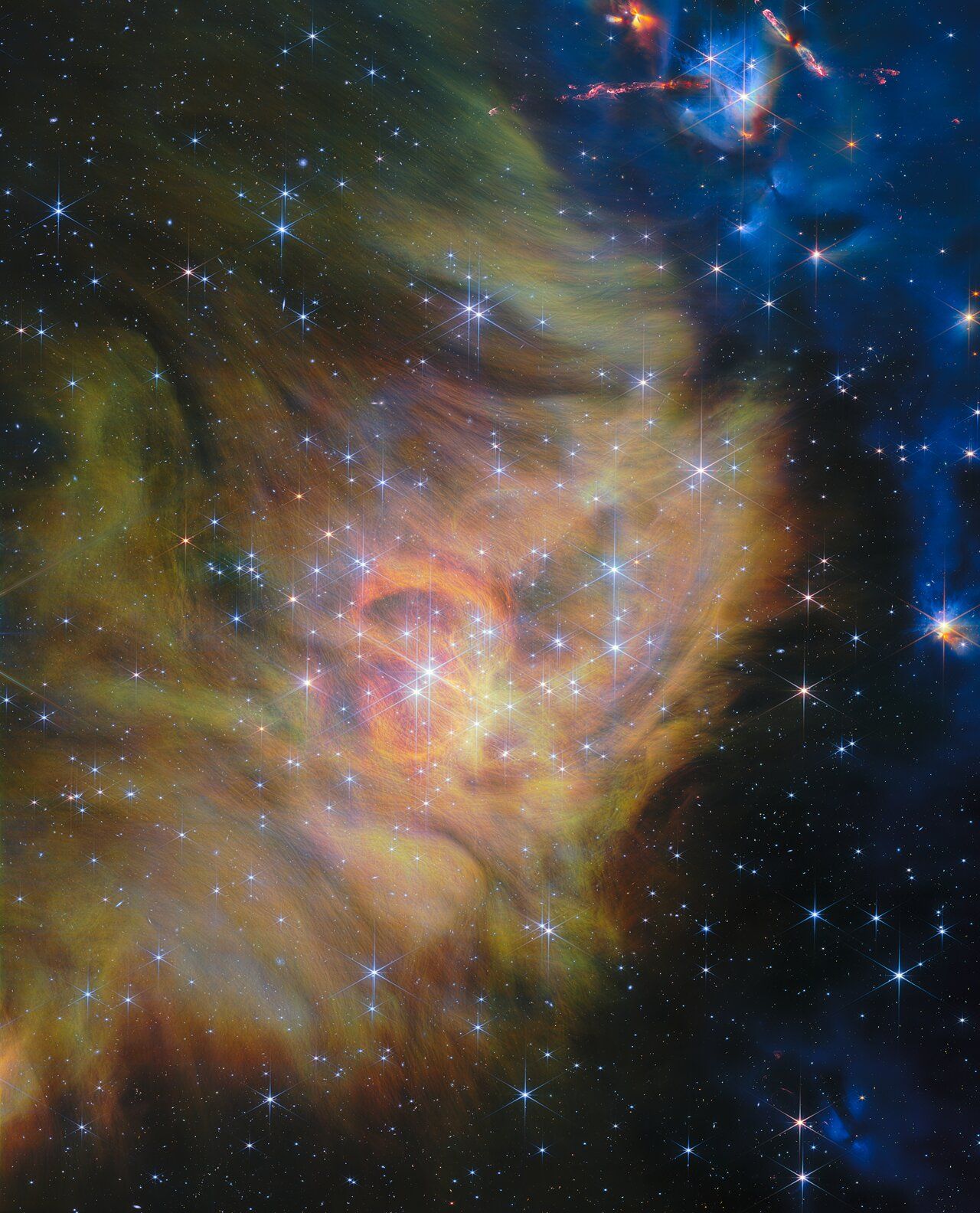
- The brown dwarfs appear in one of the largest Webb panoramas released to date, shared on 15 September 2026.
Compiled by The ScientistSomething wrong?How this is made
Why it matters
- constraint Any count of IC 348's lightest members stays provisional until the remaining candidates and the unsurveyed parts of the cluster get spectra.
- capability Researchers can now test ideas about the smallest cloud fragments that collapse like stars against identified objects of about two Jupiter masses in a nearby cluster.
- constraint At twice Jupiter's mass these objects weigh about as much as gas giants. They count as brown dwarfs because they formed the way stars do.
Nine identifications from 15 spectra is a 60 percent rate among the candidates Webb examined closely [1]. The other six were not reported as new members of the cluster [4]. Most of the candidates are still unexamined: 24 of the 39 found by the camera, about 62 percent, were not among those studied with NIRSpec [2][3]. The 2024 camera survey also covered only part of IC 348, a cluster about 1,000 light-years away in Perseus [3][1].
The camera produced a list of likely objects. The spectrograph did the identifying [4][5]. Only the nine have passed both steps.
The faintest of the nine is estimated at around two Jupiter masses, and Live Science calls these the least massive brown dwarfs ever found [6]. The same account places brown dwarfs halfway between gas giants like Jupiter and stars [9]. At twice Jupiter's mass, the new record holder sits at the gas-giant end of that span [5].
Two Jupiter masses could be where brown dwarf formation stops, or only where the survey stopped being able to see. Live Science does not report how the masses were estimated or how faint the survey could detect. A survey cannot find an object fainter than its own detection limit. So a record set by the faintest member shows that the smallest possible brown dwarf weighs two Jupiter masses or less. It does not show where that limit actually is.
How small the smallest brown dwarf can be is an open question in astrophysics, and Live Science says these objects will help researchers narrow it down [7][10]. I think the fair reading is limited. In one cluster, on estimated masses and from nine identified objects, brown dwarf formation reaches at least as low as about two Jupiter masses [5][6].
What to watch
- NIRSpec spectra for the 24 candidates not yet studied, which would show whether IC 348 holds more objects near or below two Jupiter masses.
- Publication of the mass method and the survey's detection limit, which would show whether two Jupiters is a physical floor or an instrumental one.
- A camera survey of the parts of IC 348 outside the area covered in 2024.