Product1 publisherNot yet confirmed elsewhere3 min readPublished
Sila's Moses Lake plant gets ISO 9001, and that is the interesting part
A quality-management certificate is a dull thing to announce. For silicon-carbon anodes it says the hard problem has moved from chemistry to repeatability.
The Product Desk
What happened
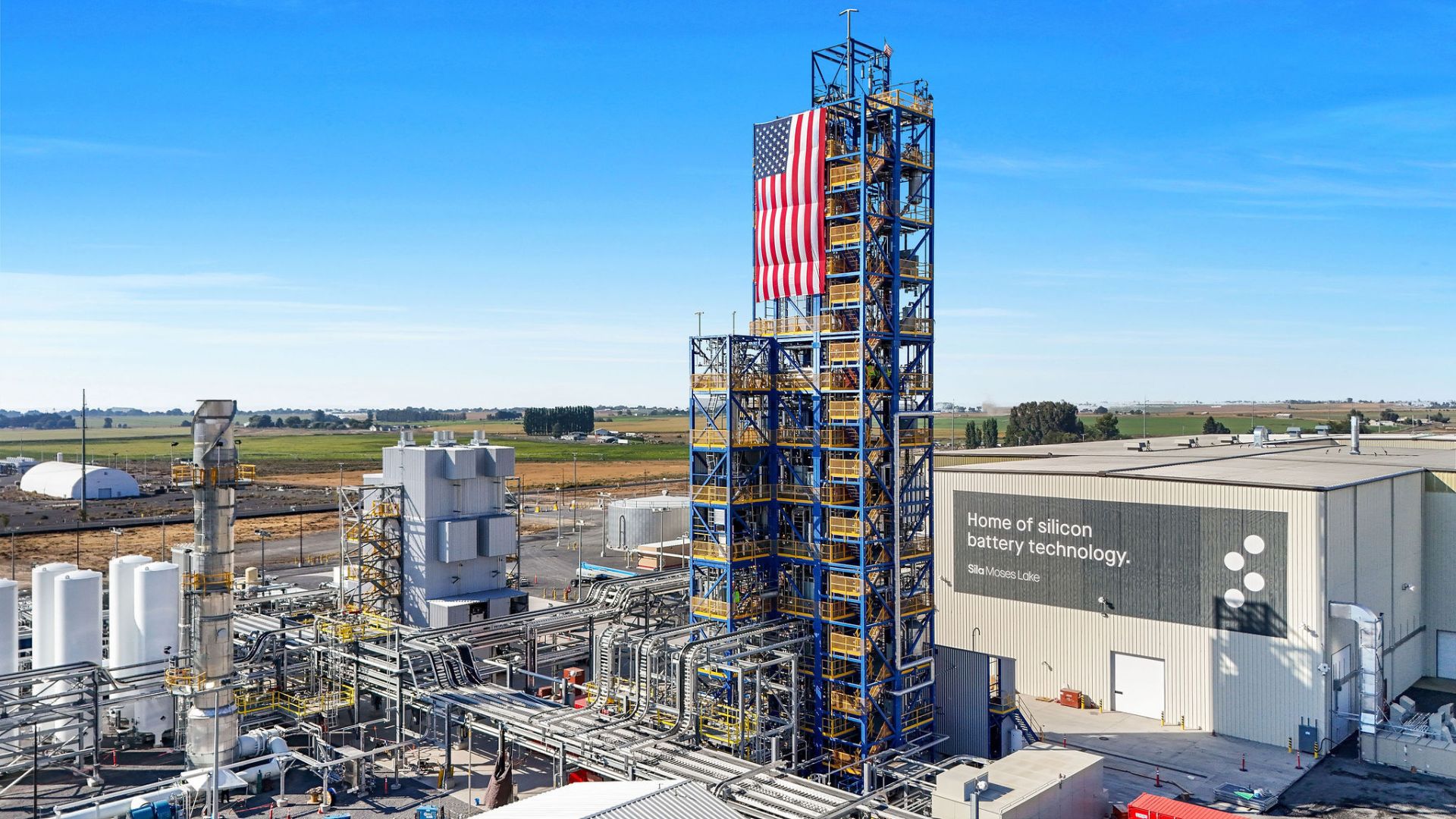
- Sila's Moses Lake, Washington plant has been certified to ISO 9001:2015 as it moves toward commercial-scale output.
- The site is built to make Titan Silicon, the company's silicon-carbon anode material, for transportation and other uses.
- A conditional loan commitment of up to $1.4 billion via the Office of Strategic Capital sits behind the expansion.
Compiled by The Product DeskSomething wrong?How this is made
Why it matters
- constraint Cell makers cannot absorb drift, so the binding limit on silicon anodes is now process control rather than cycling chemistry.
- decision Carmakers get a checkable gate: until IATF 16949 lands, a design win at Moses Lake stays a conversation rather than a supply contract.
- exposure The Alameda yield figure becomes the number Moses Lake is judged against, and any shortfall at volume is visible to a federal lender.
- precedent Announcing a quality certificate as a milestone tells the rest of the anode field what investors are being asked to price: repeatability, not energy density claims.
Repeatability is the part of a materials business that nobody films. The audit that produced this certificate looks at whether the plant has written down what it does and can prove it did it, which is why the interesting details in Sila's account are procedural rather than chemical: a manufacturing execution system that holds production recipes and raw material requirements, and that checks a reactor is ready before anything goes into it [7]. Traceability runs from material arrival through processing and analysis to final output [8]. Automation is doing the work manual processes cannot, which is producing the same thing on the four hundredth run as on the fourth [6].
That matters because of who buys the stuff. A cell maker does not buy an anode material, it buys a specification it can design a cell around, and small drifts in feedstock or process conditions show up in cell performance [9]. The company itself frames consistency as potentially mattering as much as the material science [5]. Silicon's appeal has never been in doubt: it holds substantially more lithium than graphite, which is still what most lithium-ion cells use, and it swells and contracts on cycling in ways that shorten anode life [10][11][12].
The comparison worth holding onto is Alameda. Sila says its California plant has run continuously for more than seven years at yields above 95 percent [16]. That is a company figure, not an audited one, and it is the number Moses Lake will be measured against. Nothing about the ISO certificate says Moses Lake matches it. Sila's own framing concedes the point, that commercial volumes surface problems small runs hide [13].
Then there is the standard Sila has not got yet. IATF 16949 is the automotive quality standard, and the company plans to pursue it to meet carmaker requirements [14]. ISO 9001 is roughly the entry condition for that conversation rather than the conversation itself, and Moses Lake is built to supply transportation among other uses [4]. Sitting behind all of it is a conditional loan commitment of up to $1.4 billion through the Department of War's Office of Strategic Capital, intended to add capacity at the same site [1][2], with domestic supply of advanced battery materials as the policy rationale [17].
So the sequencing is legible: certify the quality system, then scale, then chase the automotive standard, then draw against federal money that is still conditional. The certificate is evidence that controls exist before volume arrives rather than after a customer complains [15]. It is not evidence of commercial success, and the source says so plainly [15]. For anyone tracking silicon anodes, the useful shift is in what would now count as bad news: not a paper on cycling degradation, but a batch that fails incoming inspection at a cell plant.
What to watch
- Whether Moses Lake achieves IATF 16949, and how long the gap from ISO 9001 turns out to be.
- Any disclosed yield figure for Moses Lake that can be compared with Alameda's claimed 95 percent.
- Whether the Office of Strategic Capital commitment converts from conditional to drawn funds, and against which milestones.