Product3 publishersIndependently confirmed3 min readPublished
One developer's Claude-built Adobe clones narrow the contest to reliability
Brandon Thomas used Claude Opus 5.5 and Rust to build free open-source recreations of seven Adobe apps, Photoshop and Premiere among them. For an occasional user the suite is already a workable Photoshop substitute, while anyone whose work depends on tools behaving predictably still has reason to pay Adobe.
The Product Desk
What happened
- Thomas has called the suite an early alpha that is "not anywhere close to ready," and he invites outside developers to contribute and says he will pay bug bounties.
- The copies, named Photocraft, Vectorcraft, Filmcraft, Lightcraft, Printcraft, Effectcraft and Designcraft, sit on GitHub under an open-source project called Artcraft.
- Alongside the native apps, WebAssembly builds let the suite run inside a web browser, Ars Technica reported.
- Artcraft began last year as a "controllable AI for artists" for editing AI-generated images and video before pivoting to the Adobe clones, according to Ars Technica.
Compiled by The Product DeskSomething wrong?How this is made
Why it matters
- capability Occasional editors who already gave up on Adobe's subscription for free tools get a free option laid out like Photoshop, and they are the group the suite serves today.
- decision Because Thomas's parity timeline counts features, a team weighing a switch has to run its own repeatability test on real tasks before moving any work over.
- exposure Work done in the suite rests on one maintainer's alpha and volunteer fixes, so nobody is contractually answerable when a tool fails in the middle of a client job.
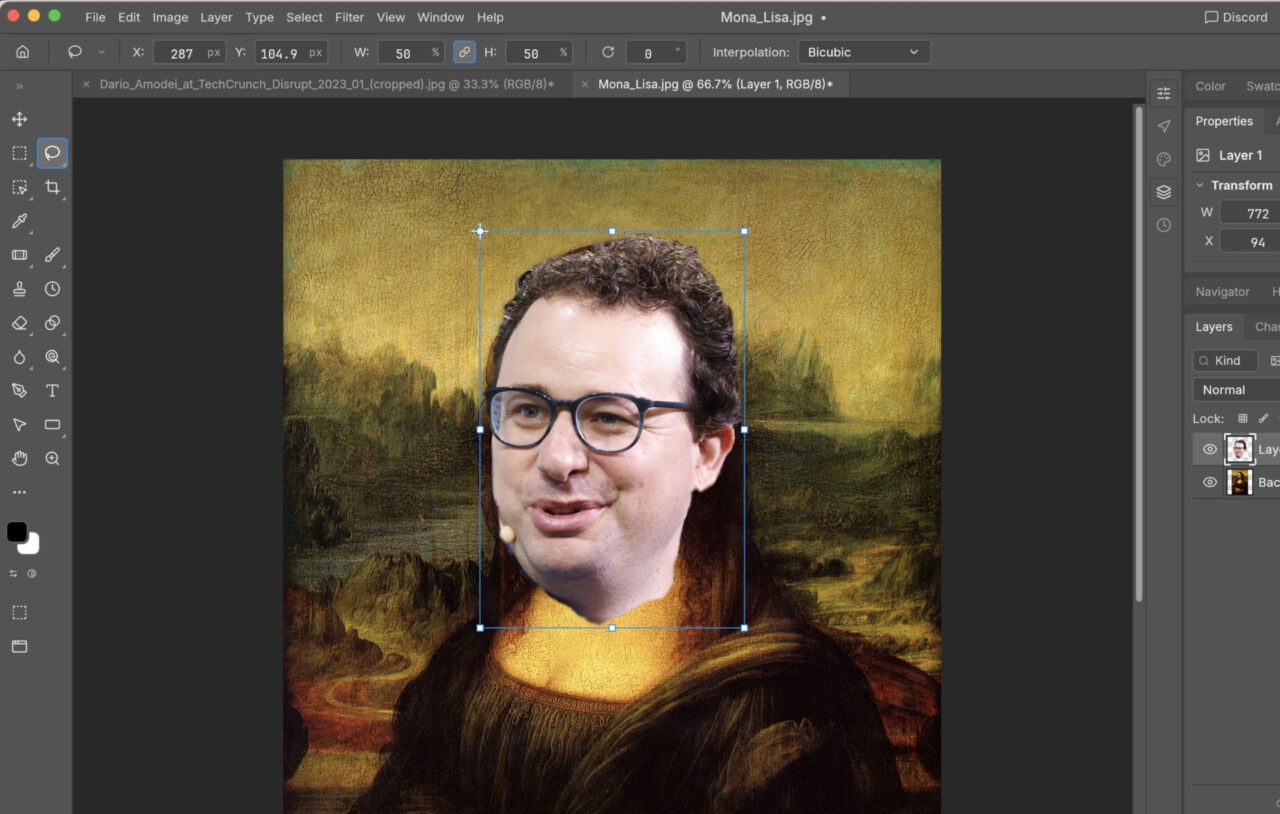
Gizmodo's tester pressed Escape to leave Free Transform in Photocraft, the Photoshop copy, and nothing happened. Then the transform undid itself. A few attempts later it worked, and the tester did not know why [11]. The rest of the edit took about a minute: lasso Dario Amodei's head, feather the selection, paste it onto the Mona Lisa, fix the levels and color [10]. Every command was where the tester expected it to be [10].
The Gizmodo writer needs Photoshop about twice a year to make a child's birthday invitations, cannot justify the monthly fee for that, and gets by with Photopea in the browser or Gimp [12]. Next to those two, Photocraft "felt like a breath of fresh air," the writer wrote [13].
The SaaSpocalypse, an idea Gizmodo describes as prevalent on Wall Street in 2026, held that people would soon stop paying for software subscriptions and code their own [14]. The one person in this story who wrote code is Thomas, who described himself on Reddit as a "15-year industry veteran who has written everything from six-nines payment rails that move billions of dollars of transaction volume a day to advanced robotics and optics automation" [6]. The birthday-invitation user just used what he made [10].
Thomas pitches the apps as "clean-room replacements" for Adobe's closed-source software, in his words as reported by Ars Technica [2]. He hopes they will soon copy Adobe's look, feel and functionality with perfect fidelity [5]. On Reddit, he said the suite would reach 100% feature parity within a month [16]. Days later he wrote on Hacker News that "99% parity will take a while, but I'm sure it'll be measured in months and not years" [17]. A parity figure counts features, and Free Transform is already one of Photocraft's features. It is also the tool that failed the tester [11].
On Adobe's moat, the evidence shows that the feature layer can be copied. One experienced developer working with Claude Opus 5.5 says he recreated seven Adobe apps [1], and in Photocraft the commands for a basic composite edit sat where a Photoshop user looks for them [10]. Neither source reports what the work cost in hours or model spend, or how many people have left Adobe for it. On this evidence, what remains on Adobe's side is predictable behavior and trust. Gizmodo opened its review by telling readers to be more cautious than its writer had been about downloading vibe-coded software [15]. Adobe's own record on trust includes a settlement: it agreed this year to a $150 million settlement of a 2024 federal lawsuit alleging it trapped people in subscription plans, Gizmodo reported [8].
The grid I'd use before rolling this out to anyone has two questions on it: how often the person does the task, and what it costs them when the tool misbehaves. Rare and cheap, the party invitation, is where Photocraft works today [13]. Frequent and cheap, say a social graphic every morning, means meeting bugs daily. That suits someone willing to report them back to the project [4]. Rare and expensive, a print job or a signed PDF, belongs in a tool the person already trusts. Frequent and expensive is where a subscription is easiest to justify, and a parity date measured in months [17] matters there only once the same task gives the same result every time. The test is ten runs: take the task the person does most, repeat it ten times in the clone, and count how many runs behave like the first.
What to watch
- Whether Thomas's next releases fix behavior bugs like the Free Transform escape failure, or mainly add features toward the parity target he set on Hacker News.
- Any response from Adobe, legal or product, to clones that copy its interfaces under a clean-room claim.
- Contributor and bug-bounty activity on the Artcraft GitHub project, as a sign of whether one maintainer's alpha becomes a maintained suite.