Invest1 publisher2 min readPublished
Washington takes 35% of a Venezuelan oil venture that must add 300,000 barrels a day by 2028
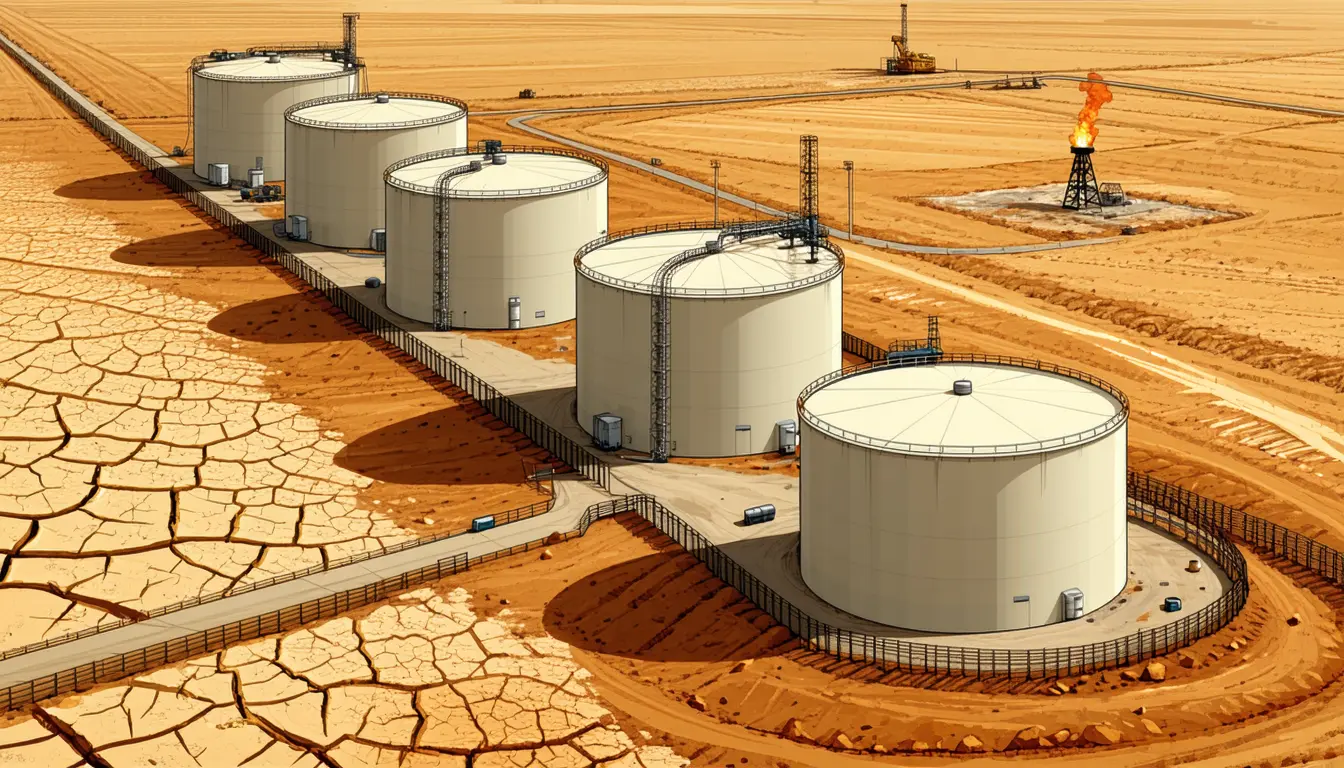
The August 28 concession hands 17 fields and an estimated 65 billion barrels of reserves to NABEP, whose current output is about 200,000 barrels a day against a target of roughly 500,000 by the end of 2028.
The Investor · Invest desk
What happened
- An agreement formalized on August 28, 2026 grants 100-year concessions across 17 Venezuelan oil fields holding an estimated 65 billion barrels of proven reserves.
- Operational rights go to North American Blue Energy Partners, overseen by Alejandro Betancourt, while the US takes a 35% equity stake in its parent through the Department of War's Office of Strategic Capital.
- NABEP produces roughly 200,000 barrels a day, second among private operators in Venezuela behind Chevron, and has set a goal of about 500,000 a day by the end of 2028.
- A White House fact sheet of August 31 said the deal carries no taxpayer costs and could generate up to $209 billion in Venezuelan government revenue; Caracas cites investment as high as $100 billion.
Compiled by The InvestorSomething wrong?How this is made
Why it matters
- constraint Both American claims on the venture, the 35% equity and the right to buy a fifth of output at cost, pay only in barrels. Washington collects nothing from the deal until drilling, pipeline and grid spending at Maracaibo lands first.
- contradiction Divide the same $209 billion by the 100 years Washington cites and Venezuela gets $2.09 billion a year; divide it by the 25 years Venezuelan statements reference and it is $8.36 billion, so the two governments are not describing one contract.
- exposure Veto power over board appointments puts the US inside the governance of a company whose fields sit under an interim government in Caracas.
- precedent Taking equity in a private oil venture through the Office of Strategic Capital establishes a route for national-security capital to buy commercial resource positions, and the next such stake will be easier to justify on this template.
Three hundred thousand barrels a day is what this contract actually asks for. NABEP pumps about 200,000 a day and has put roughly 500,000 by the end of 2028 as its stated goal [6][7]. From the August 28 signing that is about 28 months, or a little over 10,700 barrels a day of fresh production brought on every month with no slippage [2].
Then there is the condition of the assets. A substantial share of the 17 fields sit in the Lake Maracaibo basin [8], and Cryptobriefing reports that industry experts describe many of them as mature, degraded and operating with limited or no infrastructure [9]. Before output approaches former levels, the fields need new drilling, pipeline repairs, power grid connections and environmental remediation [10]. Those are procurement and construction schedules. They do not compress because a concession was signed.
The 65 billion figure does not constrain the plan. Pump the 2028 target rate for the entire hundred years and you lift 18.25 billion barrels, about 28 percent of the 65 billion said to be in the ground [3]. Capital is the binding item. The Venezuelan side's own estimate of investment as high as $100 billion, set against a 300,000-barrel increment, is about $333,000 for each incremental daily barrel [12][5] (two governments' figures divided into each other, so treat the quotient loosely). On the other side of the ledger, $209 billion spread across 65 billion barrels works out at $3.22 a barrel of reserves to the Venezuelan state [6].
Of the two American claims, the one I would price first is the right to buy 20 percent of production at cost [5]. That is 40,000 barrels a day at the current rate and 100,000 at the 2028 target [7].
The version where I am wrong is operational. Re-entering and working over wells that already exist is faster and cheaper than drilling new ones, and if most of the increment comes from wells already in the ground at Maracaibo, 2028 is a scheduling problem. The second version is strategic: the structure counters Russian and Chinese positions built up in Venezuelan oil over the past decade [14], and that counter holds at 200,000 a day.
Sequential production settles this. If the concession areas add 30,000 barrels a day across the first two reported quarters, the ramp is live and the neglect discount is too wide; if they add 5,000, the 65 billion is a reserve statement and the 35 percent is a long-dated option on somebody else's capital expenditure. Cryptobriefing told readers to pay less attention to the headline reserve numbers and more to quarterly production data from NABEP's concession areas [16].
What to watch
- Whether the term in the signed document is the 100 years US sources cite or the 25 years Venezuelan statements reference.
- Any disclosure of the price the Office of Strategic Capital paid for its 35% of NABEP's parent.
- Whether Chevron's Venezuelan position changes now that a second US-backed operator holds 17 fields.