Product1 publisher3 min readPublished
Army puts up to $49m behind a microwave that has to shoot while the truck is moving
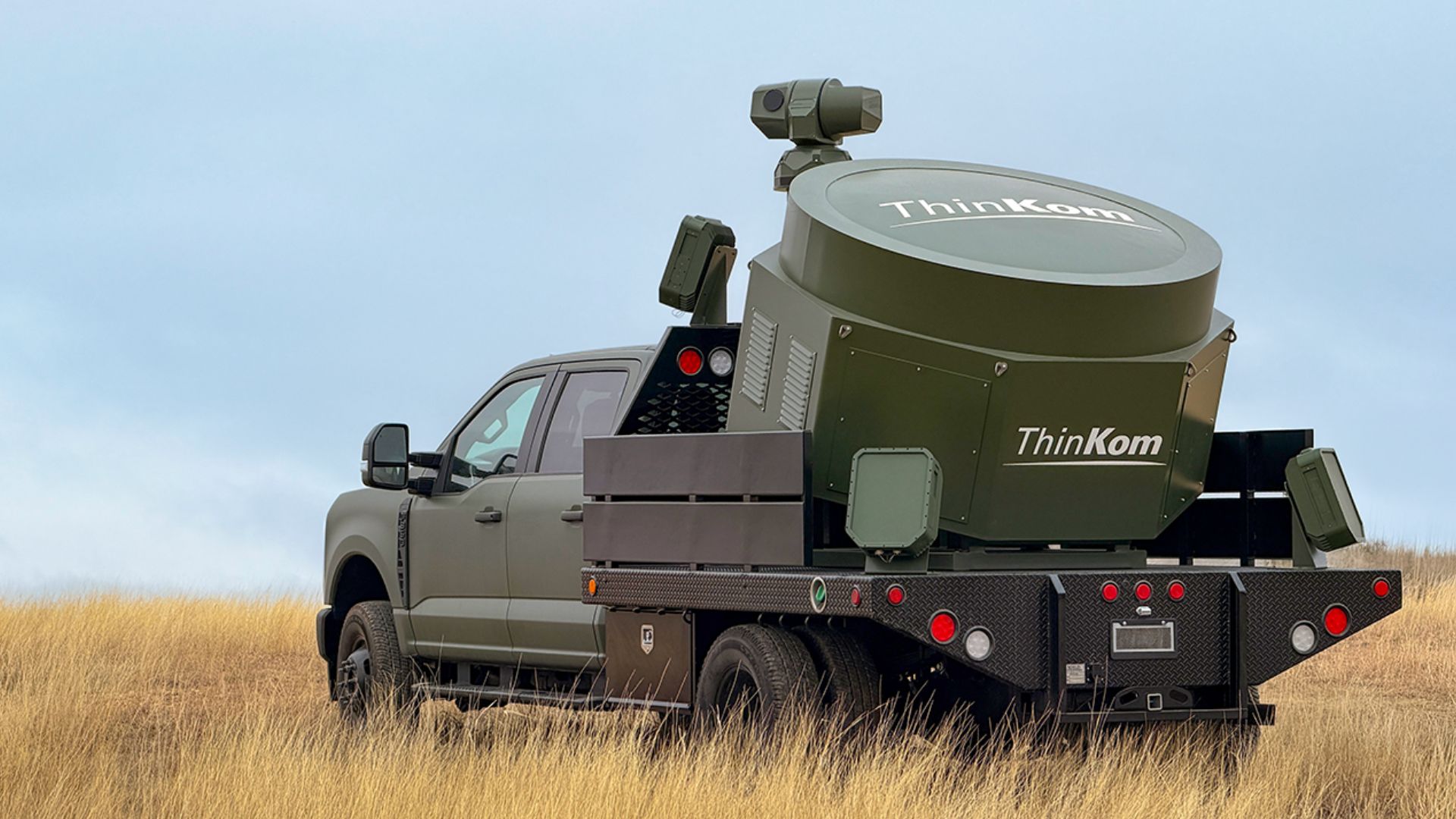
ThinKom's Alecto contract funds one of four prototypes, with field testing in 2027. The hard requirement is not the microwave itself, it is engaging drones without halting the vehicle.
The Product Desk · Product desk
Drafted by a language model from the sources cited here and checked against its claim ledger before publication. How we use AISend a correction
What happened
- The U.S. Army awarded ThinKom Solutions a prototype contract worth up to $49 million to develop and test a mobile high-power microwave system for countering drones.
- The deal was announced on August 19, 2026, and will fund testing of ThinKom's Alecto system, which is built to target unmanned aircraft from a moving vehicle.
- The project is managed by the Army's Portfolio Acquisition Executive Fires and its Program Manager for Advanced Counter-Unmanned Aircraft System Effects (PM ACE).
- The first round of funding pays for one of the four prototypes the Army wants, and field testing is set for 2027.
- ThinKom will supply Alecto as a high-power microwave effector, to be combined with sensors, fire-control gear, and a mobile platform chosen by the government.
Compiled by The Product DeskSomething wrong?How this is made
Why it matters
The U.S. Army has awarded ThinKom Solutions a prototype contract worth up to $49 million to develop and test a mobile high-power microwave system for countering drones, announced on August 19, 2026 [1][2]. The specification that matters is buried in the product language: Alecto is meant to stay active while its vehicle is moving, so units do not have to stop to answer a drone [8].
Start with the money, because the headline number is soft. The $49 million is a ceiling rather than a guaranteed procurement value [9]. The first tranche pays for one prototype, against an Army appetite for four [4], which leaves three of the four unfunded at this stage [15]. The agreement does not authorize production, and it does not commit the Army to buying any particular number of Alecto systems after the prototype phase [11]. This is an option purchase, not a program of record.
What ThinKom is actually selling is a component. The company supplies Alecto as the high-power microwave effector, which will then be combined with sensors, fire-control gear, and a mobile platform chosen by the government [5]. Government teams handle integration, test, and evaluation [10]. That division of labour is where fire-on-the-move gets decided. A radiated-energy effector that works on a static pad has to keep a beam on a small, manoeuvring target while its own mount pitches and yaws over terrain, and the antenna, the fire control, and the vehicle all have to agree. ThinKom points to its patented VICTS antenna as the enabling piece, describing Alecto as a high-capacity, low-cost-per-engagement option that can fire while moving against Group 1 and Group 2 drones [6][13]. The company frames the demand side plainly: Dan Roman, ThinKom's vice president for electronic warfare and high-power microwave programs, said the rapid proliferation of unmanned aircraft is creating an urgent need for mobile and scalable counter-UAS capability [12]. The stated effect is non-kinetic, aimed at Group 1 and Group 2 aircraft [7].
What the announcement does not contain is any performance figure: no output power, no effective range, no engagement time, no shots-per-minute claim [16]. So the interesting content of this award is not the technology description, it is the test plan. Field testing is set for 2027 [4], the calendar year after the announcement [17], and it is the government evaluators, not the vendor, who will report how the thing behaves in operational conditions [10]. The work sits under the Army's Portfolio Acquisition Executive Fires and its Program Manager for Advanced Counter-Unmanned Aircraft System Effects [3], with PAE Fires headquartered at Redstone Arsenal in Alabama and running an integrated offensive, defensive, and integrated fires portfolio [14].
Three things to watch. Whether prototypes two through four get funded, since the ceiling implies them but the initial obligation does not [4][9]. Which mobile platform the government picks [5], because the vehicle choice constrains power, cooling, and how much motion the fire-control loop must absorb. And whether the 2027 trials happen on schedule [4], with results stated as hit rates against moving-platform engagements rather than as static-mount demonstrations.