Product1 publisher2 min readPublished
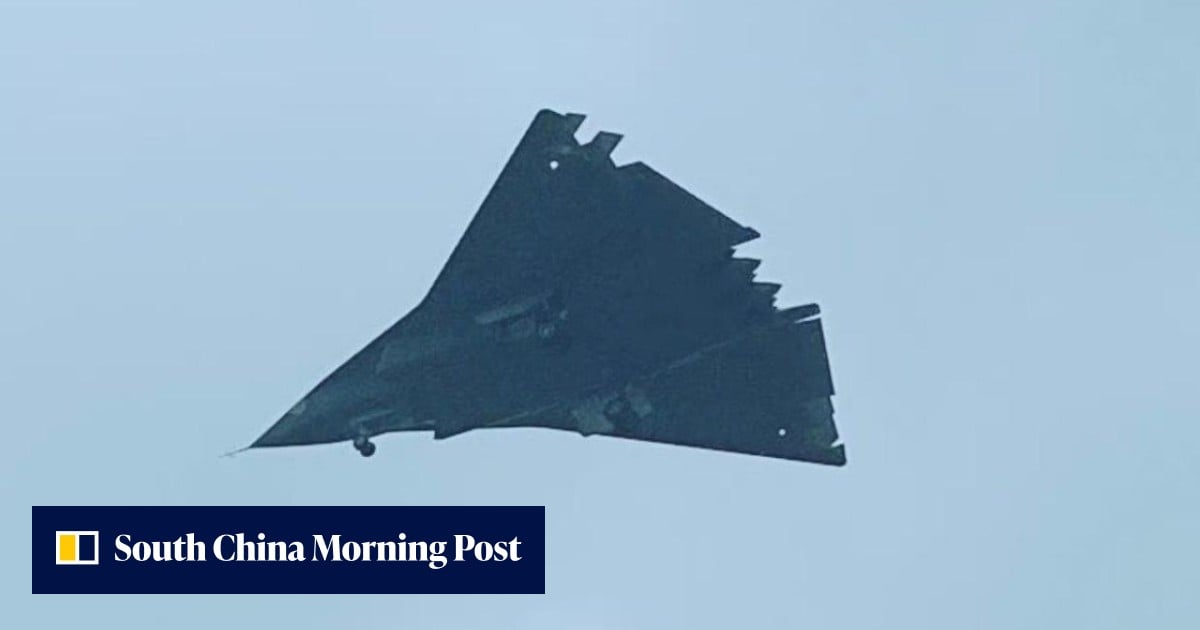
AVIC shows a fighter laser aiming system under 838 pounds beside an image of the J-36
An AVIC institute put a weight and a partly masked power figure on its fighter laser display in Beijing. The display masked the dynamic tracking accuracy, the figure that tells you whether the beam holds on a maneuvering missile.
The Product Desk · Product desk
What happened
- An AVIC research institute displayed a fighter laser tracking and aiming system at the China International Defence Electronics Exhibition in Beijing, an event that ran from September 15 to 17.
- Chinese military aviation researcher Andreas Rupprecht identified the aircraft pictured with the system as the J-36, the three-engine design that first appeared over Chengdu in December 2024.
- Exhibition material put the system's weight at less than 838 pounds, without saying which components that figure includes.
- One power figure on the display was printed as "*00kW," which could indicate an output of at least 100 kilowatts.
- The poster obscured the system's dynamic tracking accuracy, the measurement that governs how precisely an airborne beam can be held on a target.
Compiled by The Product DeskSomething wrong?How this is made
Why it matters
- constraint Cazalet said physical damage would require short engagement distances, with longer reach only against optical sensors. That bounds the mission to spoiling seekers, a terminal-phase effect. The number of missiles an opponent can launch stays the same.
- exposure The source frames the concept as relevant to US airpower, and the weapons it names, the AIM-174B, AIM-260 and AIM-424, are the programs whose terminal phase a defensive aircraft laser would contest.
- decision Anyone deciding what this display proves has to work with a weight whose contents are unspecified. Weight bounds what an airframe can carry; the accuracy figure is what would bound hit probability.
- precedent The nearest Western programme, SHiELD, spent years on pod-mounted fighter lasers and never got one onto a test aircraft before it closed in 2024.
An airborne laser has to hold its aim, and the exhibition material says plainly what makes that hard. Vibration, turbulence and rapid maneuvers disturb the beam constantly, the tracking system has to compensate, and the job gets harder as both the aircraft and the target move at high speed [8]. Even tiny aiming errors can move the beam away from its target [7]. AVIC covered that field on the poster [6].
Take the two numbers it did print. If "*00kW" means 100 kilowatts, and if the under-838-pound ceiling covers what the defense analyst Mark Cazalet said it might cover, the laser source, the beam director and the cooling system, then the package comes in below 8.4 pounds per kilowatt: 838 divided by 100 [10][20]. Both halves of that are assumptions. The poster printed no equipment breakdown and no electrical power requirement to settle either one [11].
The nearest Western attempt is useful here for calibration. The US Air Force's SHiELD program explored pod-mounted lasers designed to protect fighters from incoming missiles, and it ended in 2024 without mounting a laser pod on a fighter test aircraft [16]. The challenges program officials had named were turbulence, wind and aircraft maneuvers [17].
Cazalet said physical damage would require short engagement distances, and that lasers could reach farther when attacking or dazzling optical sensors [12]. Missile defense is one possible mission on that reading, either attacking an incoming missile or interfering with its seeker before impact [21]. Spoiling a seeker at close range changes one endgame without changing the number of rounds the shooter brought, and the American weapons named in this context, the AIM-174B, AIM-260 and AIM-424, are long-range programs [13].
The public record on China's work here goes back years. PLA procurement notices in 2020 sought an airborne laser attack pod and related control software [14]. A 2021 study used transport-aircraft flight data to model how movement and vibration affect laser tracking from a moving aircraft [15], and an AVIC publication described a 2024 trial that held a lock on a drone through clouds, birds and increasing distance [18]. Interesting Engineering reported that no public evidence currently shows the fighter flying with such a system [19].
For anyone who has to brief this upward, the two questions stay separate. Weight tells you whether an airframe can carry the thing, and Cazalet said the J-36 likely has enough space, weight capacity and power for a high-energy laser [9]. Hit probability against a maneuvering missile is the other question, and the poster answers the first one.
What to watch
- Whether any image shows the J-36 flying with a laser aperture or pod. None is on the record yet.
- Whether AVIC publishes the dynamic tracking accuracy or the electrical power requirement at a later exhibition.
- Whether AVIC's tracking trials move from drone targets to something moving at missile speed.