Product1 publisher2 min readPublished
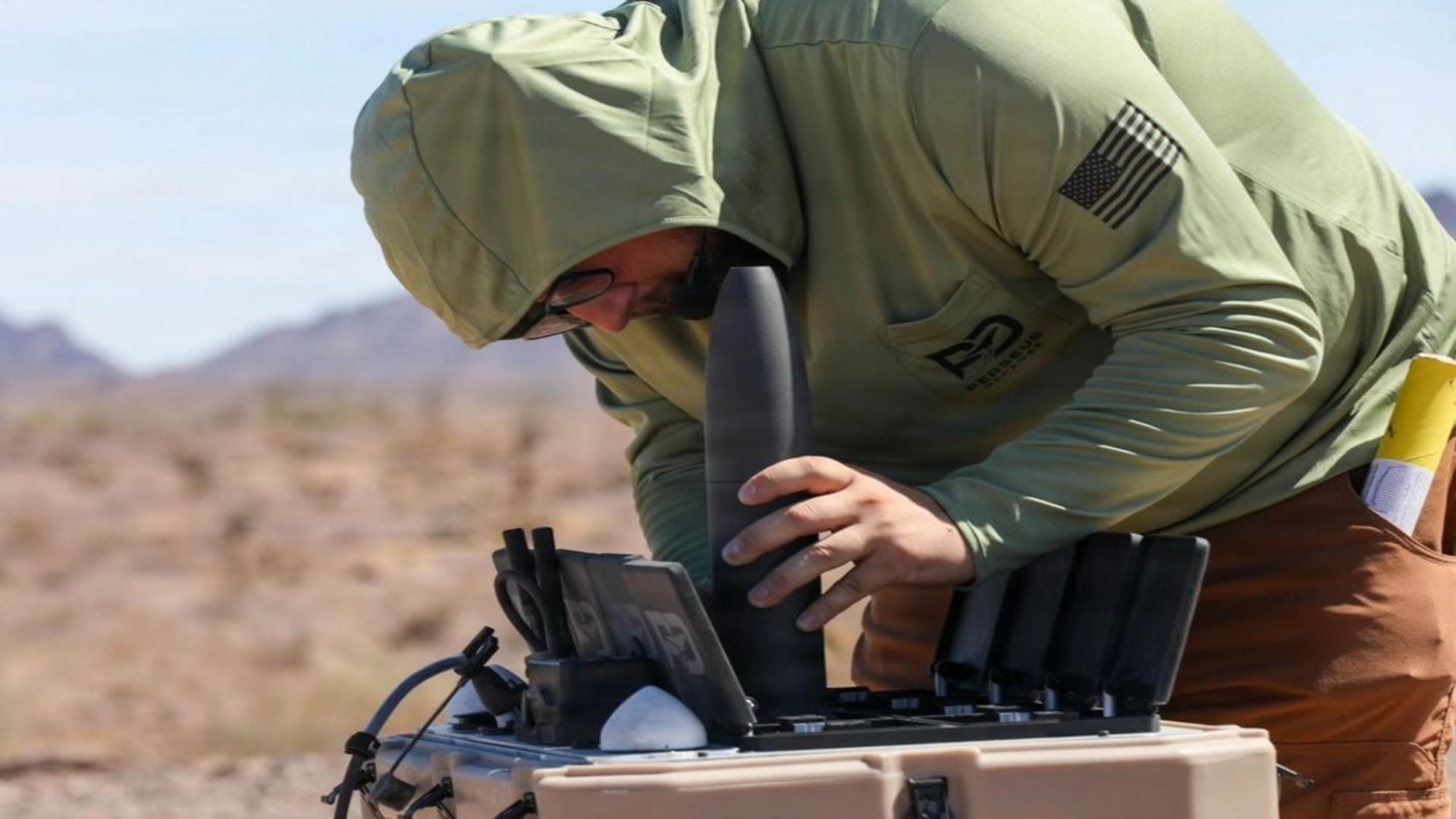
Perseus fires a $2,500 kinetic interceptor at Yuma under Falcon Peak 26.2
Perseus says each Mk-III costs about $2,500 to build, a fortieth of the price of the missiles militaries have fired at cheap drones. The figure a buyer writing a requirement needs is the cost per interception.
The Product Desk · Product desk
What happened
- Perseus Defense fired its Mk-III interceptor from an eight-shot launcher at Cibola Range Site 17 at Arizona's Yuma Proving Ground this month.
- The firing formed part of Falcon Peak 26.2, a counter-small-drone experiment involving US Northern Command, NORAD and the Pentagon's Joint Interagency Task Force 401.
- The company puts the build cost of each interceptor at about $2,500, against the missiles priced above $100,000 that militaries have used to destroy drones worth a few hundred dollars.
- The Mk-III destroys a drone by physical impact, a hit-to-kill approach that does not depend on electronically disrupting the aircraft's communications.
- Northern Command evaluated the system alongside other short-range counter-drone technologies, weighing mobility, cost per interception and magazine depth for base defense.
Compiled by The Product DeskSomething wrong?How this is made
Why it matters
- constraint A build cost cannot be compared with a fielded missile's price until someone publishes rounds expended per drone killed. A buyer writing a requirement needs that number alongside the $2,500.
- capability With a launcher under 79 pounds, a base can put coverage where there is no road and no pad, so the defended perimeter is set by where a crew can walk rather than by vehicle access.
- exposure Firing a kinetic round over a US installation leaves the debris question with the commander who authorised it, and the low-collateral claim is one the buyer has to verify on its own range.
- precedent A visitor demonstration inside a named experiment is now a viable entry route for a company founded in 2025. That route invites more counter-drone pitches priced on bill of materials.
In December 2023, unidentified drones flew repeatedly over Joint Base Langley-Eustis in Virginia, and the incursions reportedly forced the base to temporarily relocate its F-22s [12]. Similar sightings were recorded at other military installations through 2024 and 2025 [13].
Eight rounds at the company's stated build cost is about $20,000 of interceptor in a loaded launcher [20], a fifth of the price of one missile at $100,000 [21]. Cost per interception is a different figure: unit cost times rounds expended per drone killed, plus crew, storage and sustainment. The report does not say how many Mk-IIIs were fired at Yuma or what they hit [24].
The $2,500 is a build cost Perseus states [3], not a unit price on a production contract at the quantity a base would buy. At Cibola Range Site 17 the round was loaded into an eight-shot launcher and demonstrated to distinguished visitors [9], after an earlier appearance at Operation Jailbreak at Fort Carson [11]. Perseus said the system featured "Lattice-level integration," referring to compatibility with Anduril Industries' Lattice command-and-control software [10]. One of the experiment's sponsors, JIATF-401, was established in 2025 to accelerate counter-drone capability for US forces and domestic installations [14], and this year the event ran at Yuma for the first time after previous editions at Eglin Air Force Base in Florida [15].
Electronic warfare attacks the control link, by jamming it or spoofing it [6]. A drone flying a route loaded before takeoff has no link to attack, and one trailing fiber-optic cable does not radiate one [7]. Perseus's case, as the source presents it, is additive: one more layer of defense for the drones EW cannot touch [7].
Other reporting from the exercise identified a Perseus interceptor called Harpe, roughly 24 inches long with a stated engagement range of 1.2 miles [16]. Its launcher weighs less than 79 pounds, which the source says could let personnel move and deploy it without heavy vehicles or permanent infrastructure [17].
Two questions decide whether this round fits a site: whether the drones overhead carry a jammable link, and whether the ground below can take fragments coming down. Perseus is selling into the case where there is no link to jam and the debris still has to be answered for. Falcon Peak 26.2 puts particular emphasis on technologies that defeat drones while minimizing collateral damage [23], and Perseus is pitching the round as a low-collateral option for installations on US soil, where commanders must consider the risks posed by falling debris and by conventional air-defense missiles [8].
What to watch
- Whether Northern Command or JIATF-401 publishes rounds expended per drone killed from Falcon Peak 26.2.
- Whether Perseus converts the demonstration into a production contract with a per-round price at base-defense quantities.
- Whether a later Falcon Peak scores systems explicitly against fiber-optic-controlled drones, where the RF link does not exist.