Product1 publisher3 min readPublished
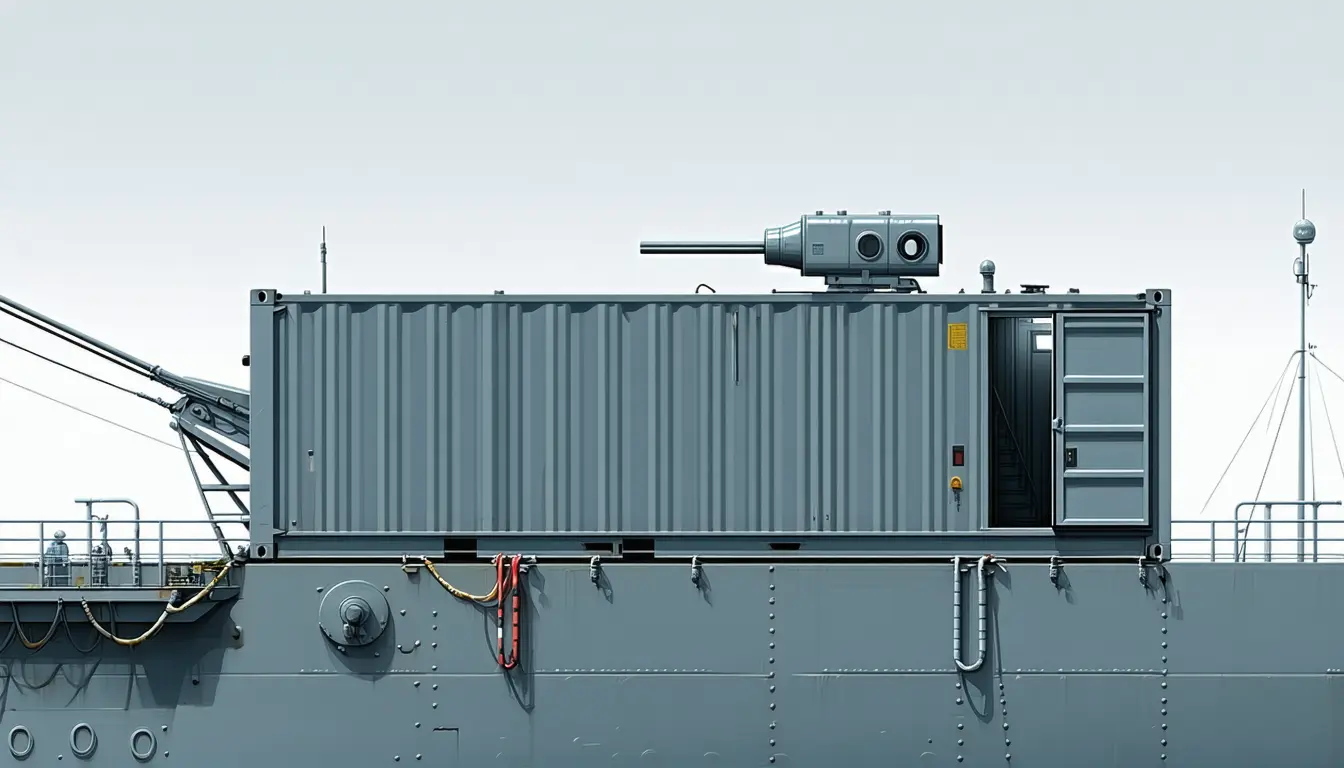
The Navy's laser road map starts with a container bolted onto a hull it already owns
Admiral Daryl Caudle says the service will field containerized lasers on ships it already has while designing power, cooling and optics into future hulls, and he is leaving the beam-combining architecture to industry.
The Product Desk · Product desk
What happened
- Chief of Naval Operations Daryl Caudle said the Navy is moving on two tracks at once, putting containerized lasers on ships it already has while designing directed energy into future hulls from the beginning.
- He said the fleet needs to move from the hundreds-of-kilowatts range toward megawatt-class capability as the technology and engineering support it.
- Caudle described lasers as part of a layered defense and said that today every VLS cell allocated to a defensive interceptor is a cell that cannot carry an offensive weapon.
- Asked to pick between coherent and spectral beam combining for shipboard missile defense, he declined, saying both offer potential pathways to higher power.
- The exchange ran in the Laser Wars newsletter after public affairs officials asked the interviewer to pare down the 18 questions originally submitted to the Office of the Chief of Naval Operations.
Compiled by The Product DeskSomething wrong?How this is made
Why it matters
- decision Suppliers have to price two different products for one customer: a container that can be craned onto a ship in service, and a power, cooling and optical architecture for ships still on the drawing board.
- exposure With the architecture question left open, the cost of backing the losing beam-combining approach sits with the vendor that picked it, not with the program office that declined to.
- constraint Caudle attaches megawatt-class power to hulls designed for it, which caps what the near-term containerized units can be asked to do on ships built around a different electrical plant.
- capability On Caudle's account, a ship's endurance in a defensive fight stops depending on how many interceptors it loaded in port and starts depending on how much electrical power it can generate and manage at sea.
The people who will find out first what salt air does to a laser's optical window are the crew of a ship that already exists. Caudle told the Laser Wars newsletter that containerized systems shorten integration timelines, allow operational experiment, and build the tactics, training, maintenance practices and human expertise the fleet will need as these weapons mature [3] [17].
So track one produces crews and maintenance routines. The power growth sits in track two, on ships not yet designed [4]. "The objective is not another demonstration. It is reliable, maintainable weapons in the fleet that sailors know how to fight," Caudle said [6].
A megawatt is 1,000 kilowatts. Moving from the hundreds-of-kilowatts range toward megawatt class is therefore about a threefold increase in output if "hundreds" means 300, and closer to tenfold from 100 [5] [16]. Caudle ties that growth to future hulls designed from the beginning with electrical generation, energy storage, cooling, combat-system integration and the optical architecture higher-power systems need [4].
Asked what the five-year road map for developing and fielding high-energy lasers looks like, Caudle described the two tracks and did not give dates, budget figures or hull counts [18]. He has been arguing for megawatt-class shipboard lasers since his 1992 master's thesis at the Naval Postgraduate School [13].
What suppliers get, then, is a requirements document. Caudle declined to pick between coherent and spectral beam combining, saying he does not want the Navy prematurely choosing an engineering architecture while industry and the technical community are still advancing multiple approaches [11]. "I want us setting demanding operational requirements and creating a strong business case for industry to solve those problems. I am much less interested in prescribing the technical solution than I am in getting a scalable, reliable weapon into the hands of sailors," he said [12]. The criteria he listed put reliability, maintainability and operation in a demanding maritime environment next to power on target, beam quality and efficiency [15]. A bid that wins on kilowatts and loses on time between failures is losing on his own list.
He also split the work: the Foundry on the engineering and industrial problems, the Fleet on operators, tactics and CONOPS [10]. That is two acceptance audiences with different tests, and the second one is the harder sell, because it is made of watch teams who have to keep the thing running between port visits.
If you are buying a drop-in version of a capability meant to live on infrastructure you already own, take his five items for future ships, generation, storage, cooling, combat-system integration and optical architecture [4], and mark which ones the container arrives with and which ones the host has to supply. Everything in the second column is schedule borrowed from the host's engineering queue, and that column decides whether the pilot can grow or only repeat itself. The acceptance test that tells you which you have is a watch team keeping one of these running for a month without help from the vendor.
What to watch
- Whether a containerized laser gets a named ship class and an installation date in the next budget request.
- Whether Navy requirements documents specify maintainability and time between failures alongside power on target.
- Whether future surface combatant designs publish electrical generation and cooling margins sized for megawatt-class weapons.