3D Systems puts qualified alloys ahead of printer capability in its Savannah River deal
The printers are already installed at Savannah River's Advanced Manufacturing Collaborative. That leaves the research money aimed at nickel superalloys and radiation-tolerant metals, which is where parts suppliers will meet the reviewers.
The Product Desk
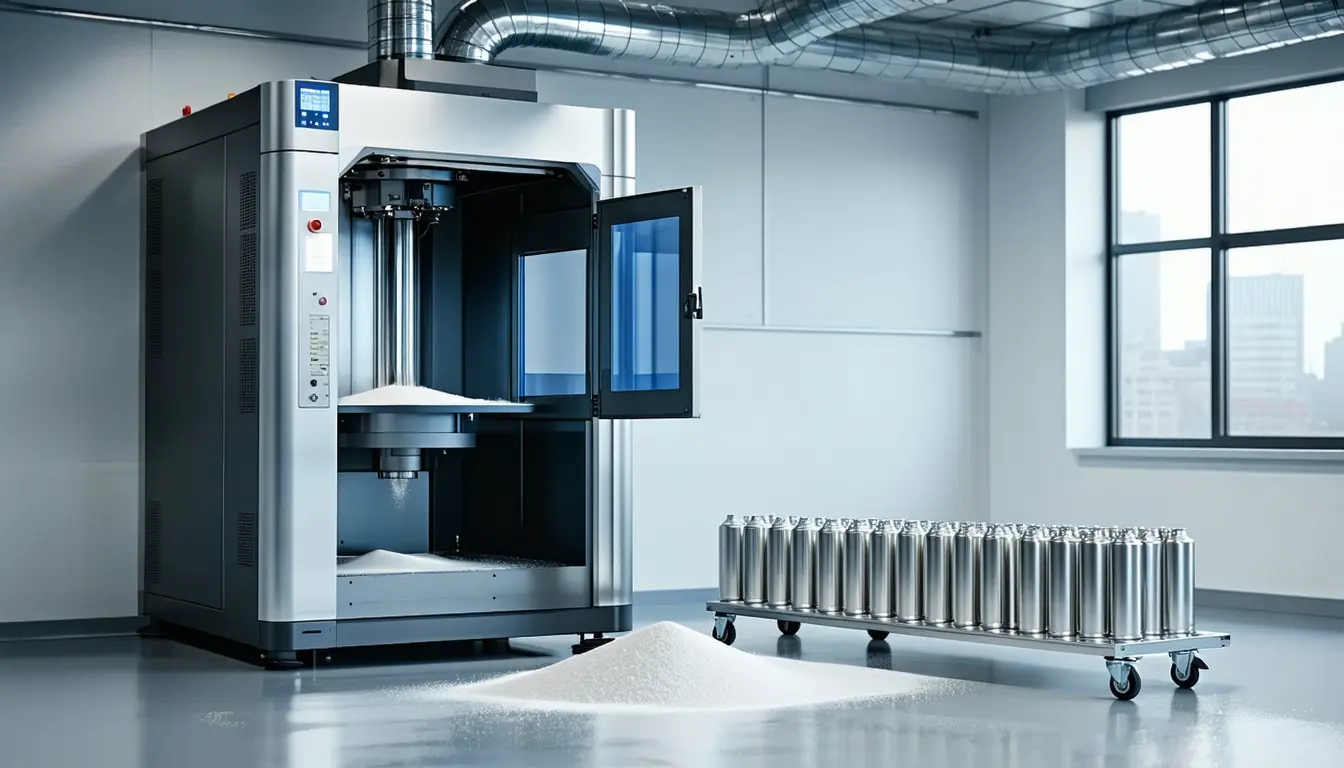
What happened
- 3D Systems and Savannah River National Laboratory signed a Cooperative Research and Development Agreement centered at the lab's Advanced Manufacturing Collaborative in South Carolina.
- The named material targets are high-temperature nickel-based superalloys and radiation-tolerant materials for components in advanced nuclear systems.
- The International Energy Agency puts global small modular reactor capacity at roughly 40 GW by 2050 under current policies and up to 120 GW in an accelerated scenario.
Why it matters
- What it limits constraint Closed-loop parameter tuning has to ship with bounds a reviewer will accept, otherwise qualified parts get built with the loop switched off and the AI work buys the supplier nothing on the shop floor.
- Who has to decide decision A three-to-one range in the reactor forecast pushes suppliers toward paying into shared material data rather than committing capital to a dedicated printed-parts line.
- Who's exposed exposure The technicians trained on these systems become the scarce input that nuclear, aerospace and defense suppliers bid against each other for, well before any machine purchase.
- What it sets up precedent Putting superalloys and radiation-tolerant alloys at the front sets the terms of the next argument with reviewers around material basis rather than printer specification.
The shop that machines valve bodies for a reactor vendor has been on the other end of this conversation. Someone asks whether the part could be printed, the answer is technically yes, and then the reviewer asks for the material data package: heat-to-heat variation, and what the alloy does after years under radiation and thermal load [3]. The printer turns out to be the cheap part of that conversation.
The announcement's own sequence supports that reading. The 3D Systems machines are already sitting at the Advanced Manufacturing Collaborative, with facility upgrades and additive specialists around them [5], while the research work is pointed at materials, equipment, AI and machine learning, and "scalable production processes" [2], with nickel superalloys and radiation-tolerant alloys named first among the materials [3].
The machine-learning piece is where the tidy story gets complicated. The partners want manufacturing parameters monitored and adjusted more intelligently during production [6], which is a reasonable engineering goal and an awkward one for whoever has to qualify the result. A process that moves while it runs is a different object to certify than one held fixed, because every adjustment the controller is permitted to make is a variable somebody has to bound on paper. Either the closed loop arrives with documented limits a reviewer accepts, or it stays a lab capability while the delivered parts get built the boring way.
The demand signal argues for the materials-first read too. The International Energy Agency puts global small modular reactor capacity at roughly 40 GW by 2050 under current policies, and as much as 120 GW in an accelerated case [7]. That is a three-to-one spread, 80 GW of uncertainty [12]. A dedicated qualified line for printed reactor internals is hard to underwrite against a number that can be off by a factor of three. A materials and process database holds its value in the 40 GW world and the 120 GW world alike, which is close to what the partners say they are after: materials, machines, software and manufacturing expertise aimed at repeatable industrial production rather than one-off components [8]. The reported account of the agreement covers scope and materials but skips the specifics: no dollar figure, no end date, no named qualification milestone [10], so nobody should read a schedule into it.
For a parts supplier, the useful exercise is a two-by-two over the parts you already sell. One axis: does an accepted material property basis exist for that alloy in the printed condition, or does someone still have to generate it. The other: can your process be frozen and documented, or does it depend on tuning per build. Frozen process with an existing data basis is a part you can quote now. Existing data with a hand-tuned process is an internal problem, cheap and yours to fix. Frozen process without a data basis is exactly where a CRADA like this one helps, and where heat exchangers with intricate internal cooling channels, reactor internals, pumps and valves mostly sit today [4]. Hand-tuned process with no data basis makes you a research partner holding a purchase order, and it is worth telling the customer which of the two they are buying.
What to watch
- Whether the material property data from the CRADA reaches suppliers or stays inside the lab.
- Whether an advanced reactor vendor names a printed part in a licensing submission.
- Whether 3D Systems offers the same closed-loop process control on customer machines outside SRNL.
Clarity's read
What the record supports and how the coverage leans. The claims behind it follow.
Reality
- Evidence38
- Adoption32
- Hype gap+32
- Incentives70
- Confidence45
Claim ledger
Ranked by verification strength, evidence, and original report placement.
- [1]
3D Systems has partnered with Savannah River National Laboratory through a Cooperative Research and Development Agreement (CRADA), centered at SRNL's Advanced Manufacturing Collaborative in South Carolina, covering nuclear energy, critical infrastructure and national security applications.
- [2]
The partners will work on new materials, manufacturing equipment, artificial intelligence and machine-learning tools, and scalable production processes for additive manufacturing.
- [3]
Material areas identified by the partners include high-temperature nickel-based superalloys and radiation-tolerant materials for complex components in advanced nuclear systems, where parts must operate under extreme temperatures, radiation or mechanical loads.
- [4]
Potential applications named include heat exchangers with intricate internal cooling channels, reactor internals, pumps and valves.
- [5]
3D Systems equipment has already been installed at SRNL's Advanced Manufacturing Collaborative, alongside facility upgrades and additive-manufacturing specialists.
- [6]
The collaboration will investigate AI and machine-learning-enabled process optimization, potentially allowing manufacturing parameters to be monitored and adjusted more intelligently during production.
- [7]
According to the International Energy Agency, global small modular reactor capacity could reach roughly 40 GW by 2050 under current policies, or as much as 120 GW under an accelerated scenario.
- [8]
The stated objective is not simply to print individual components but to develop materials, machines, software and manufacturing expertise that can move additive manufacturing from laboratory research toward repeatable industrial production.
- [9]
The agreement includes a workforce-development component in which researchers, engineers and technicians get opportunities to work with advanced additive-manufacturing systems, creating a pipeline of trained personnel for nuclear, aerospace, defense and energy industries.
- [10]
The reported account of the agreement states no dollar value, no duration or end date, and no named qualification milestone.
- [11]
The partners say additive manufacturing could contribute to domestic manufacturing capacity and supply-chain resilience as the US invests in advanced reactors and small modular reactors.
- [12]
The IEA's accelerated small modular reactor case is three times its current-policies case, a spread of 80 GW.
Get this ledger inside ChatGPT. Ask about any of our stories and the answer brings its figure, each claim’s verdict and the sources. Free, no account.
Sources
1 independent publisher whose own reporting we read for this story.
- interestingengineering.comUS 3D printing partnership targets complex prints for nuclear reactors and defence
1 article · August 29, 2026
Topics and entities
Follow any of these and your For You feed starts watching them — no settings page required.