Science1 publisherNot yet confirmed elsewhere2 min readPublished
UC San Diego team builds a 'butterfly fly' with nine light-detecting cells per eye unit
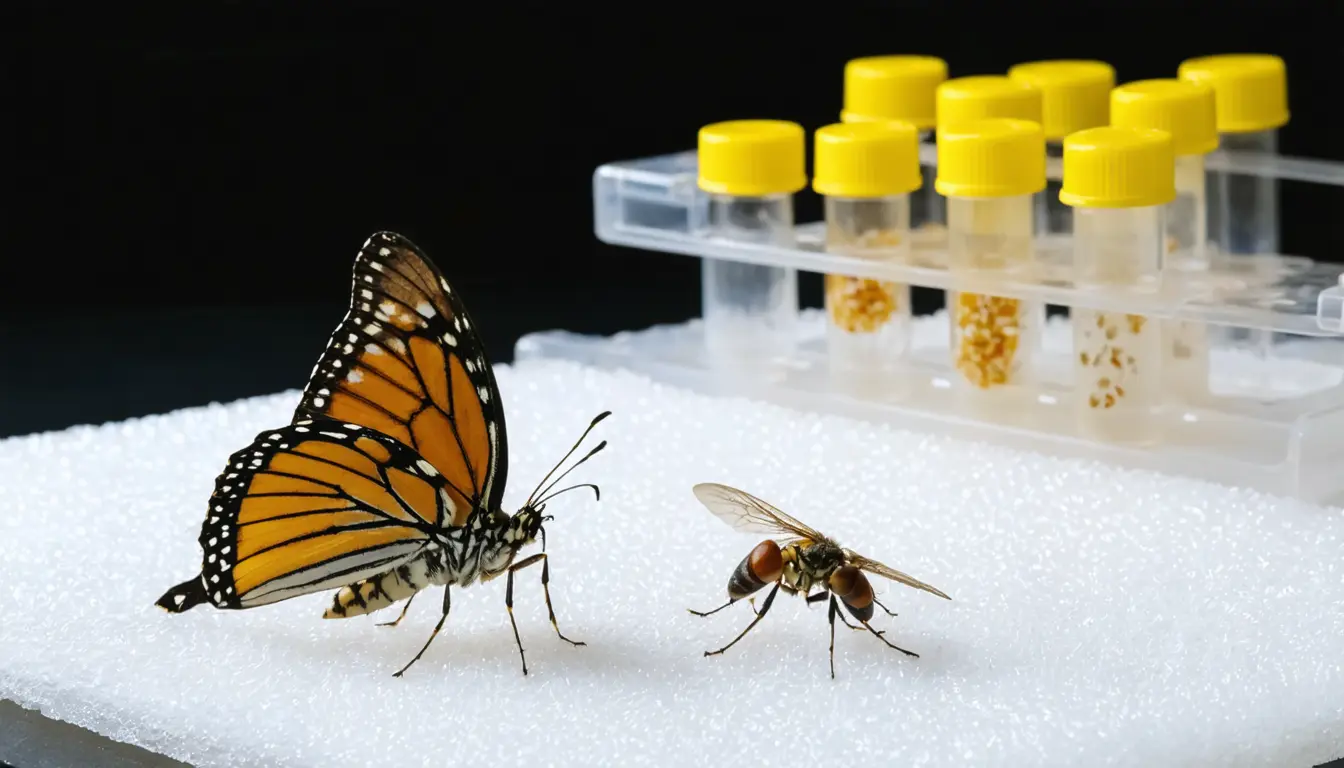
Michael Perry's UC San Diego lab found the genetic switch behind the butterfly's ninth light-detecting cell per eye unit and rebuilt it in fruit flies. The flies' brains wired the extra cell to spare neurons they would normally discard, so the change to the eye was enough on its own.
The Scientist · Science desk
What happened
- Most insect compound eyes put eight light-detecting cells behind each lens, a layout scientists believe has held for hundreds of millions of years.
- Butterflies have a ninth cell, giving them a richer range of color than flies that helps them find nectar and potential mates.
- Where flies have photoreceptors R1 to R8, painted lady butterflies, the world's most widespread butterfly, carry a second R7 cell in every eye unit.
- To build the 'butterfly fly', the team switched on a gene in fly cells that normally keep it off, timed to the brief window when the eye is built.
Compiled by The ScientistSomething wrong?How this is made
Why it matters
- precedent On the authors' account, a flexible insect brain can absorb a new input, so a new photoreceptor type can arrive through one change in the eye instead of the matched eye-and-brain change they had expected.
- constraint The fly result shows the switch can build a ninth cell; showing that painted lady ancestors gained theirs this way needs evidence from butterflies themselves.
- capability The butterfly fly gives the lab an animal in which an added photoreceptor wires up with no further edits, so how a new sensory cell finds partner neurons can be studied directly.
Turning the gene on in a fruit fly is a test of sufficiency. Comparing butterfly and fly eyes can show which genes differ between them. It cannot show which difference built the extra cell. The team made that single change in an animal that normally has eight cells per unit to see whether it was enough on its own [6]. In a fly, at least, it was: the change needed no further edits to the eye, and the flies grew nine cells per unit [6].
Perry, an associate professor in UC San Diego's School of Biological Sciences, said: "We found the genetic switch that did it." [3][4]
The researchers expected the harder problem to be in the brain. A new light detector is no use without a neuron to receive its signal, and they assumed the brain would have to evolve a matching partner over time [7]. No such change was needed [7]. Fly brains routinely make more neurons than they keep, and the ones that fail to find a connection die off [8]. In the engineered flies, those standby neurons connected to the new photoreceptor and survived [8].
"In other words, the brain was ready before the eye asked. This is a rare, concrete case of evolution making use of neurons that were otherwise going to die," Perry said [9].
A hawkmoth supplies evidence from outside the lab. The lower half of its eye is butterfly-like, with two R7 cells per unit, and the upper half is fly-like, with one [10]. The researchers say that split is about what a change would leave behind if it started in one part of the eye and then spread [10]. A single species caught partway through fits that sequence, but one animal at one point in time cannot show the change spreading.
The thing this doesn't tell you is whether the butterfly fly sees more color. Nine cells wired to surviving neurons is anatomy. Seeing more hues is behaviour, and the team describes that question as difficult to study and still open [11]. The phys.org account also does not name the gene or report what share of eye units in the engineered flies carried the ninth cell. The paper, by Ke Gao and colleagues, appears in Science Advances [12].
What to watch
- Whether the switch identified in painted ladies is active in the butterfly-like lower half of the hawkmoth eye.
- Whether the same switch turns up in butterfly species beyond the painted lady.
Clarity's read
What the record supports and how the coverage leans. The claims behind it follow.
Reality
- Evidence55
- Adoption
- Insufficient
- Hype gap+15
- Incentives
- Insufficient
- Confidence50
Claim ledger
Ranked by verification strength, evidence, and original report placement.
- [1]
Many insects see through compound eyes; behind each lens sits a cluster of eight light-detecting cells arranged in a pattern scientists believe has existed for hundreds of millions of years.
- [2]
Butterflies are a rare exception with nine light-detecting cells, which lets them navigate a richer world of color than insects such as flies and helps them locate nectar and potential mates.
- [3]
The lab of Michael Perry, an associate professor in the School of Biological Sciences at the University of California San Diego, discovered the genetic modification that gave butterflies this visual advantage.
- [4]
"We found the genetic switch that did it."
- [5]
In a Science Advances study of painted lady butterflies, the most widespread butterfly species, the researchers found that while flies have photoreceptors R1-R8, butterflies expanded their color vision by adding a second R7 photoreceptor to each eye unit.
- [6]
To test whether the genetic change was enough on its own, the team recreated it in a fruit fly, switching on a gene in cells that normally keep it off and timing it to the brief window when the eye is built; this produced a 'butterfly fly' with nine cells per eye unit instead of eight.
- [7]
The scientists assumed a new photoreceptor would require the brain to slowly evolve a matching neuron partner; that did not happen, and no adaptive change was needed.
- [8]
The fly brain regularly overproduces neurons that die off if they fail to find a connection; in the butterfly fly, the brain put these extra standby neurons to use, and according to Perry they survived and wired up correctly with no further genetic change.
- [9]
"In other words, the brain was ready before the eye asked. This is a rare, concrete case of evolution making use of neurons that were otherwise going to die."
- [10]
The team found a hawkmoth that appears partway through the same transition: the lower half of its eye is butterfly-like with two of these cells per unit, the upper half fly-like with one, roughly what would be expected if the change began in one region and spread.
- [11]
The team is now exploring the difficult-to-study question of whether the butterfly fly can in fact see more vivid color with the additional photoreceptor, as butterflies do.
- [12]
The paper is Ke Gao et al, 'Sensory receptor expansion and neural accommodation in butterfly color vision', Science Advances (2026).
- [13]
The findings provide a glimpse of how insects, with a flexible brain framework, accommodated new inputs and adapted to an emerging environmental need: an enhanced ability to see flowering plants.
Sources
1 independent publisher whose own reporting we read for this story.
- phys.orgThe genetic switch behind the butterfly's enhanced visual world of color
1 article · October 8, 2026
Topics and entities
Follow any of these and your For You feed starts watching them — no settings page required.
Entities
- Michael PerryFollow
- University of California San DiegoFollow
- Science AdvancesFollow
- Ke GaoFollow
- Painted lady butterflyFollow