Product2 publishersIndependently confirmed2 min readPublished
JBL pairs a karaoke vocal remover with 1,500 watts in its $1,800 PartyBox Ultimate 2
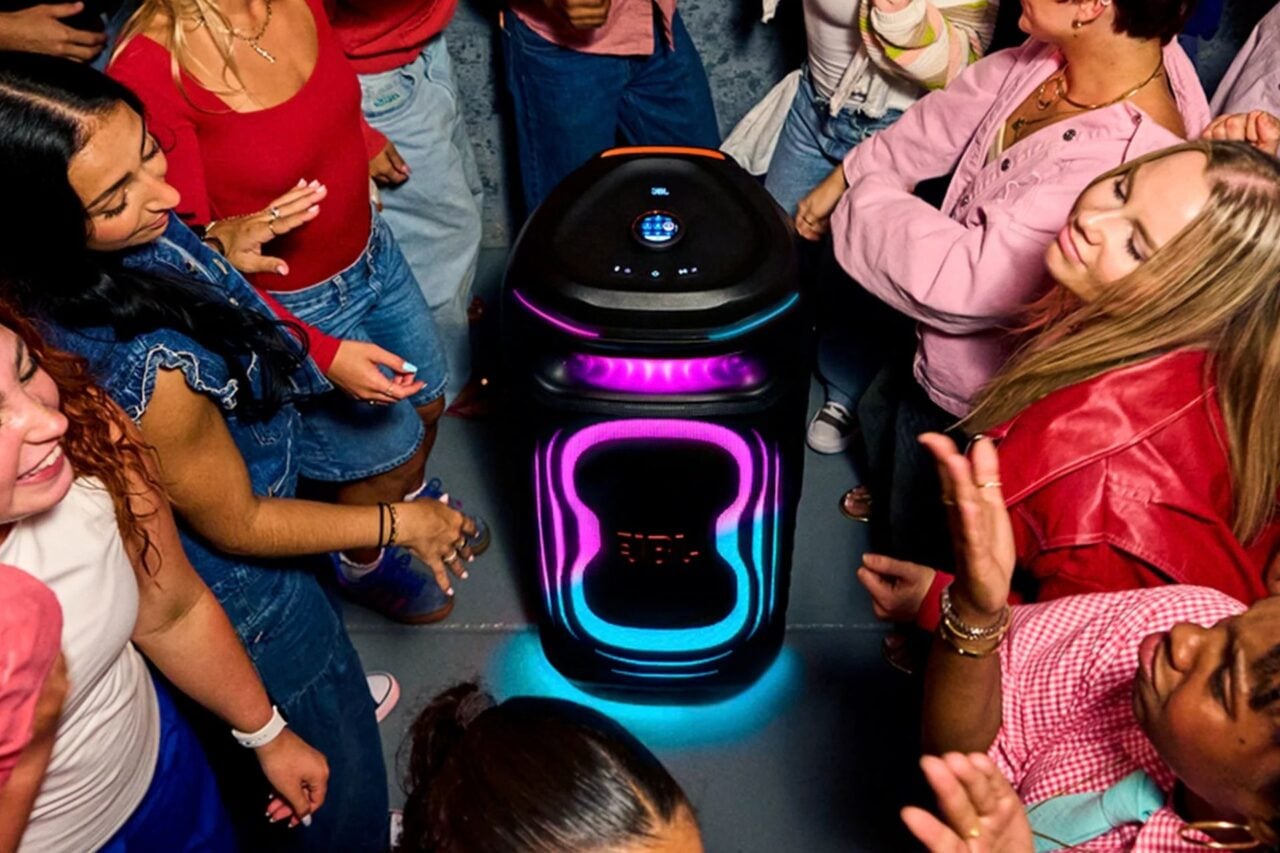
JBL's $1,800 PartyBox Ultimate 2 puts the AI vocal removal from its Bandbox Solo amp into a 120-pound, 1,500-watt speaker that must stay plugged in. It suits a host with a permanent spot near an outlet whose guests ask for songs that have no karaoke version online.
The Product Desk · Product desk
Drafted by a language model from the sources cited here and checked against its claim ledger before publication. How we use AISend a correction
What happened
- The six drivers are dual 10-inch woofers, dual five-inch midrange drivers and dual pro-grade PEN tweeters similar to those in JBL's professional systems.
- Two more AI features ship alongside vocal removal: AI Sound Boost, meant to raise volume without distortion, and Smart EQ Mode, which adjusts EQ in real time to what is playing.
- Gizmodo's reviewer has used JBL's vocal isolation on the Bandbox Solo practice amp and says it works far better than expected, but had not yet tried it on the new speaker.
- Sony's ULT Tower Max, the speaker Gizmodo compares it with, weighs 124 pounds and likewise has no battery.
- Preorders are open with free shipping and units are expected to ship October 25, 2026, but JBL charges buyers for return shipping.
Compiled by The Product DeskSomething wrong?How this is made
Why it matters
- cost A buyer who wants to try the vocal button at home and send the speaker back if it disappoints pays the freight on a 120-pound box, so the trial itself has a price.
- constraint Without a battery, the speaker and its AI features work only within cord's reach of an outlet, so hosts who move between venues get nothing from the software.
- decision Until hands-on reports from this speaker appear, anyone buying it for karaoke is choosing on one reviewer's impression of a smaller JBL product.
Someone at the party asks to sing a song that has no karaoke version online. On the PartyBox Ultimate 2, the host taps EasySing AI Vocal Removal on the top touch panel, which Engadget says is a first for PartyBox speakers, and the vocals drop out of the track [10][3].
Here's what users already do, in Gizmodo's account. "Sure, you could just pull up a karaoke version of most songs on YouTube, but being able to do it with literally any song with the push of a button is still pretty rad," the reviewer wrote [14]. JBL builds for the YouTube habit as well. Engadget says the optical input is there for TV karaoke setups [5].
Most of the AI on the spec sheet serves loudness. JBL puts the label on three features, and only the vocal remover changes what guests do; Sound Boost and Smart EQ handle volume and tuning [4]. JBL's promise for Sound Boost, as Engadget quotes it, is "detail and clarity with low distortion at every volume" [9]. The hardware points the same way. At 1,500 watts this is JBL's most powerful PartyBox, about 88 percent more than the 800-watt PartyBox 720 [15][18].
Gizmodo compares it with Sony's ULT Tower Max on bulk and power cords [12], and the Sony is four pounds heavier [19]. The coverage does not include the Sony's price or say whether it can strip vocals. On that record, the sources cannot show that the vocal button is what separates the two speakers.
The hardware narrows the buyer before the software does. The speaker stands 41.4 inches tall and moves on wheels with a handle, and it is rated IPX4 splash-proof [7][17]. Engadget says it weighs as much as a small refrigerator [11].
I'd sort the purchase on two axes. One is whether the speaker gets a permanent spot near an outlet. The other is whether the singers ask for songs that already have karaoke versions online. Fixed spot and well-covered songs is a TV karaoke setup through the optical input, where the $1,800 buys watts and a light show with ripple-wave effects and floor projection [5][16]. Fixed spot and requests YouTube cannot serve is the buyer EasySing is for. A speaker that has to travel is the wrong purchase in either column, because it has no battery [2]. I'd recommend it for that second quadrant only. The tradeoff is that the hands-on evidence so far is one reviewer's time with a smaller JBL amp [13].
What to watch
- Hands-on reviews of EasySing AI Vocal Removal on the PartyBox Ultimate 2 itself, after testing on the Bandbox Solo so far.
- A side-by-side of the Sony ULT Tower Max's price and features against the JBL's, to show whether vocal removal is a real point of difference.
- Whether JBL puts EasySing into cheaper PartyBox models, a sign it treats the feature as standard across the lineup.