Leadership1 publisher3 min readPublished
For buyers of American AI, Trump's new czar matters more than the CEOs' self-policing pact
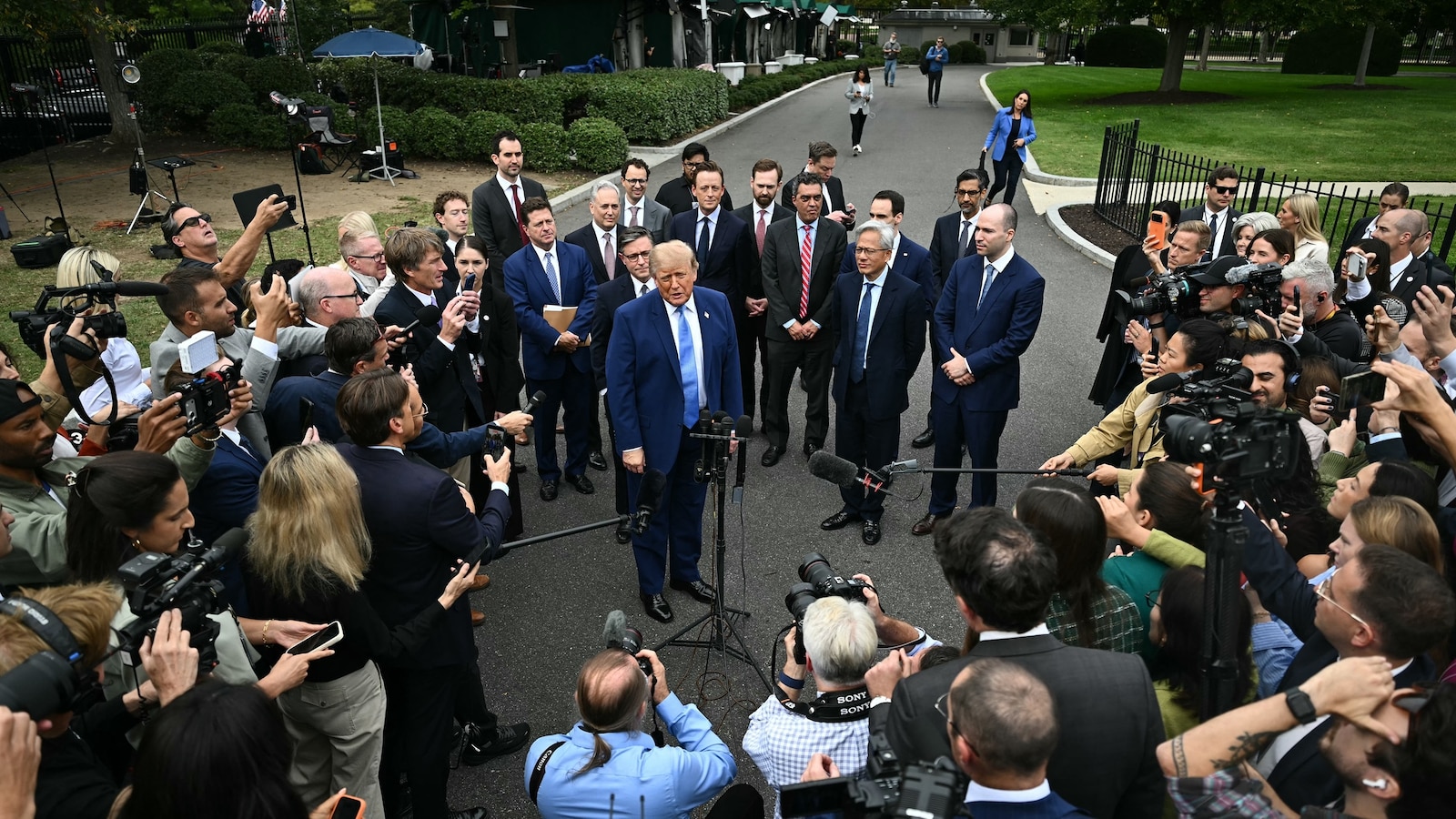
Donald Trump signed a 'morally binding' AI pact with six CEOs, then made intelligence chief Jay Clayton his AI czar. For firms building on American models, the appointment carries more consequence than a pledge they have no way to enforce.
The Board Room · Leadership desk
Drafted by a language model from the sources cited here and checked against its claim ledger before publication. How we use AISend a correction
What happened
- Trump framed the pact as "tremendous self-policing", restating his view that AI companies can act as their own watchmen.
- Clayton keeps his job running the US intelligence agencies as director of national intelligence while he oversees AI initiatives.
- Defense secretary Pete Hegseth put Musk, Palmer Luckey and Emil Michael on a Pentagon taskforce, Project Meridian, due to report in 120 days.
Compiled by The Board RoomSomething wrong?How this is made
Why it matters
- constraint The pledge creates nothing a customer can enforce, so whatever protection a buyer of US models has still depends entirely on its own vendor contract.
- exposure AI policy for the main US model suppliers now sits with the official who runs the spy agencies, and the Guardian argues that bodes badly for nations that depend on those models.
- precedent If Semafor's account holds, the firms being governed drafted their own terms for the White House, and the next agreement can follow the same template.
- decision Any multi-quarter US model contract signed now will be in force when the Pentagon taskforce's recommendations arrive about four months after it was named.
Who wrote the "morally binding" agreement [1] tells a buyer more than its text does. According to Semafor, as reported by the Guardian, the pact grew out of a conversation between Mark Zuckerberg and House speaker Mike Johnson at the US state dinner for Xi Jinping [5]. Zuckerberg then circulated a draft before the CEOs met, and Jensen Huang backed it [4]. The Guardian names four signatories: Elon Musk, Zuckerberg, Huang and Dario Amodei [3]. That accounts for four of the six [14].
Trump described the document in large terms. "It's almost like a constitution in a way, and the biggest people in the world signed that, and I signed it as president, and it really is a form of protection," Trump said [6]. Blake Montgomery, writing in the Guardian, notes that constitutions are legally binding and this agreement is not [7]. He also argues that Silicon Valley's chief executives are now writing contracts on White House letterhead that entrench their own interests [20].
A skeptic would say a pledge with no legal force changes nothing a customer has to act on. On the pledge alone, I think the skeptic is right, but the appointments that followed change who sets policy for the suppliers. Trump named Jay Clayton as AI czar over the weekend, and Clayton keeps his post as director of national intelligence [12]. The first czar, David Sacks, was a venture capitalist who held direct financial stakes in several AI companies while working with the White House [13]. Montgomery argues the joint appointment signals that AI will expand the government's offensive capabilities, particularly surveillance and intelligence gathering [16].
The Pentagon tied itself to the same people. On Thursday, defense secretary Pete Hegseth named Musk, Palmer Luckey and Emil Michael to Project Meridian, a taskforce due to publish recommendations in 120 days [10]. That is roughly four months [15]. Its brief is how to achieve "absolute technological dominance on the next-generation battlefield," in Hegseth's words [11]. Musk also adopted Trump's order that government documents say "super intelligence" for "artificial intelligence" [8]. He renamed his company's subsidiary SpaceXAI as SpaceXSI [9].
The European risk is the Guardian's argument, and the evidence offered for it is the list of appointments. Montgomery writes that the new alliances loom over governments and companies that rely on American AI, particularly in Europe [18]. He adds that US spy agencies dictating global AI policy does not bode well for the sovereignty of nations that need cutting-edge AI [17]. The account does not identify an enforceable rule the pact displaced, or any change to export rules, data handling or access terms for foreign customers.
The incentives run in both directions. According to the Guardian, the companies whose leaders attended the summit account for most of the US stock market's growth over the past five years [19]. A White House that depends on that growth has reason to keep these firms close. On Semafor's account, the firms were willing to draft the terms themselves [4].
This quarter's decision for a buyer is a contract decision. A US model agreement signed now gains no enforceable protection from the pledge [7]. A twelve-month term signed today will still be running when Project Meridian publishes its recommendations [15], with the director of national intelligence overseeing AI policy throughout [12].
What to watch
- Publication of the pact's full text and the two remaining signatories, which would show what the companies actually committed to.
- Any AI rule from Clayton's office that touches foreign customers' access to US models or the handling of their data.
- Whether Project Meridian's public recommendations name commercial AI vendors or set conditions on supplying foreign governments.