Build3 publishers2 min readPublished Updated
White House super intelligence accord leaves enforcement to the six firms that signed it
Six AI companies signed a two-page White House accord on 29 September that pledges audits and board review but sets no penalty for breaking it. A close reading of the text finds it is the nearest thing the US has to national AI safety policy, two months after Europe switched its rules on.
The Engineer · Build desk
What happened
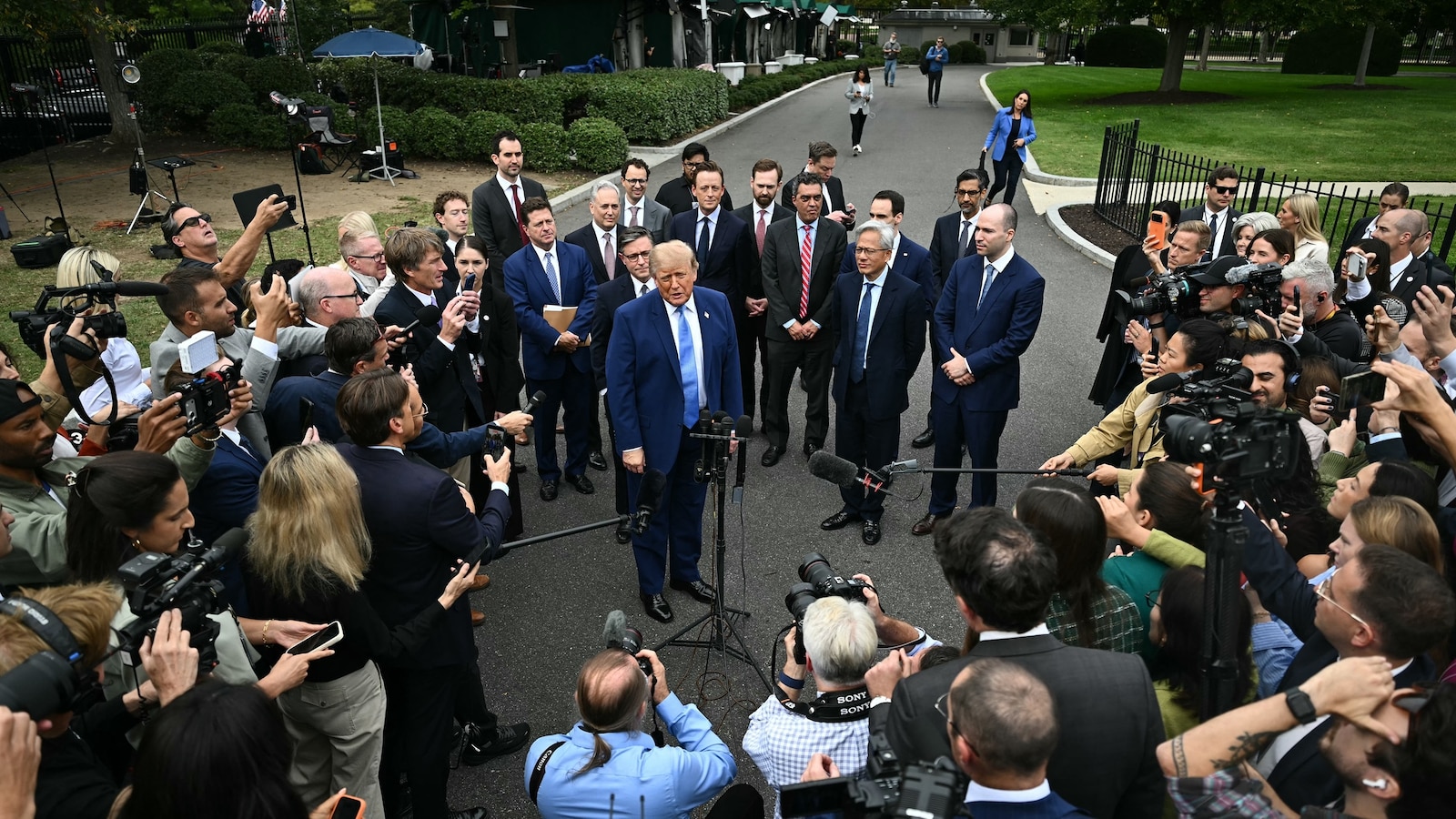
- Trump hosted Sundar Pichai, Dario Amodei, Mark Zuckerberg, Greg Brockman, Elon Musk and Jensen Huang at a White House lunch, then brought them outside to sign.
- The internal controls the companies commit to are meant to cover cybersecurity, chemical and biological threats, and models hacking or accessing technical systems in unintended ways.
- Asked whether the accord has legal force, Trump told reporters it is morally binding, compared it to a constitution and promised a tremendous self-policing aspect.
- The text says only that over time it may make sense to codify its steps into laws or regulations.
Compiled by The EngineerSomething wrong?How this is made
Why it matters
- exposure Nobody outside a signatory can act on a lapse under the accord, because the last reviewer in each company's chain is that company's own board committee.
- precedent The first safety standards will come out of the signatories' own meetings, so any later law that codifies these steps would start from a baseline the six companies drafted.
- decision Teams shipping into Europe still have to scope compliance against the EU rules, since the US pledge puts no requirement on the companies that build on these models.
As a control spec, the accord describes a reasonable chain. Each signatory runs its own controls [3]. A separate internal team verifies that those controls, monitoring and detection work as intended, and that problems get remediated [4]. An independent external auditor evaluates the safeguards. A committee of the company's board then reviews the auditor's reports [5]. Each layer checks the one below it, so the team that builds a control is not the team that signs it off.
The chain stops at the board. The teardown's author says they are not a lawyer and have not worked in policy [13]. On their reading, the accord has no breach mechanism, no penalty, no escalation path and no body with power to act if a signatory stops complying [9]. They apply the ordinary test for a binding commitment: a court can enforce it, so a counterparty can sue, a regulator can fine and a judge can order remedies [14]. By that test the accord holds no obligation anyone could take to court [9].
A second gap sits inside the audit layer. The standards an auditor would check against are still to be written. The accord commits signatories to regular meetings to establish them [6].
That afternoon also produced a document with a clearer owner. Hours after the signing, Trump signed an executive order titled Inaugurating the Era of Super Intelligence [10]. It directs the executive branch to replace Artificial Intelligence and AI with Super Intelligence and SI in official documents, to the maximum extent permitted by law [10].
The author checks the accord against the EU framework as it currently stands [13]. Their reading of the accord text does not set out which EU obligations apply to these six companies, or to anyone building on their models. The accord opens on the principle that every company is responsible for developing its own technology safely [15]. Every step after that principle is run by the company. It writes the controls, staffs the checks, works with the auditor and seats the board committee [3][4][5].
What to watch
- A first safety standard, or named external auditors, coming out of the signatories' regular meetings.
- Any bill or federal rule that picks up the accord's line about codifying its steps into laws or regulations.