Science1 publisherNot yet confirmed elsewhere2 min readPublished
Tortoise beetle mothers coat their bacterial partner in Yellow, a protein known for pigment
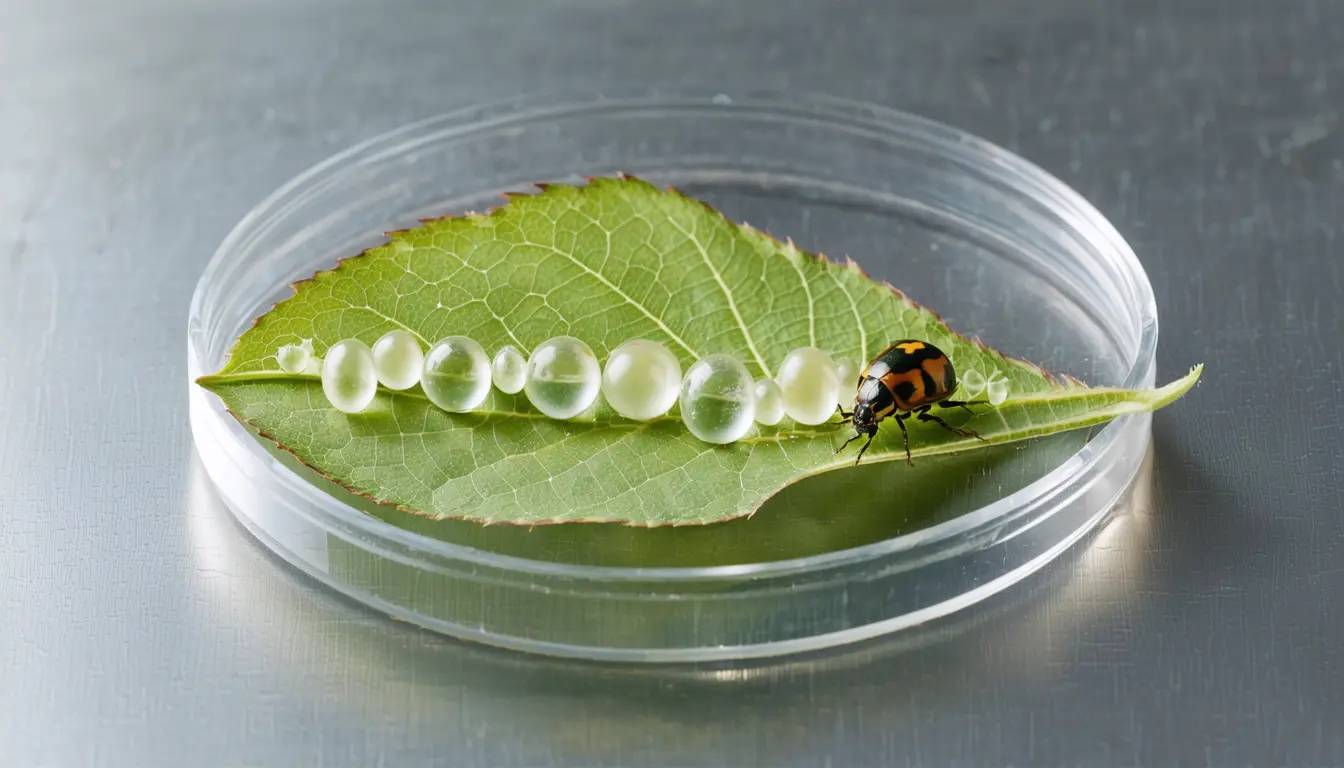
Tortoise beetles build the egg capsules that keep their gut bacteria alive on the egg for about 11 days from Yellow, a protein best known for pigmentation. The finding gives a gene family studied mostly for color and courtship a building job, one the beetle's essential bacterial partner needs.
The Scientist · Science desk
What happened
- Stammera, the bacterium that digests the beetle's plant diet, has lost so much of its genome over a roughly 60-million-year partnership that it can barely survive on its own.
- The Yellow gene is highly expressed in glands associated with the ovaries of adult female beetles and is almost undetectable in males.
- Mass spectrometry placed Yellow in the spheres, and structural modeling indicated they are built almost entirely from it, formed into a dense, glue-like matrix.
- Knocking the gene down disrupted the shape of the spheres and made the enclosed bacteria more susceptible to drying out.
Compiled by The ScientistSomething wrong?How this is made
Why it matters
- constraint The larva picks up its bacteria by eating the capsule on its egg, so each generation's partnership depends on one exposed step where the coat has to hold.
- exposure Leaf beetles are significant crop pests, and the authors suggest plants could be engineered to resist them by targeting the bacterial partner, an idea that is still only a proposal.
- precedent With another insect gene family found doing an unrelated job, a 'pigmentation' label assigned from sequence similarity is a weaker guide to what a Yellow gene does in an unstudied species.
The team started by building a reference genome. No tortoise beetle had one until they assembled it for Chelymorpha alternans [7]. After that, each experiment answers a different question, and only one of them tests cause. The sex bias in expression made Yellow a candidate [8]. Mass spectrometry showed it is an ingredient of the spheres [9]. Neither of those steps rules out Yellow being a minor component carried along with whatever really protects the bacterium. The knockdown closes that gap: cutting the gene's activity changed the sphere and changed how well the bacterium tolerated drying [10].
The thing this doesn't tell you is how large the protective effect was, or what it does to the next generation. The phys.org summary does not report effect sizes for the drying tests, and it does not say whether larvae from knockdown mothers failed to pick up Stammera. Salem describes a partnership "the tortoise beetle cannot survive without" [3], and he measures the coat's value in time. "A tortoise beetle mother wraps her bacterial partner in a protein coat, glues it to the outside of her egg, and that coat is what keeps the bacterium alive for over a week before her offspring can consume it and become infected," he said [11]. Infection rates in knockdown offspring would test the last clause of that sentence.
Yellow got its reputation in fruit flies. More than 80 years ago, differences in yellow pigmentation were found to be critical to courtship success in flies, one of the first demonstrations linking genes to complex behavior [1]. Salem said the result surprised the team: "We did not expect a gene from the Yellow family, best known for pigmentation and behavior, to be responsible for something as physical as building a protective capsule around a bacterium" [12]. The study, published in Nature Communications, adds to a growing list of insect genes with long evolutionary histories that have been put to unrelated uses [13] [16]. The gene is also highly conserved across several tortoise beetle species [14]. That fits a job the whole group shares, though conservation alone does not prove it.
Next, the team plans to work out how Yellow assembles into the protective matrix at a biochemical level [15]. The work involved the John Innes Centre, the Sainsbury Laboratory and the Max Planck Institute [2].
What to watch
- Whether larvae from Yellow-knockdown mothers fail to acquire Stammera, or grow and survive less well, which would tie the capsule directly to beetle fitness.
- The planned biochemical work on how Yellow assembles into the glue-like matrix around the bacteria.
- Any experiment testing plants designed to disrupt Stammera in leaf beetle pests.