Product1 distinct publisher3 min readPublished
AeroVironment's $464.8m Enduring-HEL award covers dozens of 30-kilowatt LOCUST X3 units. The step that made the purchase possible was a Department of War safety agreement with the FAA, signed before anyone fired.
The Product Desk · Product desk

Compiled by The Product DeskSomething wrong?How this is made
Getting clearance to fire was the hard part here; beam quality was never the issue. Before the testing AeroVironment credits at White Sands Missile Range, run with a joint task force and the Fires office, there was no route to fire a laser weapon inside American airspace at all [20][21]. Clearance, then use, then purchase, with each step measured in weeks rather than years [22], helped along by an Other Transaction Agreement, the mechanism that lets the Pentagon buy outside standard federal acquisition rules [9].
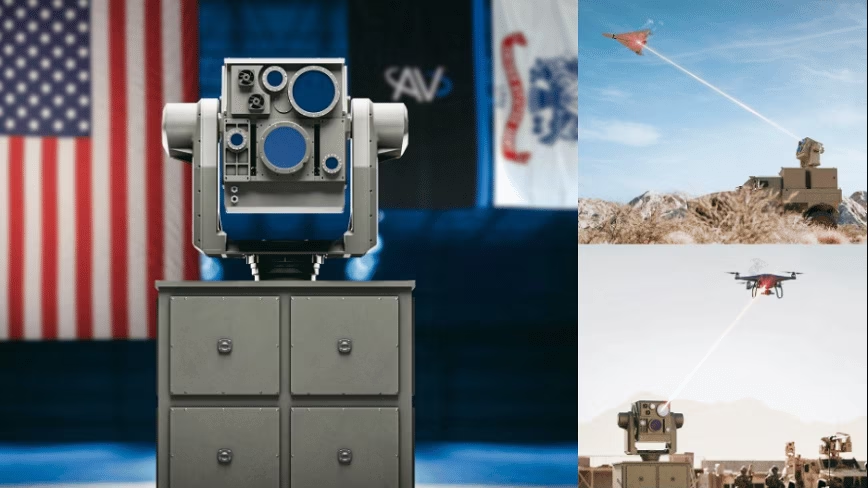
What the public operational record contains is three drones brought down over one night in one valley [10], by 20-kilowatt prototypes from the Multi-Purpose High Energy Laser programme [15]. It does not contain dwell time per kill, engagement range, or how many engagements a vehicle supports before power and cooling need attention. Those are the variables the physics turns on: this class of weapon holds a beam on a moving target until it heats to failure, and the damage depends on range, time on target and what the drone is made of [19]. Four prototypes had been delivered as of December, the last two mounted on tactical vehicles and carrying their own radar and command systems [17][18].
The arithmetic on the award is worth doing before the cheap-shot argument gets made again. Dozens of systems against $464.8m puts each one somewhere between about $19.4m at two dozen and about $7.7m at five dozen [26], support and training included in the award [7]. A drone costs a few hundred dollars and an interceptor missile costs a great deal more; that gap is the case directed energy has always made [24]. But the X3 is one effector inside a layered air defence architecture the company also sells [8], so a unit taking delivery gets a node in a system, not a gun on a rack.
The person who answers for this on a Friday is a crew on a Joint Light Tactical Vehicle [5], running a 30-kilowatt system with the vendor's own AI targeting software [8] against small and medium drones [6]. Their targets on 25 August have no confirmed operator [14]; Major General Curtis Taylor has said cartel networks are increasingly using drones to move people illegally and to watch American personnel and their law enforcement partners [13], which is the commander's account on the record. There's also a power gap between the machine that fired and the one now coming off the line: 30 kilowatts against 20 is half again the power [27], and the Army has declined to say which configuration went to the Rio Grande [16].
For anyone buying a capability that needs new permission before it can be used where they intend to use it, the useful 2x2 sets the binding constraint (physics or clearance) against the strength of the evidence (one demonstration or a sustained duty cycle). Clearance-limited with duty-cycle evidence is the cell where you buy in volume. Clearance-limited with a single demonstration, which is where Enduring-HEL sits, is where you fund the regulatory work and a small fleet and keep the rest of the money in hand. Physics-limited with one demonstration means you are funding research and should say so in the paperwork. The recommendation is to spend on the permission first, because that is what turned years into weeks here [22]; the tradeoff is that you may clear and validate one configuration and then field another, which is exactly the gap between the 20-kilowatt system that shot and the 30-kilowatt system that was bought [15][4].
Ranked by verification strength, evidence, and original report placement.
AeroVironment announced on Wednesday that it won a $464.8m award from the US Army's Portfolio Acquisition Executive for Fires.
The Enduring-High Energy Laser programme covers dozens of LOCUST X3 systems delivered over the next few years.
Each LOCUST X3 is a 30-kilowatt laser designed to work on any platform.
The Army plans to mount the systems on Joint Light Tactical Vehicles, with palletised versions as an option, and AeroVironment is studying whether the system fits on an Infantry Squad Vehicle.
The target set is group 1 to 3 unmanned aircraft, meaning small and medium drones rather than large military aircraft.
AeroVironment will also supply support and training under the award.
Distinct publishers with included, body-backed reporting in this cluster.
1 article · September 3, 2026
Follow any of these and your For You feed starts watching them — no settings page required.
product
The Army's first AMP-HEL lasers arrive mounted on GM Defense squad vehicles1 distinct publisher
invest
A US brigade took counter-drone gear to Combined Resolve and was wiped out anyway1 distinct publisher
product
Army buys prototypes, not a blank sheet: Hanwha's wheeled K9 wins up to $262.9M for M777 successor1 distinct publisher
invest
Counter-drone graduates from demo to production line: ACS says 10 a week is going to thousands a month1 distinct publisher
Evidence-backed comparisons of source perspectives and observed adoption signals. Read the methodology
Which Builder, Operator, and Investor concerns the observed source mix emphasized—not a truth score.
Evidence, demonstrated adoption, hype gap, incentives, and confidence are assessed independently, each on its own current evidence. How these are measured.
Vendor announcement, one translated field report
Trace the load: the $464.8m, the 30 kilowatts, the word 'dozens', the FAA safety agreement and the historic-first framing all come from AeroVironment's announcement. The one piece of independent observation — three drones destroyed over the Rio Grande Valley — reaches us second-hand, from Fernanda González's WIRED en Español report as carried in translation by Ars Technica. The Army confirms almost nothing: not the configuration sent to Texas, not the location, not who owned the drones, not the superlative. The Next Web's real contribution is refusing to blur the 20-kilowatt prototype into the 30-kilowatt system on order.
Four prototypes, three kills, nothing produced yet
This is further along than most directed-energy news: hardware exists in four units, two of them on tactical vehicles with their own radar, and something in that family was fired in anger with three drones down. Against that, not one production article has been delivered. 'Dozens over the next few years' is a schedule nobody has published, the mounting decisions are plans and studies — the Infantry Squad Vehicle fit is still being looked at — and the money is committed rather than earned.
Reporting deflates the superlative, not the economics
The Next Web does much of the debunking itself, which keeps this modest. What passes untouched is the trade the whole category rests on — a few hundred dollars of drone against an expensive interceptor — with no cost per shot, no magazine depth, no weather performance, and no kill probability against a Group 3 aircraft. Add the 'dozens' that lets per-unit price swing from about $8m to about $19m, and the pitch of a mature, cheap defence is running ahead of anything measured.
Announcement six days before earnings
AeroVironment publicised a first-in-history claim days before reporting quarterly results, while expanding the plant that would build the units — the timing is not incidental. The Army has its own reason to make a border drone kill visible, and the commander's statement about cartel drones does work beyond this programme. The Next Web, for its part, stitches three of its own recent stories into the framing, on drone valuations, robot dogs for immigration enforcement, and licence plate readers.
Specific, self-caveated, and unchecked
Confidence sits mid-range for an unusual reason: the facts are precise enough to be checkable — a dollar figure, a named awarding office, dated prototype deliveries, a named contracting mechanism — and the reporting marks its own soft spots. But it is one outlet relaying one company plus one translated field report, and the government has declined on every point that would corroborate the operational half.