Product3 publishers3 min readPublished
Tesla update lets US drivers tear free of a locked Supercharger cable in an emergency
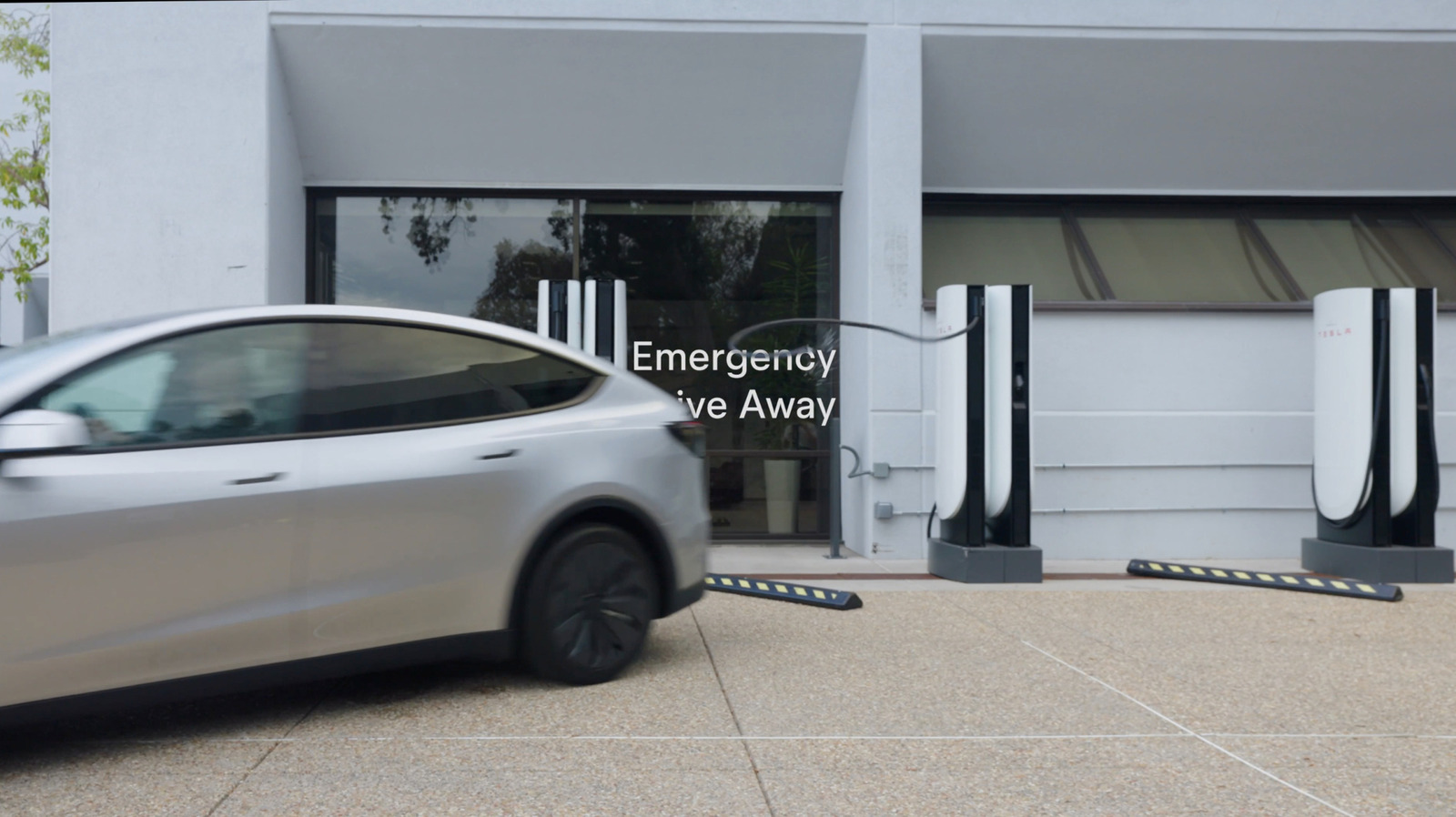
Tesla's Emergency Drive Away lets US owners leave a Supercharger mid-charge, about two months after a shooting at one in Idaho killed four people. Tesla has not said whether drivers pay for the broken handle and damaged car when the emergency is real.
The Product Desk · Product desk
What happened
- A driver who shifts into Drive while plugged in sees a warning that the car and charger will be damaged, then holds the brake and taps Activate to override the lock.
- The feature requires the latest software, works only at US Superchargers and does not support Model S and X vehicles built before 2021.
- Tesla's announcement of the feature on X did not mention the Twin Falls shooting that owners had cited when asking for it.
Compiled by The Product DeskSomething wrong?How this is made
Why it matters
- cost A driver deciding whether to flee must also accept a repair bill whose emergency terms Tesla has not set.
- constraint Owners of pre-2021 Model S and X, and anyone charging outside the US, keep the unlock-first sequence. This over-the-air safety fix covers only the cars and chargers Tesla chooses to support.
- precedent After suing a third-party breakaway adapter maker in 2024, Tesla now offers its own breakaway. That leaves the terms of escaping a Supercharger, penalties included, with the company that runs the charger.
One of the seven people wounded in Twin Falls in August was a Tesla owner charging his car [2][3]. According to Engadget, he was shot inside the Tesla taxi he was charging at an In-N-Out Burger location [4]. Under the design in place that day, a charging Tesla would not shift out of Park until the port was unlocked from the screen, the app or a button on the charger handle [5].
Afterward, owners asked for a quick release [6], and some said they would pay for it so it would not be abused, Engadget reported [7]. Tesla built a lock override that lets the car leave with the handle still attached, so the handle breaks away and falls to the ground, damaging both it and the car [1][9]. Asked what damage a driver could expect, Tesla replied that "electrical and civil cost can be up to $25k" [11]. Engadget reported it is not clear whether Tesla will charge drivers who use the feature in a real emergency [12].
The port could already be unlocked from the screen or the app [5], so changing when it lets go was a software job. Tesla shipped that change about two months after the shooting, and after owners had asked for it [6][1]. Reach is set by Tesla's support list. Pre-2021 Model S and X are left out [13], and the US-only limit applies "for now," The Verge reported [14].
Tesla had taken a position on breakaway hardware before Twin Falls [17]. In 2024 a startup called EVject built an adapter meant to let drivers break away from a Supercharger or other station without getting out of the car [17]. Tesla sued after its own testing found the adapter could overheat, then dropped the case later that year; EVject maintains its product is safe [17]. "Deliberate misuse will invoke additional penalties," Tesla said on X [10]. It did not say what those penalties are [18].
For a team shipping any lock with an emergency override, I'd sort the design on two axes. One is how many actions a frightened person needs to get out. Tesla's count is two: hold the brake, tap Activate [8]. The other is whether the user knows what they will owe before acting, and Tesla's drivers do not [12]. Fast and priced is the quadrant to build for. Fast and unpriced, where Tesla sits, puts a billing question in front of someone deciding whether to leave. A slow override fails the user in either column. I think the emergency terms belong in the same release as the override, with misuse defined in writing. The tradeoff is the one owners named themselves: an override that costs nothing invites abuse, and some offered to pay to prevent it [7].
What to watch
- Whether Tesla defines the 'additional penalties' for misuse and says whether drivers fleeing a genuine emergency are billed for the damage.
- Whether the US-only limit, described as applying 'for now', lifts, and whether pre-2021 Model S and X ever get the override.
- Whether breakaway adapter makers such as EVject keep selling to Tesla drivers now that a built-in override exists.