Science1 publisher3 min readPublished
Anthracene nanofibers carry excitons 350 nm, and a gold nanohole array pushes past 550 nm
A Science Tokyo team reports singlet exciton transport more than an order of magnitude past the 5-20 nm norm for organic semiconductors. The plasmonic bonus depends on how the fibers are laid down.
The Scientist · Science desk
Drafted by a language model from the sources cited here and checked against its claim ledger before publication. How we use AISend a correction
What happened
- Self-assembling, anthracene-based supramolecular nanofibers can enable excitons to migrate hundreds of nanometers, according to an experimental finding by researchers at the Institute of Science Tokyo.
- Excitons in conventional organic semiconductors typically diffuse only 5-20 nm before recombining, limiting the performance of optoelectronic devices.
- Excitons are created when light is absorbed and diffuse through the semiconducting material before they can dissociate into free charge carriers to generate electricity.
- The study was conducted by Professor Martin Vacha and Associate Professor Yoshimitsu Sagara of Science Tokyo with Dr. Takatoshi Fujita of the National Institute for Quantum Science and Technology in Japan, and the findings are published in Nano Letters.
- The nanofibers exhibited transport lengths of up to 350 nm and diffusion coefficients reaching up to 0.7 cm2/s, which rank among the highest reported for organic solids.
Compiled by The ScientistSomething wrong?How this is made
Why it matters
Researchers at the Institute of Science Tokyo report that self-assembling, anthracene-based supramolecular nanofibers move singlet excitons up to 350 nm, with diffusion coefficients reaching 0.7 cm2/s, which they place among the highest reported for organic solids [3][7]. That matters because excitons in conventional organic semiconductors typically travel only 5 to 20 nm before recombining, a ceiling that has capped organic optoelectronic performance for decades [4].
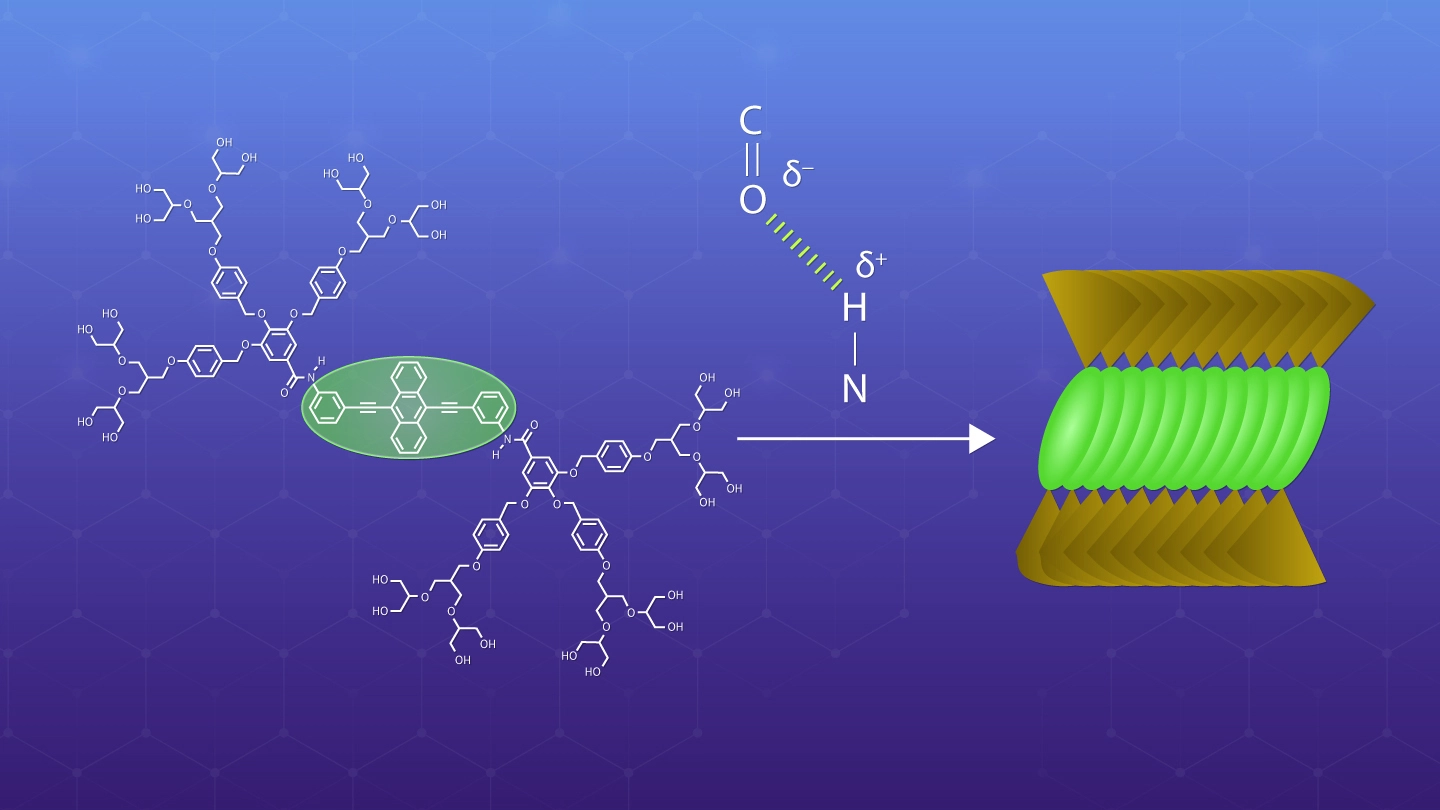
The mechanism is where the work earns attention. Excitons are created when the material absorbs light and must diffuse before they can dissociate into free charge carriers [5]. The team, comprising Professor Martin Vacha and Associate Professor Yoshimitsu Sagara at Science Tokyo with Dr. Takatoshi Fujita at the National Institute for Quantum Science and Technology, built molecules around 9,10-bis(phenylethynyl)anthracene and hung amide groups off the chromophore so that hydrogen bonding would drive assembly into ordered one-dimensional fibers, with hydrophilic dendritic side chains added to keep the material soluble [6][8]. The resulting packing is a J-aggregate, an arrangement already associated with strong electronic coupling and energy transport [9]. Transport was measured by confocal fluorescence microscopy combined with position-dependent fluorescence lifetime measurements, tracking how the emission spot broadened after laser excitation [10]. Quantum-chemical calculations put the exciton delocalized across two to three neighboring units, with substantial mixing between locally excited and charge-transfer states strengthening intermolecular coupling; the rigid hydrogen-bonded frame and low structural disorder do the rest [1][2].
Deposited on substrates patterned with regularly spaced gold nanohole arrays, the same fibers reached diffusion coefficients up to 1.3 cm2/s and transport lengths beyond 550 nm under optimal alignment, which the group describes as more than a twofold improvement over fibers on glass [11]. The word "optimal" is load bearing. Simulations indicate the gain depends strongly on the fiber's orientation relative to the nanohole lattice: fibers running parallel to the periodicity see continuous field enhancement along their length, while misaligned fibers get relatively little [12].
Two numbers deserve care. Taken at face value, 350 nm is 17.5 times the top of the conventional 5-20 nm range and 70 times the bottom, and 550 nm is 27.5 times the top [15][16]. But the best-case figures quoted for glass and for gold differ by 1.86x in diffusion coefficient and 1.57x in transport length, so the "more than twofold" claim rests on a like-for-like comparison the announcement does not spell out [17]. Vacha frames the underlying goal as still open, saying a universal design principle for long-range exciton transport "has remained an elusive goal" requiring deeper understanding of intrinsic molecular factors [13].
What to watch: whether fiber orientation on a patterned substrate can be controlled deterministically rather than sampled, since alignment is now a device parameter [12]. The announcement reports transport measurements and simulations only, with no device-level result attached [14], so the useful next datum is a photovoltaic or photodetector stack where charge extraction, not exciton range, becomes the binding constraint.