InvestNot yet confirmed elsewhere1 publisher2 min readPublished
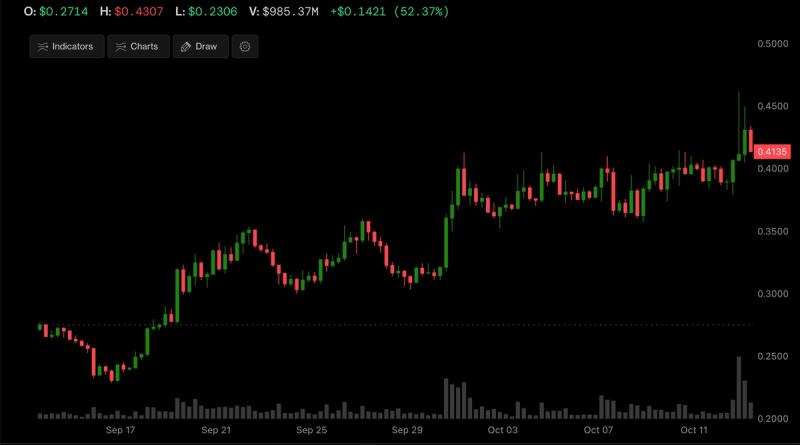
STX gains more than 50% in four weeks ahead of November's Bonding Period 3
STX, the token of Bitcoin layer-2 project Stacks, has risen more than 50% in four weeks and outperformed bitcoin, CoinDesk reported. If the lock is set by value, a higher STX price means fewer tokens locked per bitcoin staked.
The Investor · Invest desk
Three figures. Participants must lock STX worth roughly 5% of their BTC's value. On a hypothetical $1 million of staked bitcoin, that is about $50,000 of STX. If the lock is set by value, a 50% higher STX price cuts the STX tokens required by about one third.
| Figure | Value | Note | Claim |
|---|---|---|---|
| STX to lock, share of BTC value, roughly | 5% | 4 | |
| STX locked per $1 million of staked BTC, about | $50,000 of STX | hypothetical example | 9 |
| STX price rise cutting tokens needed by about a third | 50% higher price | if the lock is set by value | 10 |
What happened
- STX also gained nearly 10% in the past 24 hours and 14% over the past week.
- Stacks lets BTC holders stake and earn yield on the main Bitcoin chain while keeping their private keys, where other routes wrap assets into tokens such as wBTC or use cross-chain bridges.
- Bonding Period 3, due in November, requires participants holding STX to lock STX worth roughly 5% of the value of their BTC to secure stacking capacity.
- Periods 1 and 2 were preparatory phases to transition signers and bootstrap initial liquidity.
Why it matters
- contradiction The same article offers two explanations for the rally: interest in Stacks' design, and liquidity rotating away from the majors, with BDX, REDNER and PYTH each up 6% on the day.
- cost A BTC holder who stakes through Stacks takes price risk on a second asset, the locked STX, which can fall as fast as it has risen.
- decision Anyone wanting exposure to the November rule has to pick an entry before any BTC inflow is visible, at a price that already carries the rally.
The move began before the latest session. A 14% gain in the past week [2] against more than 50% over four weeks [1] implies the three weeks before that returned at least about 32% [8], so the earlier stretch accounts for the larger share of the gain. The rule it is said to anticipate has not started: Period 3 is due in November [4].
The explanation is also CoinDesk's, and it is hedged. The publication wrote that the outperformance likely reflects investor interest in the non-custodial design [12]. The piece does not include volume, funding or positioning data, so the link between that interest and the price is an inference.
Take the lock at face value. At roughly 5% of BTC value [4], a holder staking $1 million of bitcoin would lock about $50,000 of STX [9] (the $1 million is our illustration). CoinDesk argues that as more BTC enters the ecosystem, more STX is locked and removed from the active market [11]. In dollars that holds. In tokens, if the ratio is set by value as CoinDesk describes it, an STX price 50% higher at the same BTC value cuts the tokens required by a third [10]. If the protocol instead fixes the count in tokens, the argument runs the other way.
The lock is also described as falling on participants who already hold STX [4]. In our reading that means the first effect is a smaller float with no new buyer attached, and fresh demand comes only from BTC holders who do not yet own the token.
We think the November rule gives existing holders a reason to keep their STX through the date, and the source supports little beyond that. The counter-case is a large BTC inflow. Even at 5%, a big enough inflow would still require a lot of STX compared with daily STX trading. We would call the thesis wrong if STX gives back most of its gain before the period opens, or if it holds the gain while little BTC arrives.
What to watch
- How much BTC enters Stacks once Period 3 opens in November, set against the STX locked to match it.
- Whether STX keeps its lead over BDX, REDNER and PYTH, each up 6% on the day, or falls back into the same pack.
- Wednesday's U.S. CPI report, which CoinDesk says could move Federal Reserve rate expectations and with them the broader crypto tape.
Clarity's read
What the record supports and how the coverage leans. The claims behind it follow.
Reality
- Evidence30
- Adoption
- Insufficient
- Hype gap+40
- Incentives
- Insufficient
- Confidence40
Claim ledger
Ranked by verification strength, evidence, and original report placement.
- [1]
STX, the native token of the Bitcoin layer-2 project Stacks, has surged more than 50% in four weeks, outperforming bitcoin.
- [2]
STX surged nearly 10% in 24 hours and 14% over the past week.
- [3]
Stacks' framework lets BTC holders stake and earn yield directly on the main Bitcoin blockchain while retaining strict control of their private keys, whereas traditional frameworks require wrapping assets into synthetic tokens like wBTC or moving funds over cross-chain bridges.
- [4]
The 'Bonding Period 3', due in November, requires participants holding native STX to lock a ratio of STX alongside their BTC, equivalent to roughly 5% of the total value of their BTC, to secure protocol stacking capacity.
- [5]
Period 3 follows Periods 1 and 2, which served as preparatory phases to safely transition signers and bootstrap initial liquidity.
- [6]
BDX, REDNER and PYTH gained 6% each over 24 hours, which CoinDesk called a sign of liquidity increasingly pivoting to coins other than the major cryptocurrencies.
- [7]
Analysts are preparing for Wednesday's U.S. Consumer Price Index report, which could heavily influence expectations for upcoming Federal Reserve interest-rate decisions.
- [8]
If STX rose 14% in the last week and more than 50% in four weeks, it rose at least about 32% in the three weeks before that.
- [9]
On a hypothetical $1 million of staked bitcoin, a lock of roughly 5% of BTC value is about $50,000 of STX.
- [10]
If the lock is set by value, a 50% higher STX price at constant BTC value cuts the STX tokens required by about one third.
- [11]
CoinDesk says that as more BTC moves into the Stacks ecosystem, a larger portion of STX is systematically locked up and removed from the active market.
- [12]
CoinDesk wrote that the outperformance likely reflects investor interest in Stacks' non-custodial bitcoin staking architecture.
Sources
1 independent publisher whose own reporting we read for this story.
- coindesk.comStacks' STX, a Bitcoin layer-2 token, has surged by 50% in four weeks
1 article · October 13, 2026
Topics and entities
Follow any of these and your For You feed starts watching them — no settings page required.