Leadership1 publisher3 min readPublished
Slack Code makes the chat window a coding surface, and a platform call for engineering leaders
Slack launched Slack Code on August 20, putting coding agents into project-based channels. The question for engineering leaders is now where agent work lives, not which agent to buy.
The Board Room · Leadership desk
Drafted by a language model from the sources cited here and checked against its claim ledger before publication. How we use AISend a correction
What happened
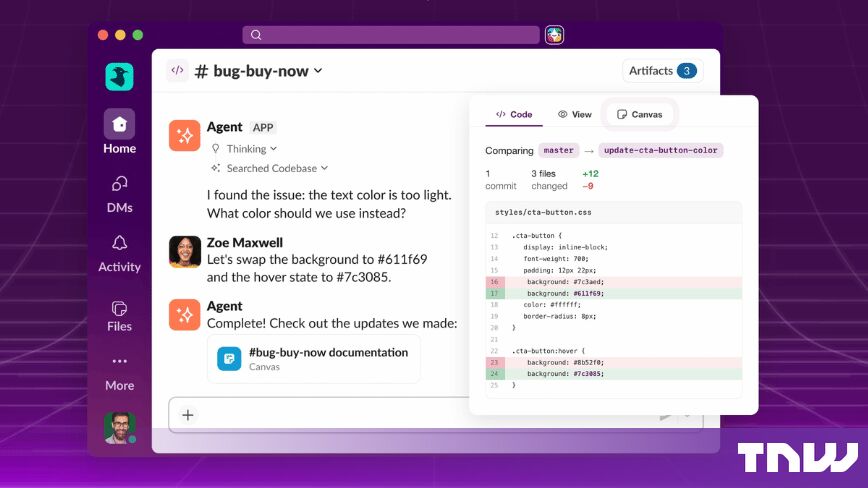
- On August 20, Slack launched Slack Code, an AI coding environment that will enable teams to use coding agents like Claude Code and GitHub Copilot directly in Slack.
- Slack Code launches with dedicated, project-based code channels where teams can manage AI agents and share context in real time; users can tag coding agents to spin up code channels from any conversation.
- According to an Anthropic survey of 500 technical leaders in the U.S., nearly 90% of organizations use AI to assist with coding today.
- Katie Steigman, VP of product at Slack, said Slack is positioning itself as a "neutral platform" for agentic work, designed to be independent of the model or agents chosen by the end user, because people want flexibility to switch models and model providers.
- Users can tag in coding agents like Claude or Cognition's Devin, and the tagged agent will spin up a code channel to perform the assigned task without leaving Slack.
Compiled by The Board RoomSomething wrong?How this is made
Why it matters
Slack launched Slack Code on August 20, an AI coding environment that lets teams run coding agents such as Claude Code and GitHub Copilot inside Slack itself [1]. The product ships with dedicated, project-based code channels for managing agents and sharing context, and any conversation can be turned into a code channel by tagging an agent [2]. That is a small interface change with a large procurement consequence: the tool your company already pays for is now bidding to be the place engineering work happens.
The context is that agent-assisted coding is no longer a pilot. An Anthropic survey of 500 US technical leaders found nearly 90% of organisations already use AI to assist with coding [3]. Slack is not trying to win the model layer. VP of product Katie Steigman describes Slack as a "neutral platform" for agentic work, deliberately independent of which model or agent a customer picks, because people want to switch providers [4]. In practice that means tagging Claude or Cognition's Devin and having the agent open a code channel to do the work without anyone leaving Slack [5]. Steigman says customers including Anthropic, OpenAI and Cognition are "doing most of their coding in Slack", while clarifying that all the initial launch partners were running code channels internally and feeding back [6]. Treat that as early-adopter evidence from AI labs, not a general enterprise benchmark.
The build history is worth noting for anyone estimating how contested this ground is. Steigman says work started roughly three months before launch with two engineers, "a very scrappy, very iterative effort" [7]. Slack also revamped Slackbot in March as a personal AI agent drawing context from messages, files and channels [8], which puts about five months between the two agentic releases [9]. This is a fast-moving land grab against Microsoft Teams for the enterprise communication layer [10], and the coding surface is the wedge.
The switching cost sits with your developers, not with Slack. Shashi Bellamkonda, principal research director at Info-Tech Research Group, told Forbes that Slack Code will require developers to move off their current platform of choice and adopt new workflows, and that persuading them is a hard question requiring a lot of work [11]. He credits the real benefit, which is giving agents access to information without staff hopping between applications, but flags two risks: whether agents get correct and current information, and whether raising the speed and volume of AI output leaves organisations creating more technical debt and more vulnerabilities [12].
Governance is the other open item. Agents acting in unaligned ways is a live concern, mitigated by the ability to stop an agent mid-task plus Slack's existing permissions and admin controls [13]. Before code reaches production, agent packages are held for an expert to sign off in the channel, which is the human-in-the-loop mechanism as designed [14]. Whether a sign-off inside a chat thread carries the same weight as a pull request review is a question each engineering organisation will answer for itself.
What to watch: Slack says code channel APIs will open to the broader developer community so any custom agent can be brought in [15]. That is the moment the decision stops being about Slack's partner list and becomes a genuine platform commitment. Watch also whether the sign-off step holds up under volume, and whether Microsoft answers in Teams. If it does, the choice becomes Slack versus Teams versus the IDE, and reversing it will be expensive.