Layered silver-and-gold nanoparticles give a pilot syphilis test lines 19% to 46% stronger
Penn State-led researchers built a pilot syphilis test that detects lower antibody levels and draws lines 19% to 46% stronger than comparable devices. The team says that could mean earlier interventions and fewer appointments.
The Scientist · Science desk
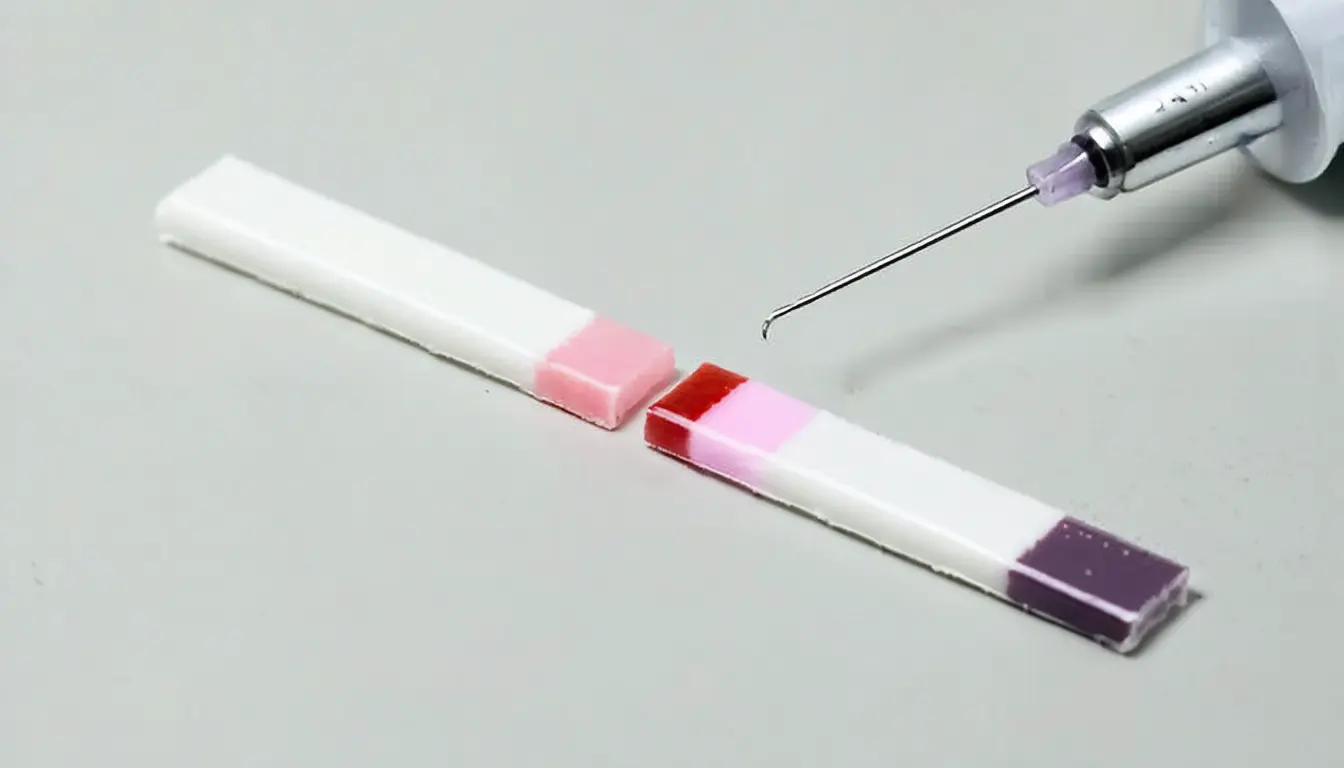
Key figures: gold nanoparticles start clumping or settling instead of flowing at around 60 nanometers, roughly 100 times smaller than a red blood cell. The layered silver-and-gold particle gave test lines at least 19% and up to 46% stronger than comparable devices.
| Figure | Value | Note | Claim |
|---|---|---|---|
| Gold particle size where clumping starts, around | 60 nanometers | 10 | |
| Vs red blood cell, roughly | 100 times smaller | 10 | |
| Stronger test lines vs comparable devices, at least | 19% | up to 46% | 1 |
What happened
- The work appeared in ACS Sensors, with Dipanjan Pan of Penn State as corresponding author.
- The CDC pathway starts with a treponemal test for antibodies to Treponema pallidum, which stay in the body for decades.
- A second, non-treponemal test looks for separate antibodies made in response to cell damage, indicating the stage of infection and whether treatment is needed.
- First author Ketan Dighe said that in a multi-layer particle, electrons combine features across the metal boundaries and produce a much stronger optical signal.
Why it matters
- What's now possible capability Reading low antibody levels could extend a rapid strip to early infection and to follow-up after treatment, when antibody levels are falling.
- Who has to decide decision Because the device follows the CDC's two-test sequence, the adoption question for clinics is how well it performs. The report leaves that open.
- Who's exposed exposure Symptoms come and go, so a missed infection can reach partners and, in pregnancy, babies. A more sensitive point-of-care test is meant to catch infections before they reach partners or babies.
That 19% to 46% range is relative to comparable devices [1]. The Phys.org report does not say how many samples were run or which devices served as comparators. Sensitivity and specificity against reference serology are separate measurements, and a pilot's optical gain does not stand in for them.
In our view the design logic is sturdier than the headline number. Dipanjan Pan explained that the limit was not the ability to detect antibodies but the ability of clinicians to see the gold nanoparticles, which become visible to the naked eye only when enough of them accumulate [9]. The obvious fix is bigger particles. Once they reach about 60 nanometers, still some 100 times smaller than a red blood cell, the particles tend to clump together or settle out instead of moving through the device [10]. So the team changed the particle's composition instead [11].
The target is the low end of the antibody range. "The low-titer range, meaning the range with the lowest concentration of antibodies, is particularly challenging for detecting syphilis," Pan said [3]. If visibility is the limit in that range, a stronger optical signal addresses it. The condition is that the gain holds on patient samples at those concentrations.
The team also kept to the CDC sequence. Running both tests lessens the chance of false-negative and false-positive results, according to the CDC [7]. "Instead, we are trying to reproduce the same sequence of diagnostic information in a much faster and potentially point-of-care format," Pan said [8].
What to watch
- Sensitivity and specificity results for the layered-particle test on patient samples, measured against the CDC's two-test sequence.
- Head-to-head numbers against named commercial rapid tests, with sample counts, so the 19% to 46% range can be put in context.
- Any report on manufacturing cost and shelf life of the silver-layered, gold-sealed particles.
Clarity's read
What the record supports and how the coverage leans. The claims behind it follow.
Reality
- Evidence50
- Adoption
- Not scored
- Hype gap+15
- Incentives
- Not scored
- Confidence55
Claim ledger
Ranked by verification strength, evidence, and original report placement.
- [1]
The pilot device swapped the typical gold nanoparticle for one layered in silver and sealed in more gold, producing test lines 19% to 46% stronger than those of comparable devices while reliably detecting lower concentrations of antibodies.
- [2]
The study describing the pilot test was published in ACS Sensors, and its corresponding author is Dipanjan Pan of Penn State.
- [3]
"The low-titer range, meaning the range with the lowest concentration of antibodies, is particularly challenging for detecting syphilis," Pan said.
- [4]
Pan said the low-titer range is clinically important because it occurs during early infection, later stages of syphilis, or after treatment, when antibody levels are declining, to make sure treatment worked.
- [5]
In the CDC's diagnostic pathway, the first, treponemal blood test detects antibodies against the syphilis bacterium Treponema pallidum, and those antibodies stay in the body for decades.
- [6]
The second, non-treponemal test looks for separate antibodies created in response to cellular damage, indicating the stage of infection and whether a person needs treatment.
- [7]
Running both tests lessens the chance of false-negative or false-positive results and gives doctors a better sense of whether the disease occurred in the past, is active or has been properly treated.
- [8]
"Instead, we are trying to reproduce the same sequence of diagnostic information in a much faster and potentially point-of-care format," Pan said, after saying the team is not asking clinicians to abandon the established diagnostic pathway.
- [9]
Pan explained that the limitation to that point was not the ability to detect the antibodies but the ability of clinicians to see the gold nanoparticles, which become visible to the naked eye only when enough of them accumulate.
- [10]
Making gold nanoparticles bigger makes them brighter, but around 60 nanometers, roughly 100 times smaller than a red blood cell, they start clumping or settling instead of flowing through the device.
- [11]
The team instead altered the nanoparticle's composition.
- [12]
When a particle has multiple metallic layers, electrons that would normally interact only within their own layer start to combine features across the metallic boundaries, creating a much stronger optical signal.
- [13]
Syphilis symptoms mimic many other diseases and can come and go without treatment while the infection keeps causing harm; if undetected, it can spread to partners and to babies during pregnancy, causing lifelong effects.
Get this ledger inside ChatGPT. Ask about any of our stories and the answer brings its figure, each claim’s verdict and the sources. Free, no account.
Sources
1 independent publisher whose own reporting we read for this story.
- phys.orgOne-step rapid syphilis test uses layered nanoparticles to detect infection earlier
1 article · October 16, 2026
Topics and entities
Follow any of these and your For You feed starts watching them — no settings page required.
Entities
- Penn StateFollow
- US Centers for Disease ControlFollow
- Dipanjan PanFollow
- ACS SensorsFollow
- Boca BiolisticsFollow