Leadership1 publisher2 min readPublished
Senate Republicans rewrite the CLARITY Act to move seven Democrats before Tuesday's vote
Senate Republicans rewrote the CLARITY Act on Sunday night and put their concessions into the text. Two of them add supervision over exchanges and stablecoin issuers, and one is relief for developers.
The Board Room · Leadership desk
What happened
- Senate Republicans released an updated draft of the CLARITY Act on Sunday night, with changes to the ethics and other provisions aimed at winning Democratic votes ahead of a Tuesday Senate vote.
- Blockchain developers would be able to avoid money transmission requirements under the revised language, which the reporting describes as making the United States a safe harbor for that activity.
- A "circuit breaker" in the draft would give Treasury Secretary Scott Bessent authority to restrict stablecoin rewards if stablecoin popularity triggers large deposit flight.
Compiled by The Board RoomSomething wrong?How this is made
Why it matters
- decision Four named provisions now exist in writing, so a compliance team can model specific text this quarter.
- exposure Stablecoin reward programs would sit inside the Treasury Secretary's discretion, making a revenue line contingent on one official's reading of deposit flows.
- cost Listing decisions at exchanges would become answerable to state attorneys general as well as federal regulators, and the venue carries that defence cost.
- precedent Lummis has called this the final version. These concessions become the floor for any future negotiation.
The four changes in Sunday night's text cut in different directions. News.bitcoin.com reports that blockchain developers would be able to avoid money transmission requirements, establishing the United States as a safe harbor for that activity [5]. Two other changes run the other way. State attorneys general would be able to enforce prohibitions on issuing digital assets and to take action against exchanges that list assets banned under the regulation [3]. A "circuit breaker" would give Treasury Secretary Scott Bessent the authority to restrict stablecoin rewards in the event of large deposit flight as stablecoins gain popularity [6]. The fourth falls on officeholders: covered individuals would have to divest crypto-linked financial interests or place them in a blind trust, which the report calls a significant advance over the previous language [4].
For an exchange, two of those provisions pull against each other in the same operation. The federal rulebook on listings gets written down, and the number of officials who can bring an action over a listing rises by however many state attorneys general choose to bring one [3]. The work falls on listing committees and record keeping, and it only bites if the bill becomes law.
Polymarket lifted the chance of CLARITY passing this year to 30 percent after the concessions, having priced the bill as dead beforehand [9]. The same quote puts about a 70 percent chance on the bill not passing this year [13].
Senator Cynthia Lummis said this was the final version, ready after President Trump agreed to "unprecedented ethics restrictions, holding every federally elected official, judge, and their spouses to some of the toughest ethics restrictions in U.S. history" [7]. Her closing line was a whip count delivered in public. "A no vote on Tuesday means opposing real ethics reforms on politicians' personal investments, handing American leadership in digital assets to our foreign competitors, and leaving Americans with zero protections in the digital asset markets," she said [8].
No Democrat has publicly taken the deal. The bill needs at least seven of them, and news.bitcoin.com reports it is still unclear whether the final draft will get there [10]. Senate Minority Leader Chuck Schumer convened a caucus on Sunday evening to discuss the party's position on the bill [11]. The floor vote is Tuesday [12].
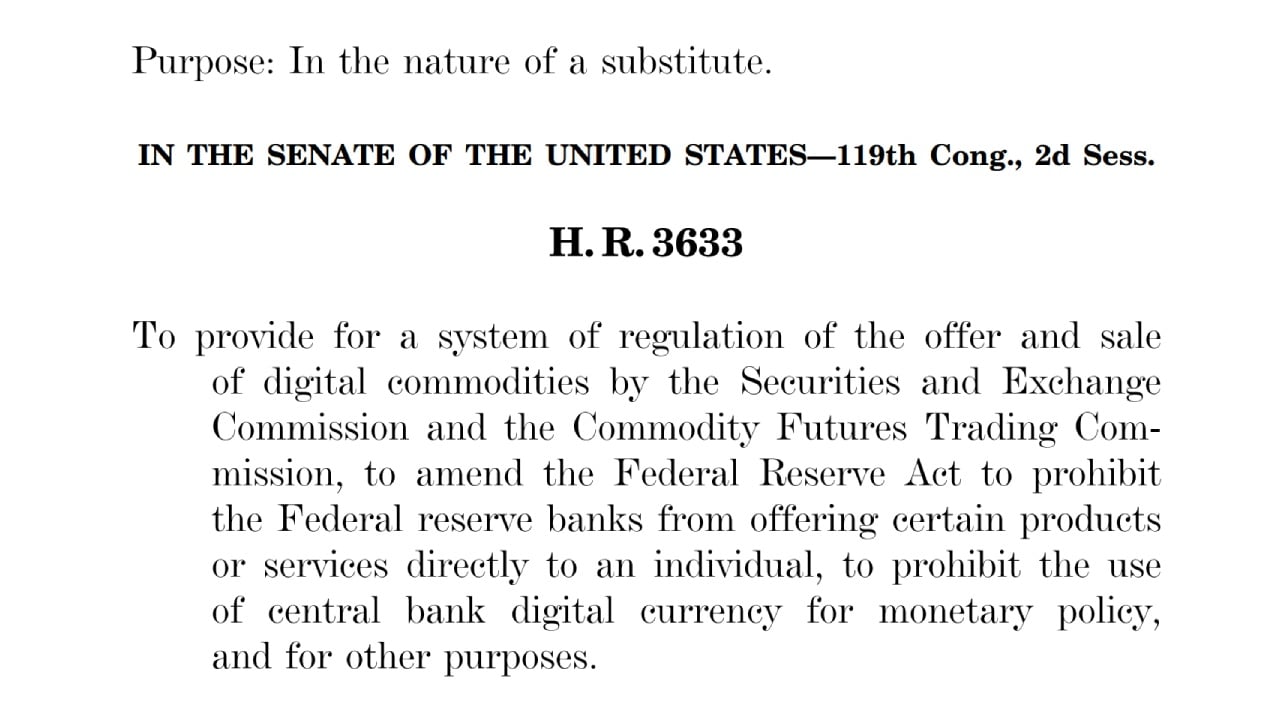
The 635-page draft [2] is now the public baseline for whatever follows. Concessions written into a bill text are quoted back in the next round, and in this case one of them has already been agreed to by the President, according to Lummis [7].
What to watch
- Whether any Senate Democrat publicly backs the revised draft before the floor vote, given that no account of Sunday's caucus was reported.
- Whether the developer exemption from money transmission requirements survives in any successor text if Tuesday's vote fails.
- Whether Treasury sets out what level of deposit flight would trigger the stablecoin rewards circuit breaker.