Science1 publisher3 min readPublished
Waves that bounced off Earth's core nudged Japan 5 mm east, and hazard models omit them
A study led by the University of Chicago's Sunyoung Park attributes the shift to core-reflected ScS waves arriving 13 minutes after the 2011 Tohoku-Oki mainshock. The motion is small; the mechanism is new.
The Scientist · Science desk
Drafted by a language model from the sources cited here and checked against its claim ledger before publication. How we use AISend a correction
What happened
- A previously unrecognized source of seismic hazard caused parts of Japan to move eastwards by up to 5 mm within minutes of the 2011 Tohoku-Oki earthquake.
- A new study finds that in the Tohoku-Oki quake the culprit was seismic waves that travelled down to Earth's core and back, a phenomenon more usually associated with imaging structures deep inside the Earth.
- Conventionally, such shifts occur when seismic waves generated by rupturing tectonic plates cause the plates to slip, triggering movements of the land mass and the ocean floor.
- The study was led by Sunyoung Park at the University of Chicago, working with Hiroo Kanamori at the California Institute of Technology and Luis Rivera at the University of Strasbourg.
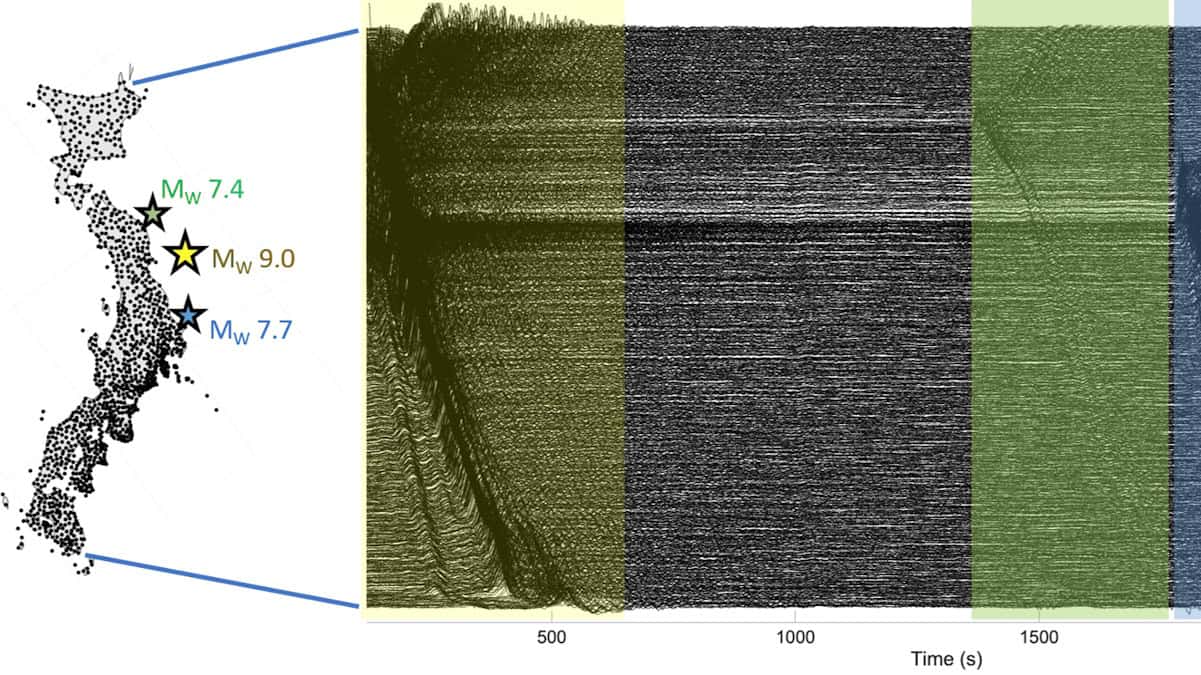
- The team studied shear waves recorded after the earthquake in Japan's dense network of high-rate Global Navigation Satellite System instruments.
Compiled by The ScientistSomething wrong?How this is made
Why it matters
Parts of Japan moved as much as 5 mm eastward within minutes of the 2011 Tohoku-Oki earthquake, and a new study attributes that shift not to the rupture directly but to shear waves that travelled down to Earth's core, reflected, and came back to the surface [1][2]. That matters because the conventional account of such motion is local: waves from the rupturing plate boundary cause the plates to slip, which moves the land and the sea floor [3]. A delayed arrival from 2,900 km down is not in that account.
The work was led by Sunyoung Park at the University of Chicago with Hiroo Kanamori at Caltech and Luis Rivera at the University of Strasbourg [4]. They looked at shear waves in Japan's dense network of high-rate GNSS receivers and found, alongside the expected phases, ScS waves that had travelled thousands of kilometres, bounced off the core, and arrived across Japan almost simultaneously 13 minutes after the main shock [5][6]. "The name ScS reflects that path: S[hear] through the mantle, c for reflection at the core-mantle boundary, and then S again on the return path," Park says [7]. Because the observed displacement appeared within minutes and the ScS arrival is 13 minutes after the mainshock, the motion in question sits after the rupture's direct waves rather than inside the usual coseismic offset [19].
The elimination step is the part worth reading closely. The team calculated displacements at every instrumented location for many possible rupture configurations to see whether Earth's elastic response to the main shock alone could produce the 5 mm; it could not reproduce the observed eastward motion [16]. They then simulated slip scenarios across the plate interfaces to bound the size and extent of the slip that would [17]. The claim the paper stakes out is a first: that ScS waves can trigger displacement-causing slip, which means hazard researchers may need to include them to capture the full consequences of a rupture at the surface and deep in the plates [9][10].
ScS is not an exotic phase. Seismologists have studied it heavily, but as an imaging tool, to constrain the depth and properties of the core-mantle boundary, lowermost mantle structure, mantle attenuation and anisotropy, and the source characteristics of large earthquakes [8]. The new reading is that it also does work on the way back.
Two things made Tohoku-Oki legible. The rupture was enormous, at magnitude 9 one of the largest ever recorded, on a shallow dipping fault offshore about 130 km east of Sendai, a geometry that sent strong shear energy nearly vertically down toward the core [11][14]. And the instrumentation was unusually thick: "Because Japan is so densely instrumented, we can look for small, coherent signals that would likely be invisible elsewhere," Park says [15].
Keep the amplitude in proportion. This is a 5 mm signal recovered from one earthquake in the best-instrumented subduction zone on the planet, and the significance is mechanistic rather than a revision of expected ground motion [1][9][18]. Tohoku-Oki already forced seismologists to revise their models of maximum magnitude and recurrence at plate boundaries because it exceeded most estimates, and its instrumented records keep yielding new process information [13]. The consequences were not academic: the tsunami drove meltdowns in three of the six reactors at Fukushima Daiichi, releasing radioactive caesium to air and water and prompting a large-scale evacuation with long-term health effects [12].
What to watch: whether the same signal turns up in other great subduction events recorded by dense GNSS arrays, and whether anyone can show ScS-triggered slip at an amplitude that changes a displacement or ground-motion forecast rather than only the physics behind it.