Science1 publisher2 min readPublished
A classical computer confirmed Duke's 13-ion simulation of string-breaking
String-breaking, the moment a stretched bond between two building blocks of matter snaps and new particles appear, has now been observed on a trapped-ion quantum simulator at Duke. Two other groups saw it on different hardware.
The Scientist · Science desk
What happened
- A team led by faculty at the Duke Quantum Center observed string-breaking dynamics related to particle-antiparticle formation on a quantum simulator, among the first such observations in the field.
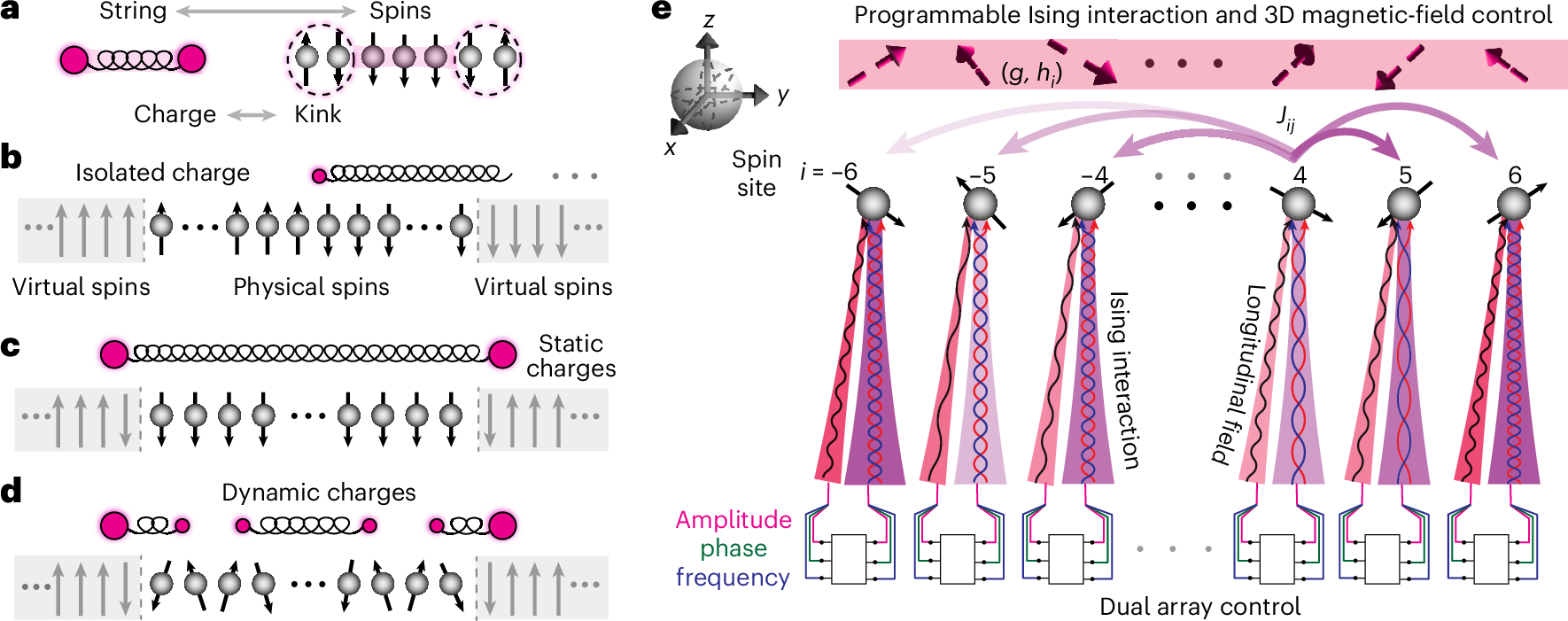
- The group encoded a string-breaking model into a chain of 13 trapped ions, tuning the interactions with laser beams so the system's energy mimicked a string stretching and then breaking.
- Starting from an out-of-equilibrium state, the researchers tracked the chain's evolution over time, watched effective charges emerge and reconstructed the string dynamics from them.
- The work is published in Nature Physics, and the authors present it as evidence that trapped-ion machines can probe fundamental questions about the universe.
- Teams led by Google and QuEra Computing recreated the string-breaking process in other models, on superconducting circuits and neutral atoms.
Compiled by The ScientistSomething wrong?How this is made
Why it matters
- constraint While the answers remain checkable on conventional hardware, the case for buying time on a simulator rests on a promise about larger system sizes.
- capability A confinement process that otherwise needs collider energies or early-universe conditions can be posed as a programmable bench experiment with tunable interactions, at small size and with repeatable settings.
- precedent Three platforms now share a problem, so replication across hardware becomes the bar a new simulator claim in this area is expected to clear.
Duke's group ran the same model classically and confirmed that the ion chain's answers were accurate [7]. That check is what makes the measurement believable. It also bounds it. The advantage sits in the future tense in the team's own account: as the problem size grows, only quantum computers, not classical computers, will be able to solve these problems [8]. The trapped-ion work is described as a step toward simulations complex enough to exceed the largest supercomputers [22].
Quarks exist only bound inside particles such as protons and neutrons, they are about a billion times smaller than an atom, and they cannot currently be observed directly [10]. Force a bound pair apart and the energy stored in the connection can convert into new charged particles, through the relation between mass and energy. The string snaps and leaves two or more pairs where there was one [11]. That takes so much energy that it happens only in extreme environments such as the Large Hadron Collider or the aftermath of the Big Bang [12]. The ions are a stand-in, and what the group reports is analogous string-breaking dynamics on a trapped-ion platform [4].
"Quantum computer simulations provide the best platform to investigate complex questions like matter formation, short of having witnessed the Big Bang itself," said Christopher Monroe, the Duke professor who led the research [14]. Arinjoy De is the paper's first author and now production machine lead at QuEra Computing. He said the work is "opening up new pathways for experimental investigations into the behavior of matter at its most fundamental level" [16]. The collaboration includes the University of Maryland, Oxford, Caltech, Cornell and KU Leuven [13].
The Duke result joins two published findings from other teams that simulated the same phenomenon on different platforms [18], so three groups have now reported string-breaking dynamics on three kinds of hardware [19]. Monroe described that cluster in the language of hardware comparison. "These are the three platforms leading the charge in quantum computing, so it's a nice benchmark and comparison for the quantum community," he said [17].
In my view what has been shown is this much. A confinement model can be encoded, run and checked on trapped ions, and something similar can be done on superconducting circuits and neutral atoms [9]. The experiment does not test whether the accuracy holds at the sizes where the classical check is unavailable. That is the only regime where a simulator would be answering a question high-energy physics cannot answer another way [8].
What to watch
- A run at a size where no classical simulation is available, and what the team uses to verify the answer instead.
- A high-energy physics group using one of these three platforms on a question whose answer is not already known.
- A direct comparison paper putting trapped ions, superconducting circuits and neutral atoms on a matched model, with error rates and run times.