Science1 publisherNot yet confirmed elsewhere3 min readPublished
Models of Scotland's Seagreen wind farm show turbine foundations cooling summer seas by 0.1 to 0.3 degrees Celsius
Modelling of Scotland's Seagreen wind farm in Scientific Reports finds turbine foundations cool summer sea surfaces by about 0.1 to 0.3 degrees Celsius. How big that effect gets depends on season, tide and water layering, so the study recommends timing monitoring for strongly stratified periods.
The Scientist · Science desk
What happened
- Transitional zones between mixed and stratified waters were among the areas most sensitive to the added mixing.
- The turbine effects can be similar in size to natural ocean variation, which may explain why earlier studies struggled to detect them.
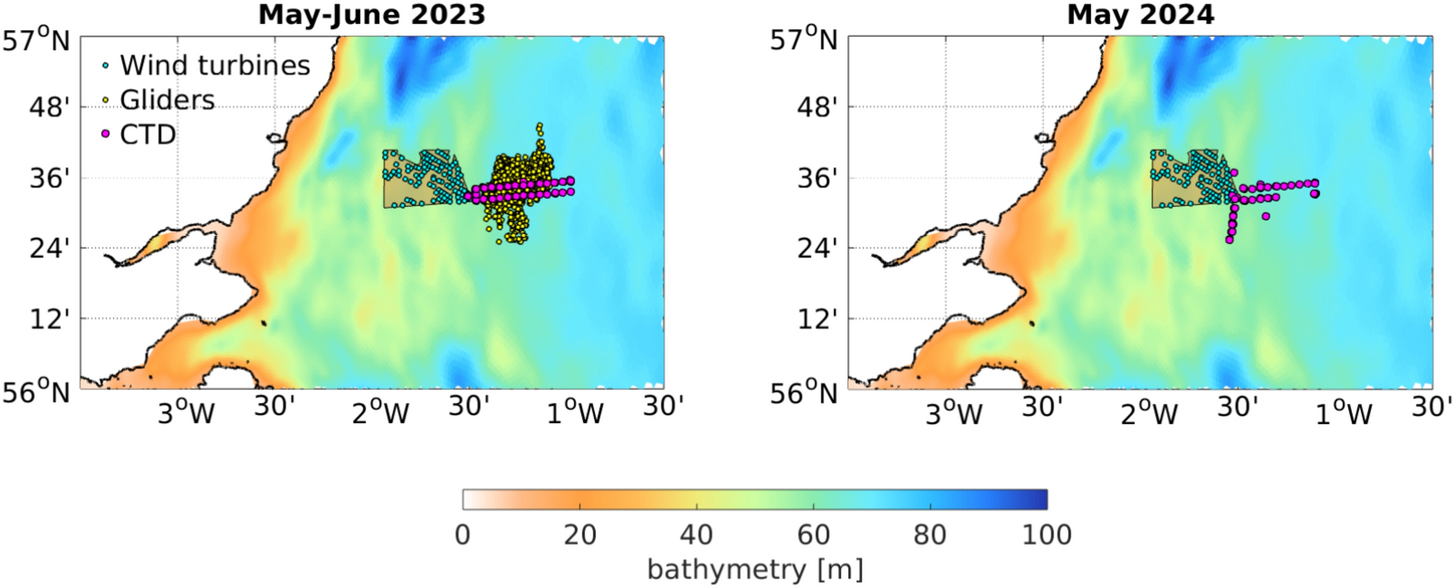
- Researchers from NOC, the University of Aberdeen and the Scottish Government Marine Directorate checked the models against instrument and glider data.
Compiled by The ScientistSomething wrong?How this is made
Why it matters
- constraint Because the turbine signal is about as large as natural variability, surveys timed outside strongly stratified periods are less likely to separate a farm's effect from background noise.
- decision Regulators and developers cannot carry one cooling figure from site to site; a farm planned for a mixed-to-stratified transition zone needs its own estimate of added mixing.
- precedent With validated physical estimates now feeding habitat-scale cumulative models, later environmental assessments in deeper, stratified waters are likely to be checked against this Seagreen baseline.
The cooling figures in this study come out of a model. The 0.1 to 0.3 degree drop in summer surface temperature and the heat-wave figure are both reported as simulation results [8][10]. Field measurements at Seagreen, from oceanographic instruments and autonomous gliders, were used to assess and support those modelled findings [4].
That design suits a faint signal. According to the phys.org account, turbine effects can be about as large as natural variation in the ocean, and that may explain why earlier studies sometimes struggled to find clear changes caused by wind farms [3]. Observations alone would have trouble telling the two apart. So the team used the models to pick out when and where impacts were most likely, then tested them against what the instruments recorded [4].
The physical process is vertical stirring. The foundations add to the sea's natural mixing, carrying cooler water up toward the surface and warmer water down toward the seabed [9]. How much that changes the surface depends on the season, the tides and how layered the water column is [1]. Transitional zones between mixed and stratified waters are among the most sensitive [2]. In the modelled 2023 marine heat wave, cooling passed 0.5 degrees in some locations [10]. That is at least 1.7 times the top of the ordinary summer range [13].
The paper's title puts detectability first [11]. Michela De Dominicis of NOC, the lead author, said: "Offshore wind farm structures can increase mixing in the ocean, but this does not always lead to changes that we can easily detect. Environmental conditions determine when and where these effects are strongest." [5]
The practical result is a rule for monitoring. Observations targeted at strongly stratified periods are more likely to pick up changes caused by turbine structures [6]. De Dominicis said the combined approach "could contribute evidence to future offshore wind site planning, as well as help to inform the design and environmental monitoring." [14]
I think the evidence supports assessing each site against its own oceanography. The size of the effect moves with local season, tide and stratification [1], so a cooling figure carried from one farm to the next would misstate the change. That view comes with conditions. It rests on one farm, Scotland's largest [12], in what Beth Scott of the University of Aberdeen, principal investigator of PELAgIO, called "deeper, stratified waters" [15][7]. The report does not say how far beyond the turbine array the cooling extends.
The thing this doesn't tell you is whether a few tenths of a degree matters to anything living there. Scott said the validated modelling "is already allowing wider-scale modeling of cumulative effects of these seasonal changes on the habitats of a variety of marine animals along with comparisons of climate change effects." [15]
What to watch
- Results from the cumulative habitat modelling Beth Scott says is under way, which would show whether a few tenths of a degree matters to marine animals.
- Whether observations gathered during a strongly stratified period at Seagreen or another farm detect the modelled cooling directly.
- Whether consenting bodies write season- and stratification-specific monitoring into conditions for new offshore farms.
Clarity's read
What the record supports and how the coverage leans. The claims behind it follow.
Reality
- Evidence55
- Adoption
- Insufficient
- Hype gap+10
- Incentives
- Insufficient
- Confidence50
Claim ledger
Ranked by verification strength, evidence, and original report placement.
- [1]
The type and level of impact depend on factors such as the season, tidal conditions and how layered the water column is.
- [2]
Some areas are much more sensitive to additional mixing than others, particularly transitional zones between mixed and stratified waters.
- [3]
In many cases the effects of offshore wind farms can be similar in size to natural variations in the ocean, making them difficult to detect; this may help explain why previous studies sometimes struggled to identify clear changes.
- [4]
The team, including researchers from NOC, the University of Aberdeen and the Scottish Government Marine Directorate, combined field measurements with numerical models; the models identified when and where impacts were most likely, while observations from oceanographic instruments and autonomous gliders were used to assess and support the modelled findings.
- [5]
"Offshore wind farm structures can increase mixing in the ocean, but this does not always lead to changes that we can easily detect. Environmental conditions determine when and where these effects are strongest."
ReportedSupportedSource: Michela De Dominicis, senior research scientist at NOC and lead author2 sources— create a free account to open themView cited source - [6]
The results suggest that carefully targeted observations, particularly during strongly stratified periods, are more likely to capture changes caused by turbine structures.
- [7]
The research was carried out within the PELAgIO ECOWind project; Beth Scott of the University of Aberdeen is principal investigator of PELAgIO.
- [8]
In the model simulations, turbine-related mixing was associated with reductions in summer sea surface temperatures of around 0.1C to 0.3C within and around the Seagreen wind farm.
- [9]
The modelling results suggest the underwater turbine structures can enhance the natural mixing of seawater, bringing cooler water toward the surface and warmer water toward the seabed.
- [10]
During the modelled 2023 marine heat wave conditions, cooling exceeded 0.5C in some locations.
- [11]
The paper, led by NOC's Michela De Dominicis and published in Scientific Reports, is titled 'Environmental controls on the detectability of hydrodynamic changes induced by offshore wind farm structures'.
- [12]
Seagreen Offshore Wind Farm is Scotland's largest offshore wind farm.
- [13]
Cooling of more than 0.5C in the modelled heat wave is at least about 1.7 times the 0.3C upper end of the ordinary modelled summer cooling range.
- [14]
"This could contribute evidence to future offshore wind site planning, as well as help to inform the design and environmental monitoring."
- [15]
"The validated modeling has allowed the most accurate and evidence-based estimates to date of the physical effects of OWF in deeper, stratified waters and is already allowing wider-scale modeling of cumulative effects of these seasonal changes on the habitats of a variety of marine animals along with comparisons of climate change effects."
ReportedInsufficientSource: Professor Beth Scott, University of Aberdeen, principal investigator of PELAgIOView cited source
Sources
1 independent publisher whose own reporting we read for this story.
- phys.orgOffshore wind turbine foundations may cool ocean surface by mixing seawater
1 article · October 7, 2026
Topics and entities
Follow any of these and your For You feed starts watching them — no settings page required.
Entities
- Seagreen Offshore Wind FarmFollow
- National Oceanography CentreFollow
- University of AberdeenFollow
- Scottish Government Marine DirectorateFollow
- Michela De DominicisFollow
- Beth ScottFollow
- PELAgIOFollow
- Scientific ReportsFollow