Satellite rainfall data challenge the idea that El Niño means more landslides
A 2021 Nature Communications study found El Niño years cut landslide exposure in Colombia, the Philippines and Indonesia. Australia's Bureau of Meteorology calls the current event near-record. A blog post on Eos cautions that this year's rainfall response may differ.
The Scientist · Science desk
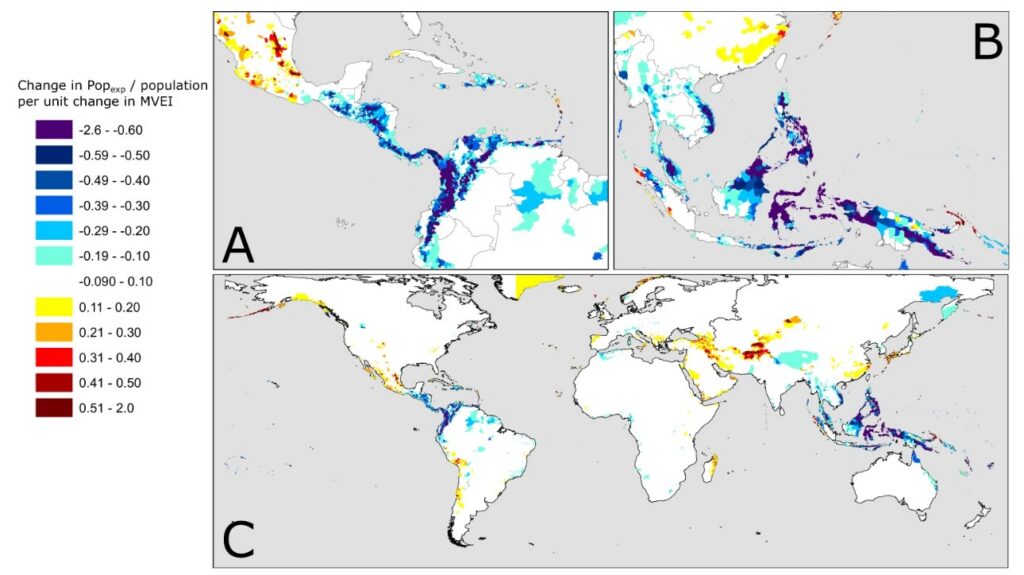
Colombia, the Philippines and Indonesia: landslide exposure falls substantially in El Niño years. Mexico, Central Asia, parts of South America: it rises. California: no effect seen. The study says La Niña drives increased impacts globally. The 2026-27 event is not typical and may differ.
- exposure Colombia, Philippines, Indonesia Landslide exposure decreases substantially in El Niño years, per the Emberson et al. map, claim 3
- exposure Mexico and Central Asia Landslide exposure increases in El Niño years, as it does in parts of South America, claim 4
- contradiction California No El Niño effect on landslide exposure seen, despite a common perception of a large impact, claim 5
- contradiction Landslide impacts globally Emberson et al. conclude La Niña, not El Niño, drives increased landslide impacts, claim 6
- constraint 2026-27 El Niño Not typical, so the rainfall response may look rather different from previous events, the blog's author says, claim 12
| Who | How | Kind | Claim |
|---|---|---|---|
| Colombia, Philippines, Indonesia | Landslide exposure decreases substantially in El Niño years, per the Emberson et al. map | exposure | 3 |
| Mexico and Central Asia | Landslide exposure increases in El Niño years, as it does in parts of South America | exposure | 4 |
| California | No El Niño effect on landslide exposure seen, despite a common perception of a large impact | contradiction | 5 |
| Landslide impacts globally | Emberson et al. conclude La Niña, not El Niño, drives increased landslide impacts | contradiction | 6 |
| 2026-27 El Niño | Not typical, so the rainfall response may look rather different from previous events, the blog's author says | constraint | 12 |
What happened
- The same map shows exposure rising in El Niño years in Mexico, parts of South America and Central Asia.
- The study's authors conclude that La Niña, the opposite phase, drives increased landslide impacts globally.
- The Bureau said both oceanic and atmospheric indices fit a strong El Niño and forecast further intensification through the rest of spring.
Why it matters
- contradiction California is widely thought to suffer landslides in El Niño years, yet the study's map shows no effect there, so the popular belief and the satellite-rainfall result disagree.
- constraint The blog's author says it is unclear how landslide patterns differ between Warm Pool and Cold Tongue events, so the map cannot yet be matched to this year's type.
- decision A landslide-risk plan that treats El Niño as a uniform multiplier conflicts with the study, which finds exposure falling in some countries and rising in others.
Emberson, Kirschbaum and Stanley paired NASA's IMERG satellite rainfall data with a global landslide exposure model [2]. Their map shows where El Niño conditions change the number of people exposed to landslide hazard, a modelled exposure measure [8]. The blog's summary calls the decreases in Colombia, the Philippines and Indonesia substantial but does not put a figure on them [3].
The blog's opening line says the 2026-27 El Niño has reached record levels [11]. The Bureau text it quotes says near-record [9], and we use the Bureau's wording. El Niño generally peaks in December, so the event is still building [1][10].
Three caveats limit how far the 2021 map travels. The blog's author says the developing event is not typical, so the rainfall response may look rather different from earlier events [12]. The 2021 dataset leaves out the very intense 1997-98 El Niño, which may have been a more useful proxy [13]. And El Niño comes in "Warm Pool" and "Cold Tongue" types. The author believes the current event may be Cold Tongue, writing it with a question mark, and says it is not clear how landslide patterns differ between the two [14].
The map cannot tell us whether its signs hold for an event this size. A study built on past events can show where rainfall shifted in those events. It cannot show what a stronger or differently structured event does to the same slopes.
In our view the 2021 map is a reasonable starting assumption for regional planning and a weak forecast for this particular event. We would hold that view until this season's satellite rainfall is compared with the paper's pattern. The blog's author lands in a similar place: many myths are not supported by the empirical data, but with an event on this scale, the author wrote, "we are venturing somewhat into the unknown" [7].
What to watch
- This season's satellite rainfall over Colombia, the Philippines and Indonesia, compared against the pattern in the 2021 paper.
- Whether the current event is classified as Warm Pool or Cold Tongue, and any analysis of how landslide patterns differ between the two.
- The December peak, and whether the Bureau's forecast of further intensification through spring is borne out.
Clarity's read
What the record supports and how the coverage leans. The claims behind it follow.
Reality
- Evidence55
- Adoption
- Insufficient
- Hype gap+10
- Incentives
- Insufficient
- Confidence50
Claim ledger
Ranked by verification strength, evidence, and original report placement.
- [1]
El Niño generally peaks in December, so the 2026-27 event may intensify further.
- [2]
Emberson et al. (2021), in Nature Communications, used the NASA IMERG satellite rainfall dataset together with a global landslide exposure model to constrain the areas where El Niño has the greatest impact on landslides.
- [3]
According to the Emberson et al. map, exposure to landslides decreases substantially in El Niño years in Colombia, the Philippines and Indonesia.
- [4]
Areas that see an increase in landslide exposure in El Niño years include Mexico, parts of South America and Central Asia.
- [5]
No El Niño effect on landslide exposure is seen in California, a state where there is a common perception that El Niño has a large impact on landslides.
- [6]
Emberson et al. (2021) conclude that it is not El Niño that drives increased landslide impacts globally, but La Niña, the opposite set of conditions.
- [7]
The blog's author writes that there are many myths about El Niño and landslides that are not supported by the empirical data, but that with an event on this scale, 'we are venturing somewhat into the unknown'.
- [8]
The map from Emberson et al. (2021) shows the areas with the greatest change in population exposure to landslide hazards as a result of El Niño conditions.
- [9]
The Australian Bureau of Meteorology's update on the 2026-27 El Niño stated that El Niño is at near-record levels.
- [10]
The Bureau said both oceanic and atmospheric indices reflect values consistent with a strong El Niño, with further intensification forecast during the rest of spring.
- [11]
The blog's opening line states that the 2026-27 El Niño has reached record levels.
- [12]
The developing 2026-27 El Niño event is not typical, so the rainfall response may look rather different from that of previous events.
- [13]
The dataset used by Emberson et al. (2021) does not capture the very intense 1997-98 El Niño event, which may have been a more useful proxy.
- [14]
There are different types of El Niño event, called Warm Pool and Cold Tongue. The blog's author believes the current El Niño may be a Cold Tongue event, marked with a question mark, and says it is not clear what the differences in landslide patterns between the two types are.
Get this ledger inside ChatGPT. Ask about any of our stories and the answer brings its figure, each claim’s verdict and the sources. Free, no account.
Sources
1 independent publisher whose own reporting we read for this story.
- eos.orgLandslides in an El Niño year
1 article · October 15, 2026
Topics and entities
Follow any of these and your For You feed starts watching them — no settings page required.
Entities
- Australian Bureau of MeteorologyFollow
- NASA IMERGFollow
- Nature CommunicationsFollow
- EosFollow