Smoke from Amazon fires pushed Manaus PM2.5 above 135 micrograms on October 12
NASA scientists say a drought tied to El Niño has primed the central and eastern Amazon for a long, severe fire season. On October 12, Manaus officials reported PM2.5 above 135 micrograms per cubic meter, the second-worst rating on a regional index.
The Scientist · Science desk
Aug 2026: Manaus gets about 5 percent of normal rainfall. Sep 2026: satellites detect a sharp rise in Amazon fire activity. Oct 12, 2026: Manaus PM2.5 above 135 micrograms per cubic meter. Dec 2026 or Jan 2027: Morton expects Manaus fires to burn until the rains.
| Date | Event | Claim |
|---|---|---|
| August 2026 | Manaus gets about 5 percent of normal rainfall | 20 |
| September 2026 | Satellites detect sharp rise in Amazon fire activity | 2 |
| October 12, 2026 | Manaus officials: PM2.5 above 135 micrograms per cubic meter | 4 |
| December 2026 | Morton: Manaus fires burn until rains come, or January 2027 | 14 |
What happened
- Increases in fire activity and smoke emissions showed up in NASA's fire-monitoring platforms from September, in a belt running from forests near Manaus and Santarém to the mouth of the Amazon River.
- Brazil's National Institute of Meteorology reported Manaus rainfall 95 percent below normal in August and 60 percent below normal in September.
- Lightning ignites less than 1 percent of fires in the wet Brazilian Amazon, so nearly all current fires were started by people, NASA's Douglas Morton said.
- Schools closed in Manaus, a city of more than 2 million, and citywide events and children's sports leagues were canceled, according to news reports cited by NASA.
Why it matters
- exposure Morton expects the fires around Manaus and Santarém to burn until the rains arrive in December 2026 or January 2027, so the October 12 smoke is an early point in a season that runs for weeks.
- cost Forest that burned in 2015 and 2023 is burning again, and Morton expects some fires to burn harder because earlier fires left the trees damaged and more flammable.
- constraint The dated forecast for the northern wave and the 2027 southern peak comes from a pattern seen in only two earlier El Niño episodes, so those dates are uncertain.
Turned around, the Manaus rainfall deficits leave the city with about 5 percent of its usual August rain and 40 percent of its usual September rain [20]. The large fires began as management fires, clearing shrubs from pastures or crops from fields, and escaped to burn freely through the parched understory [17].
Douglas Morton, an Earth system scientist at NASA's Goddard Space Flight Center, places the burning around Santarém and Manaus inside what he calls a "cascade" of tropical fire that accompanies the disrupted rainfall of an El Niño [6]. The sequence starts along the equator with drought and peat fires in Indonesia, then brings elevated fire to this part of the Amazon [6]. Indonesia has been smothered by drought, fire and smoke since August, and hundreds of homes were razed there in October [8]. "Now, in the Amazon, we're seeing the second domino in the cascade fall," Morton said, referring to the rise in fires in Pará and Amazonas [9].
Working with researchers at the University of Maryland, Vrije Universiteit Amsterdam and the University of California, Irvine, Morton described the pattern in a 2017 study after the 2015-2016 El Niño, and the team saw it play out again in 2023 [7]. They expect the next wave in November and December in Roraima, northern Pará and Amapá, plus parts of Venezuela, Guyana and Suriname [10]. Drought and fire risk should then peak around August and September 2027 in the southern Amazon regions of Brazil and Paraguay, Morton said [11].
In our view, the order of the dominoes is the part with evidence behind it: Indonesia burned from August and satellites picked up the Amazon surge in September [c9, c2]. The November wave and the 2027 peak are forecasts that have not yet arrived.
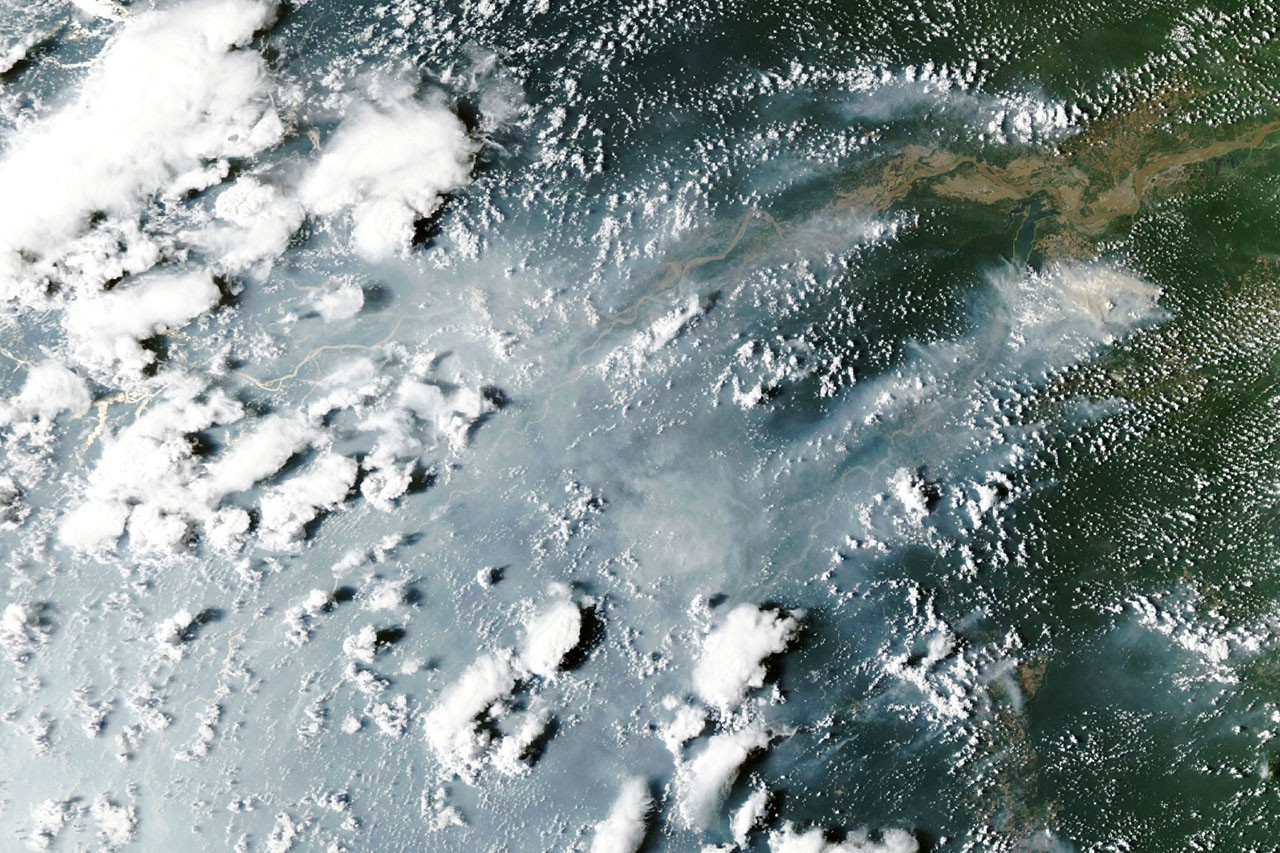
City officials reported the 135 figure for October 12, the day the MODIS instrument on NASA's Aqua satellite imaged smoke on both sides of the Amazon River [c4, c5]. Their figure does not say how long the air stayed that bad.
For the regions to the north and south, Morton said, there is still time to prepare [15]. "Given the intensity of this El Niño, this really is the year for people to avoid burning at all costs," he said [19].
What to watch
- Whether fire activity rises in Roraima, northern Pará and Amapá in November and December, as Morton and colleagues expect.
- Whether the fires around Manaus and Santarém die back when the rains arrive in December or January.
- Any further PM2.5 reports from Manaus officials after October 12, which would show how long the air stayed extremely poor.
Clarity's read
What the record supports and how the coverage leans. The claims behind it follow.
Reality
- Evidence68
- Adoption
- Insufficient
- Hype gap−5
- Incentives
- Insufficient
- Confidence65
Claim ledger
Ranked by verification strength, evidence, and original report placement.
- [1]
A drought accompanying El Niño has left the Amazon rainforest primed to burn, and scientists say the region has entered the early stages of what they think will be a long and severe fire season.
- [2]
Starting in September 2026, satellites detected sharp increases in fire activity and smoke emissions in the central and eastern Amazon, visible in NASA's FIRMS, the Global Fire Emissions Database (GFED) and NASA Worldview; the elevated region stretches from forests around Manaus and Santarém to the mouth of the Amazon River.
- [3]
On October 12, 2026, the MODIS instrument on NASA's Aqua satellite captured smoke streaming from fires on both sides of the Amazon River, with heavy smoke over Manaus, capital of the Brazilian state of Amazonas.
- [4]
On October 12, 2026, Manaus city officials reported extremely poor air quality, with fine particulate matter (PM2.5) values above 135 micrograms per cubic meter, the second-worst rating on a regional air quality index.
- [5]
The smoke disrupted daily life in Manaus, a city of more than 2 million people: schools closed, and citywide events and children's sports leagues were canceled as officials warned of hazardous air quality, according to news reports.
- [6]
Douglas Morton, an Earth system scientist at NASA's Goddard Space Flight Center, said the burning around Santarém and Manaus is part of a 'cascade' of fire in the tropics that accompanies the disrupted rainfall patterns of an El Niño; the pattern begins along the equator with drought and peat fires in Indonesia, followed by elevated fire activity in this part of the Amazon.
- [7]
Morton and colleagues from the University of California, Irvine; Vrije Universiteit Amsterdam; and the University of Maryland detailed the pattern in a 2017 study following the fire season that accompanied the 2015-2016 El Niño, and also saw the pattern play out in 2023.
- [8]
Drought, fire and smoke have smothered parts of Indonesia since August 2026, with hundreds of homes razed in October and thick smoke blanketing whole islands most days.
- [9]
"Now, in the Amazon, we're seeing the second domino in the cascade fall," Morton said, referring to the uptick in fires that has begun in Pará and Amazonas.
- [10]
Morton and his colleagues expect the next wave of fire to hit farther north in November and December in the Brazilian states of Roraima, northern Pará and Amapá, as well as parts of Venezuela, Guyana and Suriname.
- [11]
Around August and September 2027, Morton said, drought and fire risk will peak in the southern Amazon regions of Brazil and Paraguay.
- [12]
Morton said many of the same forests that burned during the El Niño events in 2023 and 2015 are burning again; forest fires in these rainforests cause especially serious ecological damage because most species are not adapted to fire.
- [13]
Morton said it is likely that some of the forest fires will burn even more intensely this time because the earlier fires partially charred trees, degrading the forest and making what remained more susceptible to burning.
- [14]
Morton expects the fires around Santarém and Manaus to continue burning until the rainy season arrives in December 2026 or January 2027.
- [15]
For the regions to the north and south of Santarém and Manaus, there is still time to prepare.
- [16]
It is so wet in the Brazilian Amazon that lightning ignites less than 1 percent of fires, so the vast majority of fires currently burning there were started by people, Morton said.
- [17]
The large fires in this region began as management fires, such as clearing shrubs from pastures or crops from fields, but have escaped and are now burning freely through the parched understory of the rainforest.
- [18]
Brazil's National Institute of Meteorology reported that Manaus rainfall levels were 95 percent less than normal in August and 60 percent less than normal in September.
- [19]
"Given the intensity of this El Niño, this really is the year for people to avoid burning at all costs," Morton said.
- [20]
Manaus received about 5 percent of normal rainfall in August 2026 and about 40 percent of normal in September 2026.
- [21]
The cascade pattern behind the northern and southern timetable was documented from two earlier El Niño episodes, 2015-2016 and 2023.
Get this ledger inside ChatGPT. Ask about any of our stories and the answer brings its figure, each claim’s verdict and the sources. Free, no account.
Sources
1 independent publisher whose own reporting we read for this story.
- nasa.govFires Arrive in the Amazon Rainforest
1 article · October 14, 2026
Topics and entities
Follow any of these and your For You feed starts watching them — no settings page required.