ProductNot yet confirmed elsewhere1 publisher2 min readPublished
Quintessent raises $40M to put quantum dots in the laser slot of AI fabrics
The Series A funds a manufacturing ramp for an eight-wavelength comb laser. Every efficiency figure in the announcement is the company's own, and no customer is named.
The Product Desk
What happened
- Cycle Capital led the round, joined by Goldman Sachs, Susquehanna International Group and Osage University Partners among others.
- The device generates light with single-material quantum dots rather than the two-material quantum wells used in some network lasers.
- Quintessent says one comb laser produces eight wavelengths, with room to extend to more.
Why it matters
- capability If the fewer-components claim survives qualification, the saving shows up in parts count and assembly, not only in the power budget, and parts count is the line item procurement can actually...
- constraint With no baseline for the power figure and no stated temperature range, nobody specifying a GPU fabric can put this part into a thermal or power model yet.
- contradiction The speed argument is made against silicon while the displacement target is quantum-well sources, so the comparison a buyer needs is the one missing.
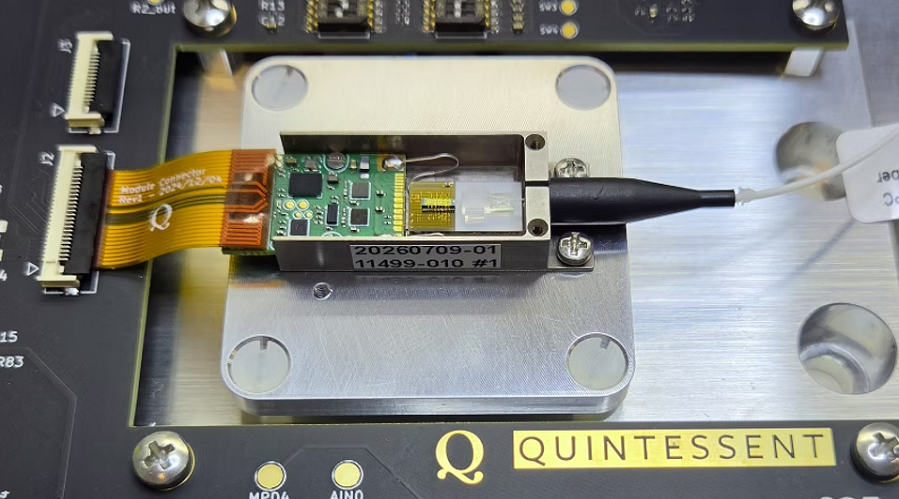
A comb laser is a bill-of-materials argument before it is a physics argument. Quintessent's pitch is that a single device puts out eight usable wavelengths [6] and gets by with fewer of the supporting parts that amplify beams and damp the voltage wobble that degrades signal quality [12][14]. For anyone costing an optical link, that is the half worth reading. Watts are a running cost; parts count lands in the purchase order and in the assembly step.
The obstacle is that the figures on offer are not the figures a fabric gets specified with. The company says the part draws 40 percent less power and runs more reliably at high ambient temperature [13]. Neither arrives with a baseline, a temperature range, or a per-wavelength line rate in what was announced [11]. A heat number is exactly the claim that decides where in a chassis a light source is allowed to sit, and there is not one to design against.
The speed case has a similar gap. Quintessent's dots are gallium arsenide, and the argument is that electrons move through it several times faster than through silicon, so the dots switch energy levels faster and the laser can pulse faster [5]. But the incumbent being displaced is the quantum-well source, built as nanosheets of two materials with diverging optical properties [4]. Mobility versus silicon says nothing about the part a buyer is actually swapping out.
On the money: $40 million is roughly 3.5 times the $11.4 million seed raised in 2024 [10][3], and it goes to manufacturing ramp plus reliability improvements [8]. Listing reliability work as a use of proceeds is the company's own statement that the part is not finished. Chief Executive Alan Liu put it plainly, describing Quintessent as starting its transition from technology development to a product-focused company [7]. That is the honest reading of a Series A in this category: the qualification grind starts now, and hyperscale optics buyers do not sign on comb spectra, they sign on failure data.
The roadmap item that says most about the business is the plan to add signal amplifiers [8]. Amplification is one of the functions the supporting components around a laser already perform [14]. Selling the amplifier as well as the source means the company is not content to win on one component's power draw; it wants a larger share of the optical line item. That is a broader fight, against whoever supplies those parts today, and this round does not fund it.
What to watch
- A published data sheet with per-wavelength line rate and an operating temperature range, which is what turns the power and heat claims into something a fabric can be sized against.
- A named module maker or hyperscaler design win, rather than a manufacturing ramp with no disclosed customer.
- Whether the promised signal amplifiers actually ship, since selling more of the optical bill of materials is a different business from winning on one component.
Clarity's read
What the record supports and how the coverage leans. The claims behind it follow.
Reality
- Evidence27
- Adoption
- Insufficient
- Hype gap+38
- Incentives76
- Confidence36
Claim ledger
Ranked by verification strength, evidence, and original report placement.
- [1]
Optical interconnect startup Quintessent Inc. announced it has raised $40 million in funding to ramp up production of its hardware, in a Series A round.
- [2]
Cycle Capital led the Series A, joined by Goldman Sachs, Susquehanna International Group, Osage University Partners and several others.
- [4]
Some network lasers generate light using quantum wells, usually nanosheets made of two different materials with diverging optical properties; Quintessent's device instead generates light using quantum dots, nanostructures that are usually spherical and made of a single material.
- [5]
Quintessent makes its quantum dots from gallium arsenide; electrons move through gallium arsenide several times faster than through silicon, so the dots switch between energy levels more quickly, which makes it possible to generate laser pulses at higher speeds.
- [6]
Quintessent says its comb laser can generate light beams with eight different wavelengths, and that the underlying technology can be extended to support higher wavelength counts and more parts of the spectrum.
- [7]
Co-founder and CEO Alan Liu said that with the funding news, Quintessent is starting its transition from tech development to a product-focused company.
- [8]
Quintessent will use the round to ramp up manufacturing of the comb laser and make reliability improvements, and plans to develop additional optical products later, including signal amplifiers that help improve connection reliability.
- [9]
The more data-carrying light beams travel through a fiber-optic link at once, the higher its throughput, and each beam uses a different wavelength to avoid interference.
- [10]
The $40 million Series A is about 3.5 times the size of the 2024 seed round.
- [11]
The announcement as reported contains no customer or design win, no baseline for the 40% power claim, no operating temperature range, and no per-wavelength data rate.
- [12]
Quintessent says its comb laser makes do with fewer supporting components than rival products, which translates into lower costs.
- [13]
The company says its technology uses 40% less power and can operate more reliably at high ambient temperatures.
- [14]
Network lasers usually rely on an array of complex supporting components that amplify light beams and mitigate voltage fluctuations that can reduce signal quality.
Sources
1 independent publisher whose own reporting we read for this story.
- siliconangle.comQuintessent bags $40M to develop lasers for AI clusters
1 article · August 24, 2026
Topics and entities
Follow any of these and your For You feed starts watching them — no settings page required.
Topics
Entities
- Quintessent Inc.Follow
- Alan LiuFollow
- Cycle CapitalFollow
- Goldman SachsFollow
- Susquehanna International GroupFollow
- Osage University PartnersFollow
- Gallium ArsenideFollow
- SiliconANGLEFollow