LeadershipNot yet confirmed elsewhere1 publisher3 min readPublished
Anthropic's hardware standard shrinks instrument integration to a configuration task
Anthropic's research preview cuts weeks of bespoke instrument integration down to hours for labs and manufacturers, which moves the binding constraint on unattended experiments from engineering capacity to whoever signs for them.
The Board Room · Leadership desk
What happened
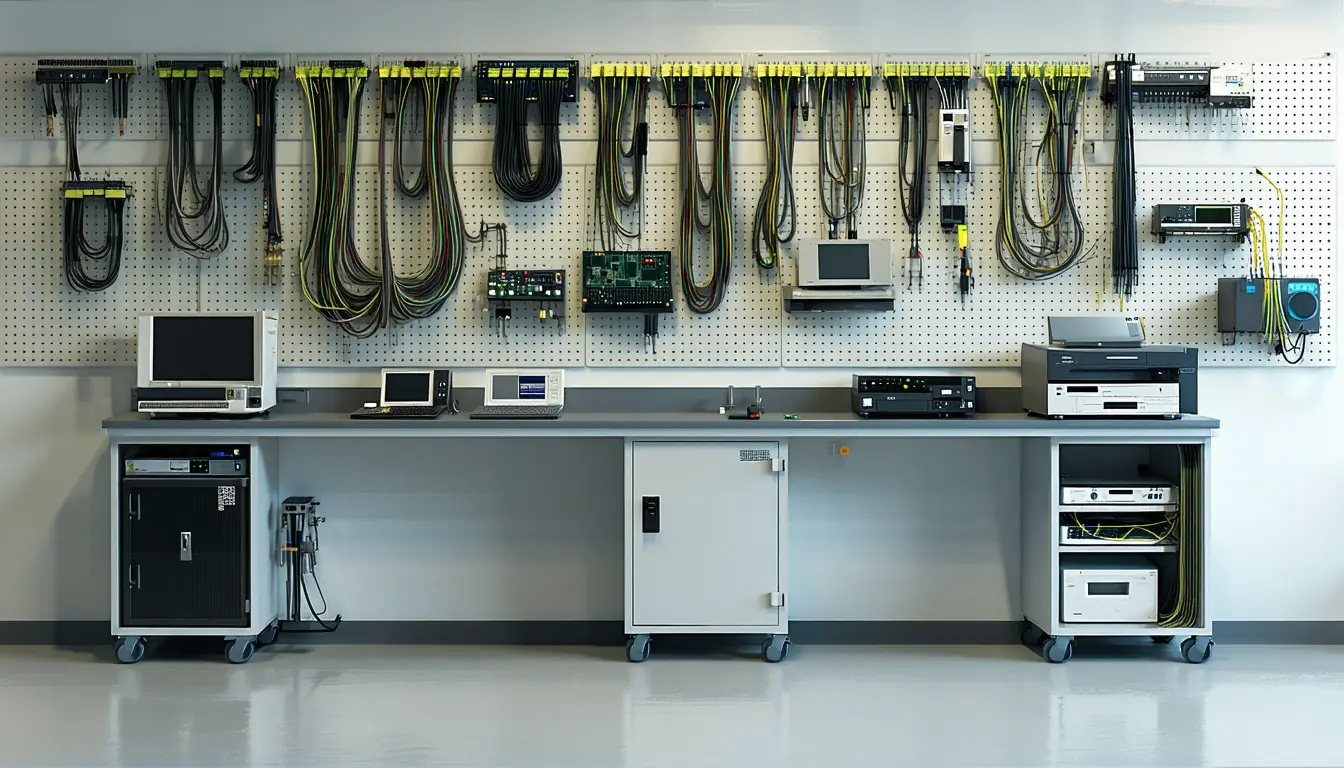
- Anthropic has opened a research preview of the Model Hardware Standard, a shared specification for AI agents to operate physical devices, to a first group of research labs and advanced manufacturers.
- The standard is pitched at running microscopes, liquid handlers and robotic arms in parallel, on work as varied as routine drug discovery experiments and laser calibration on a quantum computer.
- Anthropic says integration work that normally takes a facility weeks, and sometimes months, drops to hours or minutes once devices are exposed through the standardized MHS driver.
- That driver reduces device control to read and write primitives and advertises each instrument in a standard format, so agents and hardware find each other without a bespoke translator in between.
- Anthropic is circulating the early version among partners in science, robotics, electronics and manufacturing to build safety evaluations and best practices before the standard goes open source.
Why it matters
- constraint Once integration is cheap, a facility can connect more instruments than it has qualified people to answer for overnight, and staffing rather than engineering becomes the ceiling on autonomous runs.
- decision Any lab joining the preview has to choose whether its safety envelope lives in operator-written driver tags or in hardware interlocks that hold regardless of what the agent believes.
- exposure If an agent recovers from a hardware error unaided, the first record of a failed run sits in its own logs, leaving the operator to reconstruct what happened from telemetry the agent produced.
- precedent A model-agnostic specification headed for open source means the primitives Anthropic settles now become the vocabulary that rival vendors' agents inherit when they reach for the same instruments.
The load-bearing artefact in this design is not the transport layer, it is a text file. Anthropic says the MHS driver carries tags in which the operator writes, in plain language, what code cannot show, and its own example is the weight of a robot arm, which matters for knowing how to manipulate it safely and has historically sat in a paper manual or in someone's head [13][10]. From those tags the driver generates a reference file stating what the device can measure, what can be adjusted, and what safety limits will be enforced [11]. Whoever answers that setup interview is authoring the operating envelope an agent will treat as ground truth.
Size the compression at its endpoints before accepting it. Two months of one specialist at 40 hours a week is about 320 hours, so against a one-hour setup the ratio is roughly 320 to 1, and against a ten-minute one closer to 1,900 to 1 [16]. Those endpoints are Anthropic's own framing rather than a measured benchmark, and the preview post gives no per-device timings [15]. Even the conservative end is enough that bespoke integration work, which the company says currently requires specialists because most devices do not talk to each other, stops being the reason a facility runs one instrument at a time [5].
A facility manager's objection is fair: the drivers were never the expensive part, qualified hands and physical interlocks were, and a shared specification buys neither. That is right about cost and beside the point on sequencing, because removing the cheap constraint pushes throughput against the expensive one, and the expensive one here is a named person willing to authorize work that continues after everyone has gone home.
The supervision question gets sharper exactly where the standard is most useful. Anthropic describes agents sequencing steps across instruments, adjusting parameters as conditions change, and in some cases recovering from hardware errors without intervention [6]. It also says that for long-running tasks, or when devices must be driven faster than the agent's online reasoning allows, the agent chains driver commands into code files [14]. In that mode the per-step reasoning a reviewer would want to inspect is not happening per step, and commands can arrive by three routes at once: MCP, a command line interface, and API code files [12]. Anyone assigning responsibility for an overnight run needs to know which route issued the instruction that ruined the sample.
The board-deck version reads cleanly: a model-agnostic specification that works with any programmable device and is reachable through standard protocols such as the Model Context Protocol [8], provenance from a collaboration with HHMI Janelia Research Campus [4], and integration measured in minutes instead of months. What it omits is that the post names no other preview participants, sets no open-source date, and does not say who is accountable when an agent operates equipment unattended [15]. This quarter the decision in front of a lab director is narrow, which instruments to expose and to whom. Next quarter's consequence is that reference files written quickly during a preview become the de facto safety limits for as long as they keep working, because configuration that works is rarely reopened.
What to watch
- Whether the open-source release ships with an evaluation suite for unattended operation, or only the driver specification.
- Whether instrument makers start publishing their own MHS reference files, which would move the safety envelope off the operator's desk and onto the vendor's.
- Whether any preview lab publishes logs from an overnight run in which an agent recovered from a hardware error on its own.
Clarity's read
What the record supports and how the coverage leans. The claims behind it follow.
Reality
- Evidence24
- Adoption18
- Hype gap+42
- Incentives82
- Confidence58
Claim ledger
Ranked by verification strength, evidence, and original report placement.
- [1]
Anthropic says MHS reduces integration work that typically takes weeks or months to hours or minutes.
- [2]
Anthropic is opening a research preview of the Model Hardware Standard (MHS), a shared specification for AI agents to safely operate physical devices, to a first group of scientific research labs and advanced manufacturers.
- [3]
MHS enables AI agents to operate multiple lab and manufacturing instruments, such as microscopes, liquid handlers and robotic arms, in parallel, and to perform tasks ranging from routine drug discovery experiments to laser calibration on a quantum computer.
- [4]
The development of MHS began as a collaboration between Anthropic and HHMI Janelia Research Campus.
- [5]
Anthropic says it typically takes a lab or manufacturing facility weeks, if not months, to set up and integrate its hardware, because most devices do not communicate with each other and instead require specialists to build bespoke integrations.
- [6]
Anthropic says MHS helps researchers and engineers orchestrate autonomous, round-the-clock experiments and workflows, with agents able to reason through each step, update parameters in real time, and in some cases recover from hardware errors without intervention.
- [7]
Anthropic is sharing an early version of MHS with partners across science, robotics, electronics and manufacturing in order to collaborate on safety evaluations and best practices for AI systems operating physical equipment, ahead of making the standard open source.
- [8]
MHS works with any device that has a programmable interface, is model-agnostic, and any agent harness can access it using standard protocols such as the Model Context Protocol.
- [9]
MHS introduces a standardized driver built on simple primitives such as read (for example, get temperature) and write (for example, set temperature), and makes each device discoverable in a standard format so devices and agents can find each other across networks without a bespoke translator program in between.
- [10]
The MHS driver contains tags that let the user write device information directly in natural language, either themselves or by chatting to an agent that interviews them about their hardware setup; much of this information has to date been stored in paper manuals, on a user's computer, or as tacit knowledge.
- [11]
From the tag information the MHS driver automatically produces a reference file describing a device's general characteristics, such as what it can measure, what can be adjusted, and what safety limits will be enforced, giving the agent what it needs to operate the device.
- [12]
MHS provides three mechanisms for an agent to control hardware: MCP, the command line interface, and code files (APIs), which work together to enable orchestration across multiple devices via a single line of code.
- [13]
Anthropic cites the weight of a robot arm as an example of a machine characteristic that is not discernible from code alone but is important for knowing how to manipulate the device safely.
- [14]
Anthropic says that when an agent needs to execute long-running tasks or operate devices faster than its online reasoning would allow, it can chain together driver commands from one or more devices in code files.
- [15]
Anthropic's preview post names no preview participants other than HHMI Janelia Research Campus, gives no per-device integration timings, sets no date for open sourcing MHS, and does not state who is accountable when an agent operates equipment unattended.
- [16]
Taking Anthropic's own endpoints, two months of a single specialist's time is roughly 320 working hours, which is about 320 times a one-hour setup and about 1,900 times a ten-minute one.
Sources
1 independent publisher whose own reporting we read for this story.
- anthropic.comPreviewing the Model Hardware Standard \ Anthropic
1 article · August 27, 2026
Topics and entities
Follow any of these and your For You feed starts watching them — no settings page required.
Topics
Entities
- AnthropicFollow
- Model Hardware StandardFollow
- Model Context ProtocolFollow
- HHMI Janelia Research CampusFollow
- GenentechFollow
- ClaudeFollow