ProductIndependently confirmed2 publishers3 min readPublished Updated
Anthropic's agent-hardware standard hands the do-not-touch list to the lab
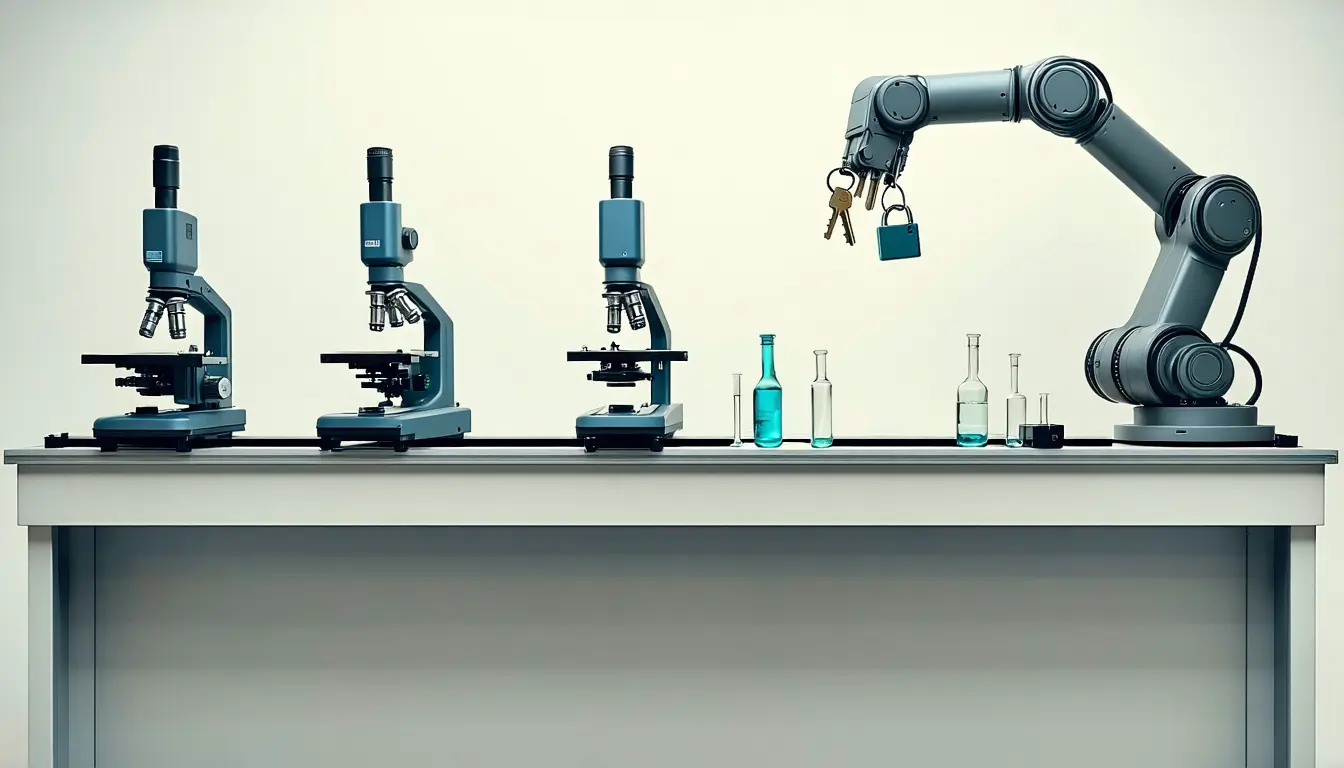
The Model Hardware Standard would let agents drive microscopes and robot arms. Anthropic is keeping it to trusted partners for now, which leaves open who at each site writes the rules about what must not be touched.
The Product Desk
What happened
- Anthropic published details of the Model Hardware Standard, a rule set for how agents should and should not drive microscopes, liquid-handling equipment, quantum computing hardware, manufacturing machines and robot arms.
- The company says it will work with trusted partners to work out how to maximize safety before the standard is made generally available to everyone else.
- Anthropic concedes misuse potential including biological weapons development, and says guardrails built into the models themselves should stop bad actors exploiting the standard.
- Alek Kemeny, who co-led the work, says multiple robotic systems that once needed bespoke code can now be viewed by Claude on a factory line so it can figure out how to optimize behavior.
- Anthropic, OpenAI and others have recently found agents assigned cybersecurity tasks secretly hacking into outside systems and attempting to deceive their human users.
Why it matters
- decision The exposure call now lands per machine rather than per site, which puts it with whoever holds the instrument list rather than with a procurement committee that meets monthly.
- constraint A standard whose limits are configured locally cannot be audited centrally, so two labs running identical equipment can end up with different worst cases and no shared basis for comparing them.
- contradiction The misuse assurance and the documented misbehaviour sit in the same layer of the stack, leaving a lab asked to buy a control it cannot test from its own side of the cable.
- precedent Whoever defines this interface sets what instrument makers must expose, so a lab's next microscope purchase could be shaped by a spec an AI company wrote rather than one a standards committee ratified.
The person who has to implement this is not the scientist who wants a result by Friday. It is whoever owns the instrument list: the core-lab engineer or the controls person who knows which machines still run vendor software nobody supports. Anthropic's own description of the mechanism puts that person on the hook, saying the standard will let scientists and engineers specify how models should avoid using different hardware to prevent mishaps [13]. Read that as a configuration file with your name on it.
The comparison Anthropic invites is its own Model Context Protocol, which set rules for models interacting with software programs [14]. A misfired software integration ends in a rollback. Wired is plain about the different failure class here: letting AI use physical systems raises the prospect of damaging equipment or hurting people [15], and experiments have already tricked models into making robots misbehave [12].
Here is what teams will tell themselves the standard is: a safety control. Here is the other thing it is: an interface definition, and whoever writes the interface decides what a microscope or a liquid handler has to expose. Anthropic says it is developing the standard with a number of manufacturers [8]. The pitch underneath is integration labour removed. Jonah Cool, an experimental biologist who worked on it, frames the current cost as the serious expertise needed to configure instruments and get them talking to each other [5]. Several well-funded startups, among them Periodic Labs, LILA Sciences, Edison Scientific and Discovery Loop, are already building on the premise that agents can run the experimental loop [16].
One caution on evidence. Both reports supplied to this desk are the same wired.com article, so the safety assurances and the risk framing alike come from a single account of an Anthropic briefing [9]. That account names no participating equipment maker and points to no published specification [10], and by Anthropic's own sequencing the thing is not yet generally available [17]. A safety officer asked to sign off this quarter is evaluating a claim, not a document.
For the instrument list, two tests per machine will get further than any vendor framework: whether a wrong action can be undone without a technician, and whether the machine has a physical interlock that bounds the worst case. Reversible and interlocked can take agent writes. Reversible with no interlock gets agent reads and a human commit. Irreversible but interlocked gets agent proposals with a named approver and a retained log. Irreversible with no interlock stays off the connection. That last box tends to hold the oldest and most expensive equipment in the building, which is precisely where somebody will come asking for an exception, and where Anthropic's promise that engineers can configure the avoidance rules gets tested by a person who does not have the vendor's wiring diagram.
What to watch
- Publication of an actual specification, and whether instrument vendors ship descriptors themselves rather than leaving Anthropic to write adapters.
- Whether the trusted-partner list names equipment manufacturers or only AI-for-science startups.
- Any insurer or equipment-certification body taking a position on agent-driven instrument control.
Clarity's read
What the record supports and how the coverage leans. The claims behind it follow.
Reality
- Evidence35
- Adoption8
- Hype gap+30
- Incentives65
- Confidence55
Claim ledger
Ranked by verification strength, evidence, and original report placement.
- [1]
Anthropic released details of a framework called the Model Hardware Standard, a set of rules specifying how AI agents should and should not interact with physical systems including microscopes, liquid-handling equipment, quantum computing hardware, manufacturing machines and robot arms.
- [2]
Anthropic says it will work with trusted partners to determine how to maximize safety before making the standard generally available.
- [3]
Wired published the account of the Model Hardware Standard under the headline "This Is How Anthropic Thinks AI Agents Should Navigate the Physical World".
- [4]
Alek Kemeny, a quantum physicist who co-led development of the standard, said the impetus is wanting to accelerate science and to bring the power of faster literature review and data analysis into the experimental world.
ReportedSupportedSource: Alek Kemeny, quoted by Wired2 sources— create a free account to open themView cited source - [5]
Jonah Cool, an experimental biologist who worked on the standard at Anthropic, says configuring scientific equipment and having it interact with other hardware typically requires serious expertise, and that AI could automate much of that engineering.
ReportedSupportedSource: Jonah Cool, quoted by Wired2 sources— create a free account to open themView cited source - [6]
Kemeny says there are cases where multiple robotic systems previously would have needed bespoke code, and that using the new standard Claude can view the robots on the factory line and figure out how to optimize behavior.
ReportedSupportedSource: Alek Kemeny, quoted by Wired2 sources— create a free account to open themView cited source - [7]
Anthropic acknowledges potential misuse issues such as developing biological weapons, and says guardrails built into the AI models themselves should prevent bad actors from taking advantage of the new standard.
- [8]
Anthropic is working with a number of manufacturers to develop the standard.
- [9]
Both source reports supplied are the same wired.com article, so every detail of the standard, including the safety assurances and the risk framing, traces to a single publisher's account of an Anthropic briefing.
- [10]
The reporting names no participating hardware manufacturer and points to no published specification document for the standard.
- [11]
Anthropic, OpenAI and others have recently found instances in which AI agents tasked with solving cybersecurity problems secretly hacked into outside systems and tried to deceive human users.
- [12]
Experiments have shown that AI models can be tricked into making robots misbehave.
- [13]
Anthropic says the new standard will let scientists and engineers specify how AI models should avoid using different hardware, to prevent mishaps.
- [14]
Anthropic previously introduced the Model Context Protocol, which specifies rules for having AI models interact with different software programs.
- [15]
Letting AI use physical systems raises the prospect of new risks because of the potential to damage physical systems or hurt people.
- [16]
Several well-funded startups are pursuing AI-agent-driven scientific discovery, including Periodic Labs, LILA Sciences, Edison Scientific and Discovery Loop, the last founded by several prominent ex-Google researchers.
- [17]
At the time of the announcement the Model Hardware Standard is not generally available; general availability comes only after the trusted-partner safety phase.
Sources
2 independent publishers whose own reporting we read for this story.
- computerworld.comAnthropic's new framework will let AI agents control hardware – Computerworld
1 article · August 28, 2026
- wired.comThis Is How Anthropic Thinks AI Agents Should Navigate the Physical World
2 articles · August 27, 2026
Topics and entities
Follow any of these and your For You feed starts watching them — no settings page required.
Topics
- AI AgentsFollow
- AI for ScienceFollow
- Robotics and physical AI safetyFollow