Product2 publishers2 min readPublished
Porsche's fully recycled cathode overshoots Europe's 2031 lithium minimum by 17 times
Porsche and cylib's pilot cathode is 100% recycled at a time when EU law will ask for 6% recycled lithium in 2031. Whether it becomes supply depends on operational testing and on how many European packs come back.
The Product Desk · Product desk
What happened
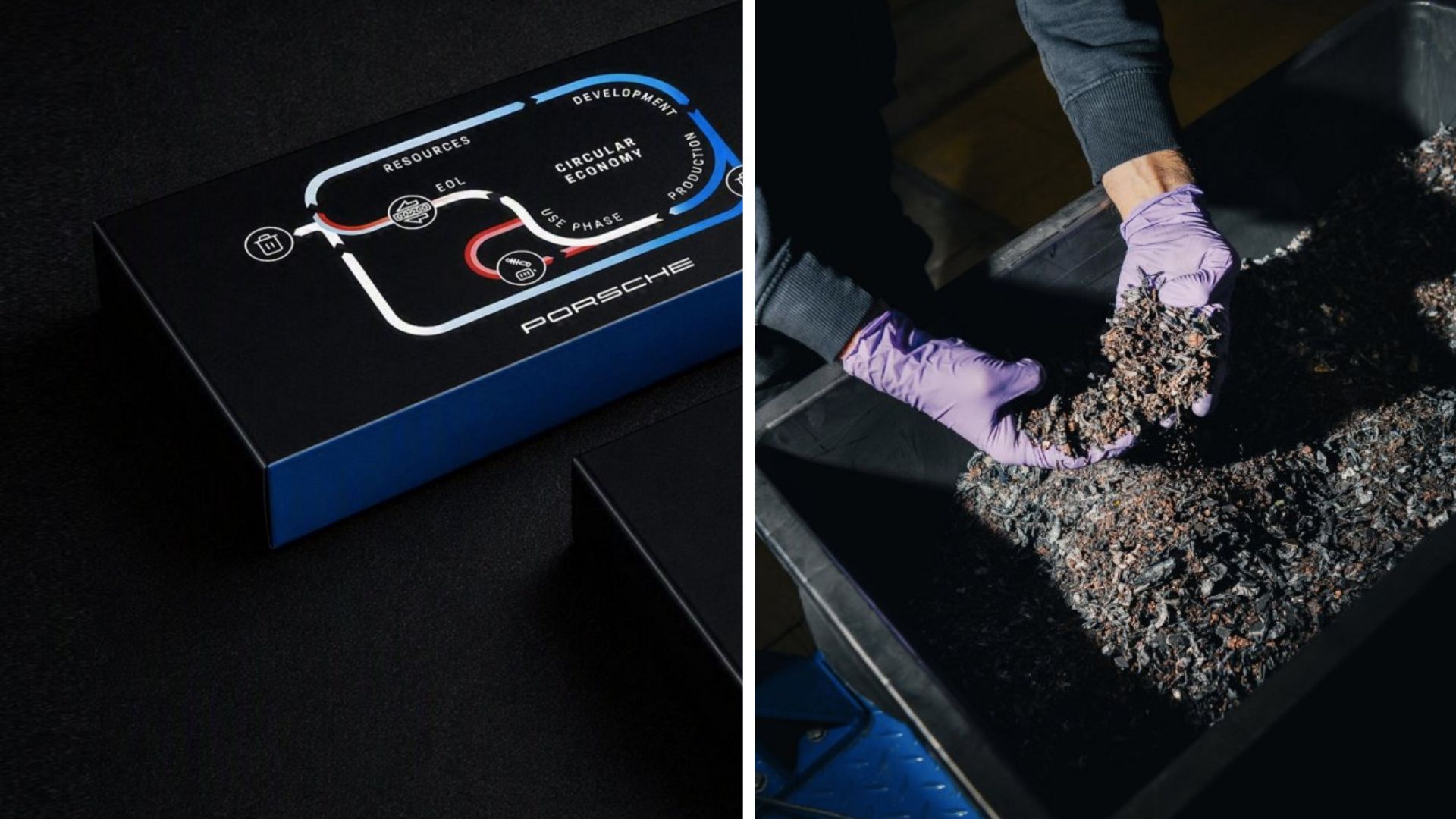
- Porsche and the Aachen recycler cylib have built pilot battery cells whose cathode active material, the lithium, nickel, cobalt and manganese, came entirely out of Porsche's own end-of-life high-voltage packs.
- Those cells are now undergoing extensive operational testing, and Porsche says initial tests have already indicated the technical feasibility of the approach.
- The packs come from Porsche Centers across Germany and have been recycled since May 2026 using a water-based process.
- The recovered raw materials are tracked through a dedicated material account and will be available to Porsche and selected partner companies for battery cell production from 2028.
- EU rules will require a new electric vehicle battery to contain 6% recycled lithium, 6% recycled nickel and 16% recycled cobalt from August 2031.
Compiled by The Product DeskSomething wrong?How this is made
Why it matters
- constraint The ceiling on this material is how many European packs come back, so a cathode that passes every test can still be unavailable in the volumes a model line needs.
- decision Procurement teams have two routes to the 2031 minimums: blend a small recycled fraction into primary material, or qualify a cathode already at 100% and blend down as the minimums rise.
- exposure Anyone treating Porsche's quality claim as independent validation is reading a supplier assessment co-signed by one of that supplier's investors.
- precedent Recycled-content documentation becomes a legal duty in the same year Porsche's material account opens, so the paperwork and the material arrive on carmakers together.
Porsche still has to establish that the recycled raw materials meet its standards for value, quality and performance when used in batteries, the company says [4]. "With battery cells made entirely from recycled raw materials such as lithium and cobalt, we have achieved an important technological milestone," said Joachim Scharnagl, member of the executive board for procurement at Porsche [3]. This is the third phase of a project begun last year [18].
A fully recycled cathode is about 17 times the 6% recycled-lithium minimum that takes effect in August 2031, and about eight times the 12% required from 2036 [19]. The Next Web reported that the harder numbers sit on the other side of the process: 50% of the lithium in waste batteries must be recovered by 2027, and 80% by 2031 [10].
"The pilot project with Porsche demonstrates that our approach is feasible in practice: valuable raw materials from Porsche batteries at the end of their first life can potentially flow back into new high-performance batteries for Porsche vehicles," said Dr. Lilian Schwich, co-CEO and co-founder of cylib [17]. TNW reported that few European EV batteries are dead yet, because the cars are still on the road, and that Chinese and South Korean firms supplied 90% of Europe's batteries last year [15].
Porsche Ventures co-led cylib's EUR 55M round in May 2024 with World Fund, alongside Bosch Ventures, and The Next Web described the announcement as a customer praising a supplier it part-owns [12][13]. cylib, a spin-off from RWTH Aachen, says its process recovers more than 90% [14]. In Munich, Tozero raised money in 2024 to process 30,000 tonnes of battery waste a year on a water-based route of its own, and has raised EUR 17M in total [16].
Two tests separate an announcement like this from a supply option, and they apply to any recycled-content pitch a materials team gets this year. The first is qualification in the buyer's own cells, on the buyer's own duty cycle. The second is contractable tonnage on a date the buyer can build to. Neither account reports how many pilot cells Porsche and cylib built [21]. When both hold, recycled cathode material is a second source.
What to watch
- Porsche says further pilot results are due in the second half of 2026; read them for cell performance, not material suitability.
- Whether the 2028 material account comes with contracted tonnage for the selected partner companies or only access to it.
- Whether Porsche commits recycled cathode material to series-production cells, which it has so far called a potential future application.