Product3 publishers3 min readPublished
Also raised $150M for a parts bin, not a bicycle
The Rivian spinout's Series D takes it to $455 million and past a $1 billion valuation. The only product shipping is a $4,500 e-bike that arrived months late.
The Product Desk · Product desk
Drafted by a language model from the sources cited here and checked against its claim ledger before publication. How we use AISend a correction
What happened
- Also, the micromobility startup that spun out of Rivian, raised a $150 million Series D led by Prysm Capital.
- The Series D included existing backers Eclipse, Greenoaks and MVP Ventures.
- Also has raised $455 million since its founding less than two years ago.
- Fortune, which first reported the raise, said it pushed Also's valuation past $1 billion.
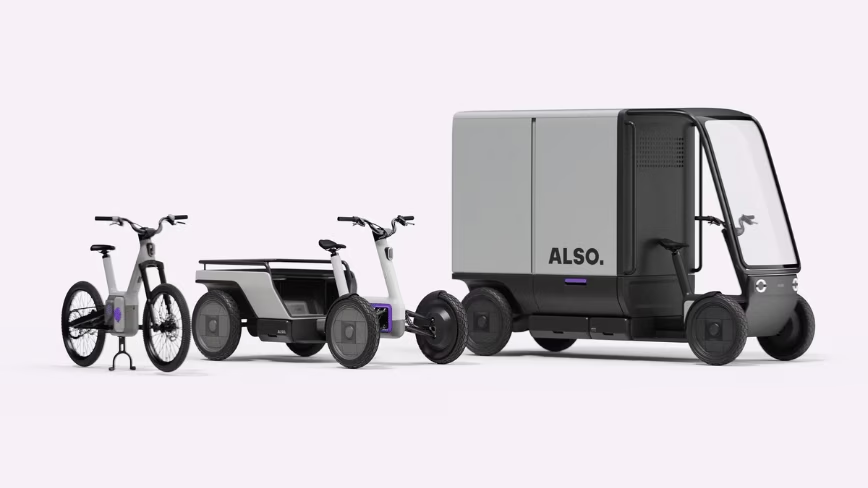
- Also makes its own motors, batteries, computing and software, and says that stack can be dropped into anything smaller than a car, from pedal-assist delivery quads to fully autonomous vehicles.
Compiled by The Product DeskSomething wrong?How this is made
Why it matters
Also, the micromobility company that spun out of Rivian last year, has closed a $150 million Series D led by Prysm Capital, with existing investors Eclipse, Greenoaks and MVP Ventures taking part [1][2]. That brings the total raised to $455 million in under two years and, according to Fortune, values the company above $1 billion [3][4]. What is being funded is not the bike.
Also builds its own motors, batteries, compute and software, and says that stack can be dropped into anything smaller than a car, from pedal-assist delivery quads to fully autonomous vehicles [5]. The new money will go to accelerating its autonomous driving work and the "simultaneous progression of multiple autonomous form factors," all built on the same electric architecture as the consumer bike and the commercial delivery quad [6]. Co-founder Chris Yu told Fortune that "its market is every vehicle smaller than a car," arguing that moving one passenger across town in a 7,000-pound van or SUV makes little sense on cost or congestion [7][8]. He said the goal is for small-vehicle autonomy to be an unremarkable part of the transport mix within five years [9].
Prysm's Jay Park framed the bet as a repeat: the firm backed Rivian early because of "wonderfully designed, vertically integrated electric trucks, vans and SUVs," and sees Also applying the same approach to smaller vehicles [10]. The vertical-integration argument is also why the Rivian tie matters operationally, not just on the cap table. Rivian holds a minority stake and RJ Scaringe sits on the board [11]; per TheNextWeb, Rivian's growing on-road fleet generates the driving data Also expects to need to train its own self-driving systems [12].
Against that, the shipping record is thin. The TM-B is a pedal-assist two-wheeler with no mechanical connection between pedals and rear wheel, a 5-inch circular display and over-the-air updates; Launch Edition units started shipping in late July at $4,500 [13]. Per TechCrunch, that launch edition was delayed for months, with pre-orders now open on performance and standard models and initial deliveries due in fall [14]. Volume is meant to come from commercial: the TM-Q quad hauls more than 400 pounds and runs in bike lanes, and Amazon has agreed to buy thousands of customised units [15]. DoorDash signed a multiyear agreement on March 31 to develop and deploy small autonomous delivery vehicles and took a stake in the $200 million round disclosed the same day [16].
Two things in the arithmetic are worth holding onto. Bloomberg reported that the March round already valued Also at $1 billion [17], so "above $1 billion" after another $150 million is an increment, not a step change. And the Series D is about a third of every dollar the company has ever raised [18].
The category context is unkind: Rad Power Bikes has filed for bankruptcy, Juiced Bikes has collapsed and Porsche has exited e-bikes [19]. Analyst David Zipper reads the failures as saturation; Yu says they are "not a signal about the demand and the size of the market" but a sign of how hard the work is [20]. Micromobility overall is put at roughly $50 billion, with analysts expecting it to more than double by the early 2030s [21].
Watch whether the fall deliveries of the standard and performance bikes land on time, and whether Amazon's quad order converts into disclosed volume. Watch also for the first autonomous form factor to be shown in hardware rather than described.