Invest1 publisher3 min readPublished
Democrats hold roughly 2-to-1 Texas advertising edge after MAGA Inc's $10 million boost to Paxton
More than $3.4 billion is chasing a chamber that decides who staffs the administration and who fills open court seats for the rest of the term, and the spending so far shows the two sides pricing the same seats very differently.
The Investor · Invest desk
What happened
- Spending across all Senate races this midterm cycle is expected to exceed $3.4 billion, with control of the chamber in play less than two months before Election Day.
- Democrats need a net gain of four seats, and Chuck Schumer says Iowa and Texas have become paths that nobody was tracking a year ago.
- The Senate Leadership Fund added $6 million in Michigan after Abdul El-Sayed won the primary, taking its total there to $51 million, its third-highest state figure.
Compiled by The InvestorSomething wrong?How this is made
Why it matters
- exposure A four-seat swing puts every remaining nomination within reach of a blocking majority, which is what makes administration staffing and open court seats the real underlying asset in a $3.4 billion advertising market.
- decision With more than $390 million still uncommitted, Trump's political fund now has to choose between shoring up Paxton in Texas and holding cash for the Alaska, Iowa, Ohio and North Carolina defences, and it cannot do both at Maine prices.
- constraint Nearly $70 million of attack spending failed to stop El-Sayed's nomination, which caps what either side can expect the marginal advertising dollar to deliver in the states now being bid up.
- contradiction Republicans' public line that not everything will break against them sits awkwardly beside their own leader saying on the record that he worries about losing the chamber, and the second reading is the one their spending pattern supports.
What the money is bidding for is the confirmation calendar. The Senate confirms or blocks nominees, so a net change of four seats [3] decides who staffs the administration and who takes open court seats for the balance of the term [2]. How many vacancies, and in which agencies, the reporting does not quantify, so the stake stays qualitative even as the spending does not.
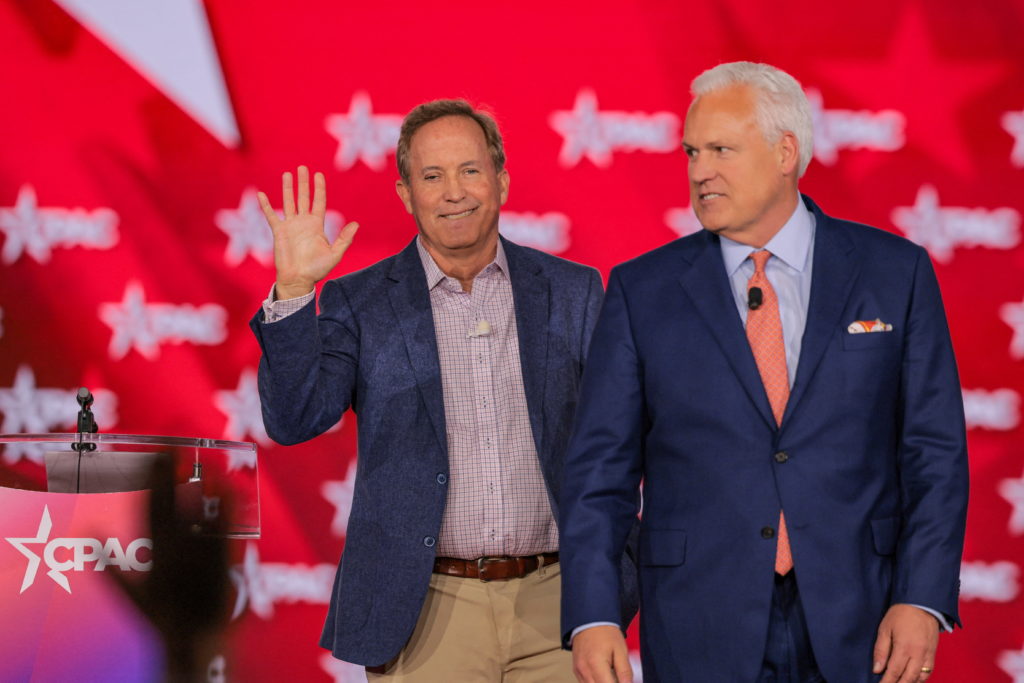
In Texas, James Talarico and allied groups have put nearly $30 million into advertising since the May runoff against less than $3 million from pro-Paxton groups [8][9], and MAGA Inc's $10 million, the first major general election investment of its midterm [10], lifts the Paxton side to roughly $13 million, still under half of the Democratic number [1]. Senate Republican leaders had to petition for that check [11]. The fund held more than $400 million last month, which makes the Texas commitment about 2.5 percent of the pot and leaves something north of $390 million uncommitted [2][3]. That is a revealed price on a seat, and it is a low one, placed by a leadership that wanted John Cornyn on the ballot rather than the attorney general who beat him [12].
Maine runs the other direction. Susan Collins and aligned super PACs have spent almost $80 million, per AdImpact, against close to $45 million spent and reserved by Troy Jackson's side since he became the nominee [14][15], a gap of about $35 million and a ratio near 1.8 to one [4], in a state where Kamala Harris outpolled Trump in 2024 [16]. Some of that gap is calendar rather than conviction: Graham Platner won the June nomination and quit in July [17], delegates picked Jackson in late July [18], and a shorter window buys less air at worse prices. The two sides' Maine money together is roughly $125 million, about 3.7 percent of the whole $3.4 billion [1][7], for one seat.
Michigan is where the arithmetic gets uncomfortable for everyone selling advertising. Nearly $70 million was spent against Abdul El-Sayed [19] and he won the primary anyway, narrowly, over Haley Stevens [20]. The Senate Leadership Fund then added $6 million to bring its Michigan total to $51 million, the third-highest of any state [21][22], which is a 13 percent top-up on the $45 million it had already committed [5], spent on a seat no Republican has won since 1994 [23].
The reading I would take is that Democrats are buying cheap optionality in states Republicans hold while Republicans defend expensive incumbencies, and the tell is that the party with more than $400 million on hand deployed 2.5 percent of it while its Senate leaders asked publicly for more. Or rather, the more interesting version: the six Republican-held seats now named as targets, Alaska, Maine, North Carolina, Ohio, Iowa and Texas, give Democrats two seats of slack against a required net of four, but only if Michigan, Georgia and New Hampshire hold [8], and Michigan is the one where nearly $70 million of primary attack advertising has already been logged against their nominee. Republicans' own answer is that everything is unlikely to break one way [4], and John Thune telling KELOLAND News he does worry about the chamber while calling it competitive [5] is what a leader says when he still expects to hold. Two things would break my read. If Michigan slips, the four-seat net stops being an arithmetic problem and becomes an implausible one, since Mike Rogers lost by fewer than 20,000 votes in 2024 [24]. And if the uncommitted $390 million lands in October, Texas stops being an option Democrats bought cheap and becomes a seat they have to fund at Maine prices.
What to watch
- Where the remaining $390 million of MAGA Inc money lands, and whether Texas or the Alaska, Iowa, Ohio and North Carolina defences get it.
- Whether Democrats consolidate behind El-Sayed in Michigan, the seat their four-seat arithmetic assumes they hold.
- Whether AdImpact's Maine numbers show Jackson's reservations closing on the Collins side's almost $80 million.