Product1 distinct publisher3 min readPublished
Ken Paxton and James Talarico disagree about tax breaks and local control, but they ask for the same thing on water. That moves cooling design out of the campaign column and into the siting spec.
The Product Desk · Product desk

Compiled by The Product DeskSomething wrong?How this is made
The person this lands on owns the cooling spec for a Texas site that already has a land option and an energisation date. Water has been sitting in the permitting column and power in the fight column. Paxton's four-point plan and Talarico's plan both put closed-loop water in the fight column [3][4], and neither the plans nor the reporting put a number on what a closed-loop redesign costs or how many months it adds.
The two platforms diverge on plenty. Talarico wants the state sales tax incentives gone and local communities given more say [4]; Paxton wants a federal DATA Act, a ban on Chinese technology inside facilities and criminal liability for AI safety violations [3]. On water they land in the same place [5]. So for anyone modelling risk, the party question resolves identically on cooling and stays open on tax treatment.
Site teams tend to read a long interconnection queue as proof that demand is real. Texas regulators are reading the same queue as an unverified claim on shared infrastructure, because the state has no reliable way to tell which of those projects will be built [8]. About 90% of the requests are data centres, roughly 427GW of them [2], and the "more than five times record peak" comparison implies a state record peak under about 95GW [3]. A queue slot is an option, not a build, and the state now treats it that way.
The disclosure record made that easier. Of the companies Texas asked about water and electricity use, 7.4% answered, which leaves 349 that did not [1]. Rules get written from the numbers that turn up. Governor Abbott says the grid operator's data is incomplete and that lawmakers can handle it when they return in January [11], while his Democratic challenger Gina Hinojosa wants a moratorium and a special session on the grounds that developers arrived in neighbourhoods with no rules in place [10]. Abbott has also directed the Public Utility Commission and ERCOT to protect residential ratepayers from data centre infrastructure spending [12], which concedes the household cost argument rather than rebutting it. National polling in the same report has local opposition at 61%, up 12 points since March [13][4].
The industry answer so far has been community funds and local hiring promises [15]. Separate that from the thing actually being done, which is water and grid rules drafted in an election year by people who did not get their questionnaires back.
The useful cut for Monday is two questions, not one. Does the design survive a closed-loop mandate without a rebuild, and does the schedule survive both the interconnection audit and a January legislative session? Yes and yes, proceed. No on water, yes on schedule: buy the redesign now, because it is cheaper than re-permitting. Yes on water, no on schedule: hold the land and re-time. No on both: move the load, though Texas has the most permissive power market and the largest project concentration, so tightening there gives other states a template [16]. Closed loop is the one line both campaigns have already signed [5], which makes it the cheapest assumption on the sheet.
Ranked by verification strength, evidence, and original report placement.
Texas hosts more data centres than any other US state, and Reuters reports that Republican competition over regulating them has put Big Tech on notice in the state.
Data centres have become a major issue in the Texas races for governor and a US Senate seat, in a state where the industry was until recently seen mainly as an economic development success.
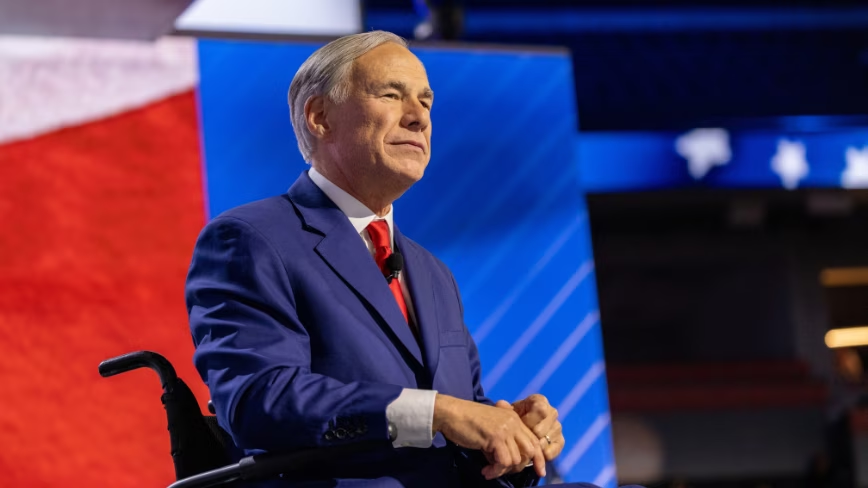
Ken Paxton, the Texas attorney general running for Senate, published a four-point Texas First Data Center Plan last month calling for a federal DATA Act, closed-loop water systems, a ban on Chinese technology inside data centres and criminal liability for AI safety violations.
His Democratic opponent James Talarico's Hold Data Centers Accountable Plan would end the state sales tax incentives that attracted the industry, establish federal minimum standards, give local communities more control over projects and require closed-loop water systems.
Candidates from opposite parties independently landed on the same water policy, closed-loop systems, which the source treats as a sign the issue has moved from ideology to utility bills.
Governor Greg Abbott is campaigning on measures he has already introduced, saying "What I have done is working. The guidelines and guardrails I've established are now universally adopted across the state of Texas," pointing to requirements that data centres avoid taking water needed by communities and putting excessive pressure on the grid.
Distinct publishers with included, body-backed reporting in this cluster.
Follow any of these and your For You feed starts watching them — no settings page required.
product
Texas siting risk moves from the county to the capitol as both Senate candidates run at data centers1 distinct publisher
security
Texas turns the interconnection queue into a gate: 1,800 projects and 474 GW on hold1 distinct publisher
invest
The data-center backlash is now a permitting variable, not a PR problem1 distinct publisher
invest
Texas froze 474 gigawatts of interconnection queue, and the audit is now the schedule risk1 distinct publisher
Evidence-backed comparisons of source perspectives and observed adoption signals. Read the methodology
Which Builder, Operator, and Investor concerns the observed source mix emphasized—not a truth score.
Evidence, demonstrated adoption, hype gap, incentives, and confidence are assessed independently, each on its own current evidence. How these are measured.
One relay, specific numbers, nothing checked
474GW, 28 of 377, 61% — every figure in the story arrives through The Next Web, which credits Reuters for the politics and names no source at all for the polling. The quotes are direct and the numbers are specific enough that anyone could verify them; in our coverage nobody has. No ERCOT filing, no text of either candidate's plan, no pollster.
Two levers pulled, the rest is campaign literature
Two things have actually happened in Texas: new grid connections are paused pending an audit, and the utility commission and ERCOT have been told to keep residential ratepayers off the buildout bill. Closed-loop mandates, ending the sales tax break, local veto power and a moratorium are all proposals waiting on a January legislature. And the industry's own participation is its own reading: 349 of 377 companies did not answer when the state asked about their water and power.
Convergence real, implication stretched
Two rival candidates writing the same sentence about cooling water is genuinely worth noticing — and it is not yet a siting rule. Our own framing, that this moves cooling design out of the campaign column and into the spec, runs ahead of anything binding in Texas before January. The closing suggestion that other states will copy a Texas model gets no test anywhere in the reporting.
Everyone quoted is running for something
Two Senate candidates with rival plans, a governor whose newfound guardrails postdate a $40bn Google announcement he promoted by nine months, a challenger demanding a moratorium, a party committee worried about an Ohio seat, and an industry answering with community funds and hiring promises. The water policy may well be sound engineering; the reason it is being announced now is an election calendar.
Uncontested because uncorroborated
Nothing in this story is disputed, but that is a function of there being one teller rather than agreement among several. The figures are internally consistent and the arithmetic holds. The parts most likely to change the picture — what the grid audit finds, what January's session actually passes, what closed-loop retrofits cost — are precisely the parts no one has yet.