A proteomic study of 28 postmenopausal ovaries finds the tissue still changing into the 70s
Northwestern and Buck Institute researchers found structure, metabolism and immune proteins still shifting in the ovaries of 28 postmenopausal women. The authors say later studies need larger, more diverse cohorts and longitudinal health data.
The Scientist · Science desk
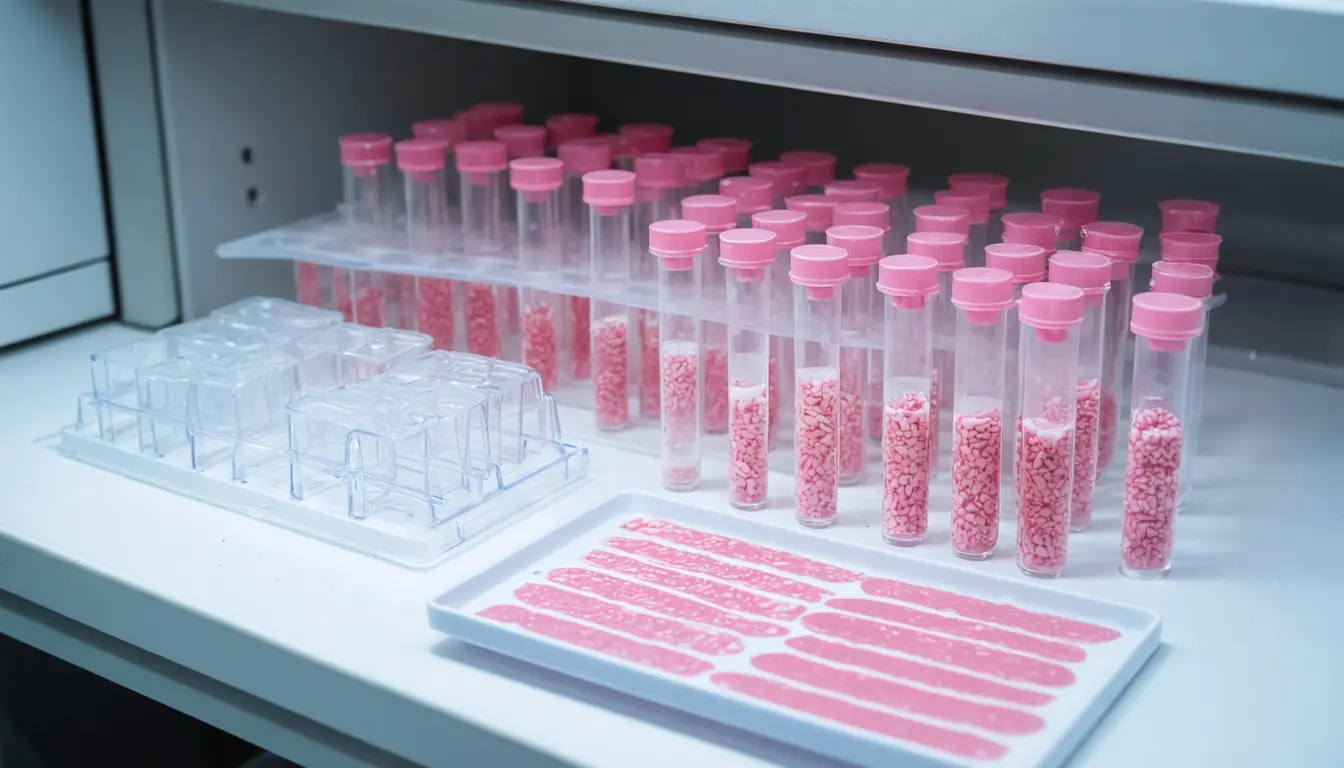
Key figures: the team quantified 5,812 protein groups; the postmenopausal women studied were ages 50 to 75; ovaries from women 70 and older showed stronger signatures of lipid metabolism and innate immunity.
| Figure | Value | Note | Claim |
|---|---|---|---|
| Protein groups the team quantified | 5,812 protein groups | 4 | |
| Youngest age studied | 50 years old | 1 | |
| Ovaries from women 70 and older: stronger signatures | 70 years and older | of lipid metabolism and innate immunity | 6 |
What happened
- The team ran diaPASEF mass spectrometry on the tissue and quantified 5,812 protein groups across the samples.
- Ovaries from women in their 50s were richer in RNA processing, gene regulation, proteostasis and tissue-structure proteins, while those from women 70 and older showed stronger lipid metabolism and innate immunity signatures.
- Recurring signals were folded into BuckPOMS, a 26-protein signature marked by loss of structural and epithelial programs and gain of matrix remodeling, inflammatory signaling and complement activation.
- Histologically normal ovaries, particularly from women in their 60s, overlapped with senescence programs and proteins previously linked to ovarian cancer; the authors stress this is not evidence of malignancy.
Why it matters
- What's now possible capability The work gives researchers a reference map of ovarian aging confined to the decades after menopause, a baseline that later cohorts can be compared against.
- What it limits constraint The link from ovarian remodeling to systemic aging and chronic disease risk is the authors' hypothesis, and the tissue studied was ovarian only, so the bone and brain connection is untested here.
- What it sets up precedent In our view, a cancer-linked protein found in a postmenopausal ovary now needs an age-matched healthy comparison before anyone reads it as a malignancy signal.
We'd expect idle tissue to look much the same across the decades after menopause, and these samples did not [6]. The team ran differential-abundance testing, multivariate modeling, continuous-age regression and pathway analysis to separate changes shared across age groups from those that progressed with age [5]. In the paper, published in Aging Cell, the analyses converged on a shift from cellular maintenance toward active remodeling [2][7].
"What became clear across all these methodologies is that the ovary was not stagnant," said Birgit Schilling, a co-corresponding author at the Buck Institute [10]. The assumption she is pushing against is common. "I would venture to say most people assume those ovaries are just sitting there doing nothing, similar to the appendix," said Francesca Duncan, the other co-corresponding author, at Northwestern [3].
The study measured the tissue's proteome [14]. The thing this doesn't tell you is what those proteins do in a living ovary. Staining tissue for a protein is an independent check on a mass-spectrometry reading, and the source reports that check for two extracellular proteins, WNT4 and fibromodulin [9].
The denominator is small. Twenty-eight women covered ages 50 to 75, a 25-year range [1][15], and the source does not say how many women sat in each age group. The authors say later studies will need documented age at menopause, hormone-therapy history and longitudinal health outcomes to distinguish chronological aging from time since menopause and treatment effects [12]. In our view the differences describe these women at different ages. They do not yet attribute anything to age itself, to time since menopause or to treatment.
Duncan put the open question this way: "We do not yet know if there's ever a point in a woman's life when this organ is no longer beneficial and it's actually harmful," [17].
What to watch
- Whether the 26-protein BuckPOMS signature reappears in an independent cohort that records age at menopause and hormone-therapy history.
- Longitudinal data tying ovarian protein changes to bone, brain or cardiovascular outcomes, which ovarian tissue alone cannot show.
- Follow-up on the cancer-linked proteins found in histologically normal ovaries of women in their 60s.
Clarity's read
What the record supports and how the coverage leans. The claims behind it follow.
Reality
- Evidence55
- Adoption
- Not scored
- Hype gap+20
- Incentives
- Not scored
- Confidence50
Claim ledger
Ranked by verification strength, evidence, and original report placement.
- [1]
Scientists at Northwestern University and the Buck Institute for Research on Aging analyzed healthy ovarian tissue from 28 postmenopausal women ages 50 to 75.
- [2]
The paper, 'The Human Ovary Exhibits Dynamic Molecular Remodeling in the Decades Post-Menopause,' was published in Aging Cell.
- [3]
Co-corresponding author Francesca Duncan of Northwestern University Feinberg School of Medicine said: "I would venture to say most people assume those ovaries are just sitting there doing nothing, similar to the appendix,"
- [4]
Using data-independent acquisition mass spectrometry coupled with parallel accumulation-serial fragmentation (diaPASEF), the team quantified 5,812 protein groups.
- [5]
Differential-abundance testing, multivariate modeling, continuous-age regression and pathway analyses were used to identify changes shared across age groups and those that progressed with age.
- [6]
Ovaries from women in their 50s contained more proteins linked to RNA processing, gene regulation, proteostasis and tissue structure, while ovaries from women 70 and older showed stronger signatures of lipid metabolism and innate immunity.
- [7]
The analyses converged on a shift from cellular maintenance toward active remodeling.
- [8]
The researchers integrated recurring signals into the Buck Postmenopausal Ovary Molecular Signature (BuckPOMS), a 26-protein consensus signature marked by loss of structural and epithelial-associated programs and gain of extracellular matrix remodeling, inflammatory signaling and complement activation.
- [9]
The researchers also validated two extracellular proteins, WNT4 and fibromodulin, by immunohistochemistry.
- [10]
Co-corresponding author Birgit Schilling of the Buck Institute said: "What became clear across all these methodologies is that the ovary was not stagnant,"
- [11]
Histologically normal ovaries showed overlap with senescence-associated programs and proteins previously linked to ovarian cancer, particularly among women in their 60s; the authors stress this is not evidence of malignancy and that healthy aging and cancer may share inflammatory and matrix-remodeling biology.
- [12]
Future prospective studies will need documented age at menopause, hormone-therapy history, larger and more diverse cohorts, and longitudinal health outcomes to distinguish chronological aging from time since menopause and treatment effects.
- [13]
By narrowing the analysis to the decades after menopause, the researchers produced a reference map of continued ovarian aging.
- [14]
Rather than focusing only on hormones, the team measured the tissue's proteome.
- [15]
The cohort's ages span 25 years.
- [16]
The authors wrote that ongoing molecular remodeling in the postmenopausal ovary challenges the notion that the ovary is an innocent bystander in the post-reproductive period and suggests a potentially more active role in systemic aging and chronic disease risk in women.
- [17]
Duncan said: "We do not yet know if there's ever a point in a woman's life when this organ is no longer beneficial and it's actually harmful,"
Get this ledger inside ChatGPT. Ask about any of our stories and the answer brings its figure, each claim’s verdict and the sources. Free, no account.
Sources
1 independent publisher whose own reporting we read for this story.
- genengnews.comProteomics Reveals Ovarian Remodeling Decades After Menopause
1 article · October 15, 2026
Topics and entities
Follow any of these and your For You feed starts watching them — no settings page required.
Topics
- Biology of agingFollow
- ProteomicsFollow
- Menopause and ovarian agingFollow