BuildNot yet confirmed elsewhere1 publisher2 min readPublished
OSPA v1.0 puts Meta, Microsoft and Alibaba behind one switch-platform spec at OCP
Meta, Microsoft and Alibaba co-lead OSPA, a new OCP initiative whose switch-platform specification v1.0 has been submitted to OCP. MetaRoCE now has open-source implementations; the rack and fabric designs are described, with release terms unstated.
The Engineer · Build desk
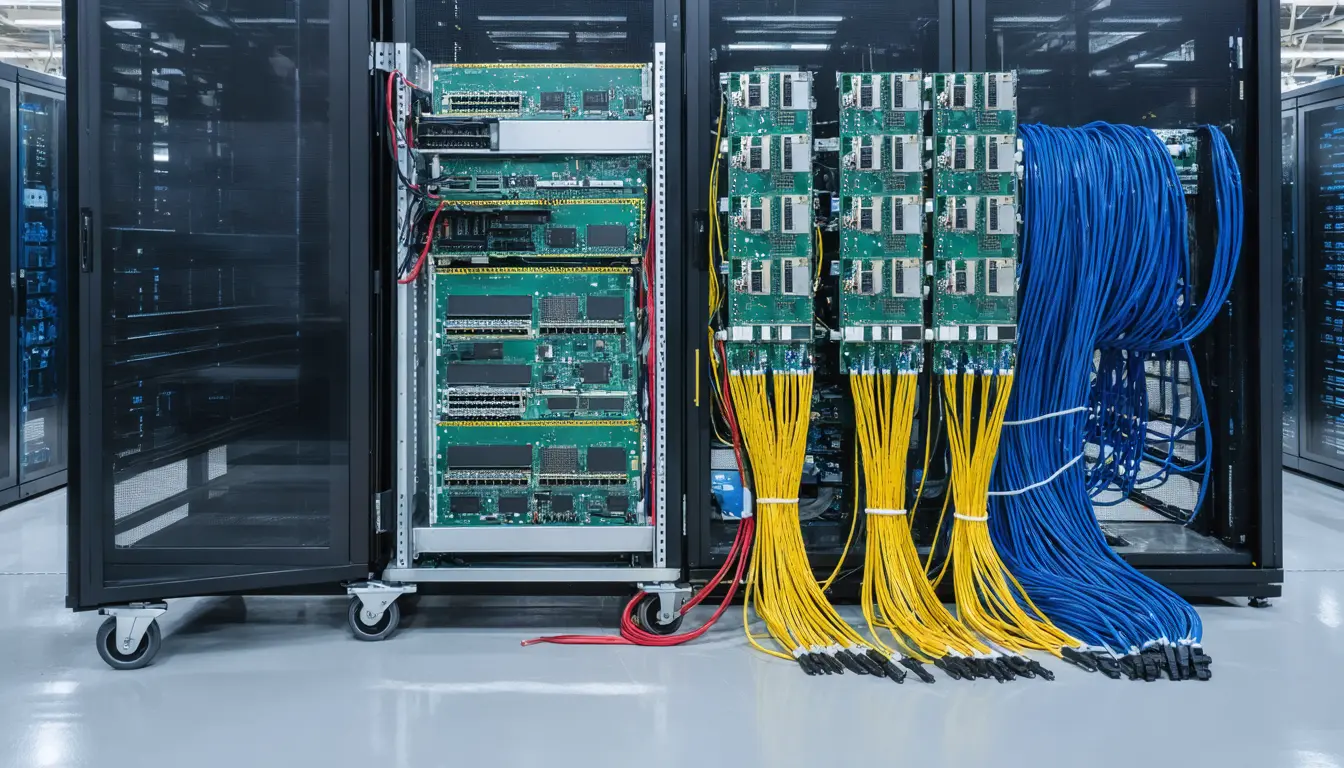
Four figures: IceCube switch blades deliver 102.4 Tbps of 128x800G non-blocking capacity; the 102.4T generation is a 2x bandwidth increase over Meta's 51.2T platforms; in FPF each GPU uses eight independent 100G links; Tahan delivers 6.4 Tbps per MTIA 300 accelerator.
| Figure | Value | Note | Claim |
|---|---|---|---|
| IceCube switch blade, 128x800G non-blocking | 102.4 Tbps | 4 | |
| Gain over 51.2T platforms | 2 x bandwidth | 6 | |
| Each of a GPU's FPF links | 100 G | 7 | |
| Tahan, per accelerator | 6.4 Tbps | 8 |
What happened
- IcePack, Meta's first-generation liquid-cooled network rack, is built on OCP's existing ORV3-HPRv1 rack standard.
- IceCube blades come in a Broadcom Tomahawk6C variant and an NVIDIA Spectrum-6 variant, and both run Meta's open-source FBOSS over OCP's SAI.
- In Flattened Planar Fabric, each GPU uses eight independent 100G links into eight different switches, one per plane, in place of a single-plane uplink.
- On the scale-up side, Meta's MTIA 300 uses an Ethernet-based 51.2T switch called Tahan, delivering 6.4 Tbps per accelerator.
Why it matters
- capability A team qualifying 102.4T switches can compare Broadcom and NVIDIA silicon under one open network OS and one abstraction layer.
- constraint IcePack is a liquid-cooled rack, so adopting it is a facilities decision as well as a purchase: the site needs liquid at the network rack.
- contradiction Meta frames the release as open, yet its FPF learnings are described as shared with cloud partners, and no file release for the fabric is stated.
- decision Vendors and integrators Meta invites to join OSPA now have a v1.0 document to read before deciding whether to build to it.
Each GPU gets eight 100G links, one into each of eight planes [7]. That is 800G per GPU in aggregate [10]. Lose one link and the GPU keeps seven-eighths of its bandwidth, a 12.5% loss, assuming the planes are equal [11].
Meta lists larger non-blocking GPU clusters than single-plane topologies as the first of four FPF advantages [13]. It also says FPF changes the control plane of the fabric, not only how GPUs attach to it [14]. The post text we reviewed does not quantify the cluster-size gain or describe the control-plane change. We'd expect that change to carry most of the adoption cost. Meta says it has shared its FPF learnings with its cloud partners [15].
The switch numbers check out. 128 ports at 800G is 102.4T [12], double the 51.2T platforms IceCube follows [6]. IceCube comes in a Broadcom Tomahawk6C variant and an NVIDIA Spectrum-6 variant. Both run FBOSS, which uses OCP's Switch Abstraction Interface [5].
MetaRoCE has open-source implementations [2]. FBOSS is described as open source [5]. OSPA is a specification submitted to OCP, and it addresses the switch platform layer [1]. For IcePack, IceCube and FPF, the post describes designs. The text we reviewed does not say design files are being released.
In our view, the sensible order of evaluation follows that line. Read the OSPA v1.0 text and test MetaRoCE first, because Meta calls those open. Treat the rack and the fabric as architecture write-ups until a release says otherwise. The only comparative figure in the material is the 2x capacity step over 51.2T. It describes port speed, and how a given training job will behave on it still has to be measured.
Meta invites engineers, silicon vendors, system integrators and operators to join the work [9].
What to watch
- Whether OCP publishes the OSPA v1.0 specification and who beyond Meta, Microsoft and Alibaba signs on.
- Where the MetaRoCE open-source implementations live, under what license, and which NICs they run on.
- Whether IcePack, IceCube or FPF design files and control-plane details are contributed to OCP or stay as architecture write-ups.
Clarity's read
What the record supports and how the coverage leans. The claims behind it follow.
Reality
- Evidence35
- Adoption
- Insufficient
- Hype gap+30
- Incentives60
- Confidence45
Claim ledger
Ranked by verification strength, evidence, and original report placement.
- [1]
OSPA (Open Switch Platform Architecture) is a new OCP initiative, co-led by Meta, Microsoft and Alibaba, that standardizes the switch platform layer; specification v1.0 has been submitted to OCP.
- [2]
MetaRoCE is Meta's RDMA transport protocol for AI networks, now with open-source implementations.
- [3]
IcePack is Meta's first-generation liquid-cooled network rack and is based on OCP's ORV3-HPRv1 rack standard.
- [4]
IceCube switch blades are 102.4-Tbps fabric switches that deliver 128x800G non-blocking switching capacity and sit inside each IcePack rack.
- [5]
IceCube comes in two variants, one built on Broadcom's Tomahawk6C switch ASIC and one on NVIDIA Spectrum-6; both run Meta's open-source FBOSS network operating system, which leverages OCP SAI (Switch Abstraction Interface).
- [6]
The 102.4T generation represents a 2x bandwidth increase over Meta's 51.2T platforms.
- [7]
With Flattened Planar Fabric (FPF), each GPU connects via eight independent 100G links to eight different switches, one per network plane, replacing the traditional single-plane uplink architecture.
- [8]
Meta's MTIA 300 system uses Tahan, an Ethernet-based 51.2T scale-up switch delivering 6.4 Tbps per accelerator, with a preview of a next-generation 72-accelerator-per-rack design on 102.4T silicon.
- [9]
Meta invites engineers, silicon vendors, system integrators and operators to join Meta and the OCP community.
- [10]
Eight 100G links give 800G of aggregate fabric bandwidth per GPU.
- [11]
Losing one of a GPU's eight equal 100G links removes 12.5% of its fabric bandwidth.
- [12]
128 ports at 800G is 102,400G, or 102.4T, consistent with IceCube's stated capacity.
- [13]
The first of FPF's four listed advantages is larger non-blocking GPU clusters compared to single-plane topologies.
- [14]
Meta says FPF changes how GPUs connect to the network and the network control plane of the fabric.
- [15]
Meta says it has shared learnings from FPF with its cloud partners.
Sources
1 independent publisher whose own reporting we read for this story.
Topics and entities
Follow any of these and your For You feed starts watching them — no settings page required.
Topics
- Open Compute ProjectFollow
- AI Data Center NetworkingFollow
- Liquid-cooled data center infrastructureFollow