Build3 distinct publishers3 min readPublished
NVIDIA puts the cost of 3D-Guided Neural Rendering at 50 to 60% of performance. The work of feeding it with guide buffers and per-character masks lands on the art pipeline as much as on the renderer.
The Engineer · Build desk

Compiled by The EngineerSomething wrong?How this is made
Start with what the pass consumes. mezha.net, citing itc.ua, describes a model that reads the finished game frame together with engine data: colours, motion vectors, lighting and surface information [13]. Tom's Hardware's description from its March first look matches, listing engine inputs including the colour buffer and motion vectors in combination with an input frame [6]. One frame in, one frame out, with motion vectors handed over by the engine, and that is where NVIDIA's claim of determinism and temporal stability comes from [12].
Now the price. NVIDIA's own estimate is a 50 to 60% performance reduction with neural rendering enabled [11]. Convert it to frame time, because frame time is the budget you actually hold. A 50% frame rate drop is a 2.0x frame time and a 60% drop is a 2.5x frame time, so the neural pass costs between one and one and a half times everything else the frame does [20]. That cost has to be budgeted as a distinct stage; LOD tuning will not cover it.
The published headline numbers are up to 370 fps at 4K ultra with ray tracing on an RTX 5090, and up to 590 fps at 1440p, and the same source says those runs used an extended DLSS feature set including Super Resolution and Multi Frame Generation, so they do not isolate neural rendering [18]. Apply the 50 to 60% figure to the 4K number and you get 148 to 185 fps [21]. NVIDIA has not published that combined figure, so treat it as arithmetic, not measurement. Tom's Hardware also notes that only 4K results for the 5090 and 5080 were shared, from one game, and reads them as marketing material [8]. For any of it to transfer to your title, your expensive pixels would have to be the ones this model was tuned for: light through ears, light catching hair, skin lit over facial geometry scanned from real athletes [23].
The controls are where the schedule goes. Developers choose between neural models, adjust structure and tone intensity, and apply semantic masks that decide how strongly the model may alter a given object or region [16]. Visual Concepts senior producer Peter Kavic describes setting overall tone and style to match existing art direction, then using a per-pixel uplift control mask to fine-tune detail on characters because likeness has to be respected [3]. That is per-asset authoring with art review attached, against a model NVIDIA says it will keep optimising through the autumn [15].
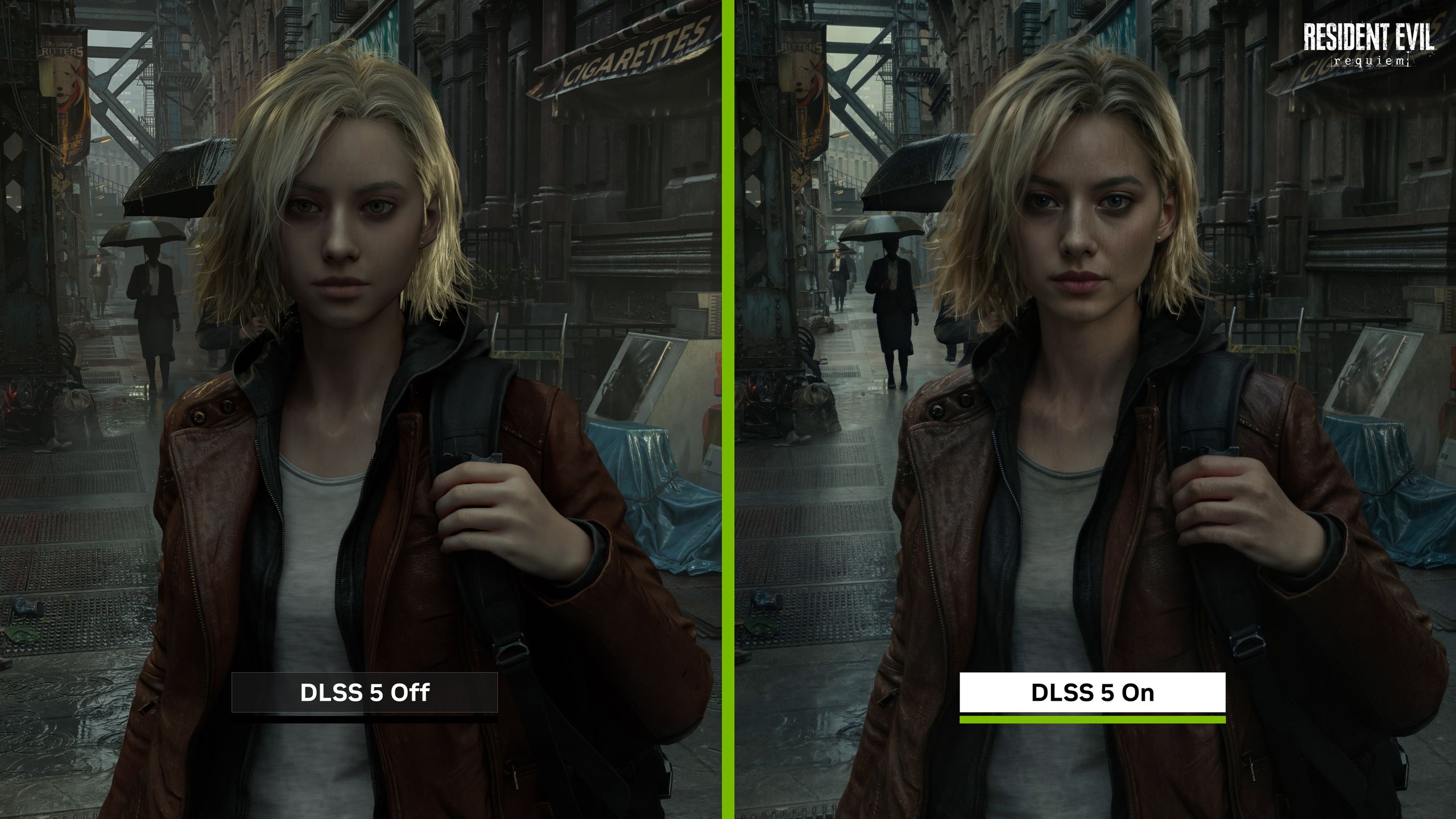
Jensen Huang's framing of DLSS 5 as "the GPT moment for graphics" [10] sits oddly beside a component described as changing the lighting and detail of objects in an already-rendered image [13]. In NBA 2K27 it arrives as a separate option called DLSS Neural Rendering, gated behind a new Game Ready driver and switchable during a match or a replay with F9 [17]. A live A/B key belongs to a stage you can bypass. One scheduling note: mezha.net dates the launch 3 September 2026, while NVIDIA's own post gives the day and the hour without a year [19][2].
Ranked by verification strength, evidence, and original report placement.
DLSS 5 will be available starting September 3rd at 9pm Pacific Time in NBA 2K27, by developer Visual Concepts and publisher 2K, for all GeForce RTX 50 Series GPUs and laptops, and GeForce NOW.
Tom's Hardware reported that the DLSS 5 model is trained to infer how complex scene features such as characters, skin, hair and environmental lighting should look in the real world, given inputs from the game engine including but not limited to the colour buffer and motion vectors, in combination with an input frame.
The technology works on a one input frame to one output frame basis and uses motion vectors supplied by the game engine, which NVIDIA says provides determinism and temporal stability.
Unlike resolution upscaling and frame generation, the new DLSS component focuses on changing the lighting and detail of objects in an already-rendered image, with the model analysing the finished game frame together with engine data: colours, motion vectors, lighting and surface information.
NVIDIA is releasing DLSS 5, which introduces 3D-Guided Neural Rendering, described by the company as a step toward Hollywood-grade photorealism in real-time graphics.
In NBA 2K27 the technology is added as a separate option called "DLSS Neural Rendering", requires a new NVIDIA Game Ready driver also scheduled for September 3, and can be switched on and off during a match or a replay using the F9 key.
Distinct publishers with included, body-backed reporting in this cluster.
mezha.net
1 article · September 1, 2026
nvidia.com
1 article · September 1, 2026
tomshardware.com
1 article · September 1, 2026
Follow any of these and your For You feed starts watching them — no settings page required.
build
China's accelerator swap makes Cambricon supply, not export policy, your ship-date risk1 distinct publisher
build
H200s reach China at 2.5% of the order book, and Hong Kong holds the rest2 distinct publishers
product
Washington's secret AI test is coming for open weights, and release dates go with it2 distinct publishers
invest
Nvidia's August 26 print: 92% of the quarter rides on one segment1 distinct publisher
Evidence-backed comparisons of source perspectives and observed adoption signals. Read the methodology
Which Builder, Operator, and Investor concerns the observed source mix emphasized—not a truth score.
Evidence, demonstrated adoption, hype gap, incentives, and confidence are assessed independently, each on its own current evidence. How these are measured.
Facts firm, measurement absent
Everything with a date attached is solid and cross-checked: the launch time, the hardware gate, the driver, the toggle. Everything about how the pass actually performs rests on the vendor — and the single number the story turns on, the 50-60% cost, reaches us only through mezha.net crediting itc.ua, with NVIDIA's own release not mentioning a performance figure anywhere. Nobody outside the NVIDIA-2K partnership has played it.
One title, one generation, day zero
A single basketball game, a driver that lands the same evening, and a GPU line that has been on sale for a year. NVIDIA promises many more titles in coming weeks and months, which is a roadmap, not adoption. The liveliest deployment in this story is unsanctioned: Tom's Hardware reports modders already running the leaked DLL on Turing-era cards, which tells you about demand rather than about support.
Vocabulary ahead of the measurement
"The GPT moment for graphics" is a large sentence to hang on a feature that, by its maker's own estimate, hands back half to two-thirds of your frame rate and runs in one sports game. The underlying mechanism is genuinely constrained — engine buffers as an unyielding foundation, artist masks over faces — so this is not vapour. But the photorealism framing arrives with no independent test, and Tom's Hardware is right that a one-game, 4K-only, top-two-cards benchmark set is a claim about marketing confidence rather than performance.
Feature sells the silicon it needs
The mechanism description, the performance numbers and the enthusiastic quote all originate with the company that sells the only hardware this runs on, or with the studio it partnered with for launch. The disclosure pattern follows the incentive precisely: 4K results for the two priciest cards, no isolated cost for the pass itself, no answer on whether a 40-series owner ever gets it. Tom's Hardware names the marketing provenance; mezha.net faithfully relays the vendor framing without that caveat.
Sure about the trade-off, not its size
We can say with confidence what the pass does, what it needs from the engine, and what hardware it demands. The magnitude is another matter: one relayed sentence carries the 50-60% figure and the arithmetic built on it, and the 370 fps headline cannot be reconciled with that cost because nobody has said whether the neural pass was even on. September 3 converts most of this from assertion to measurement within a day.