Invest3 publishersIndependently confirmed2 min readPublished
Korea loads half of its 10-satellite NEONSAT constellation onto Nuri's fifth flight
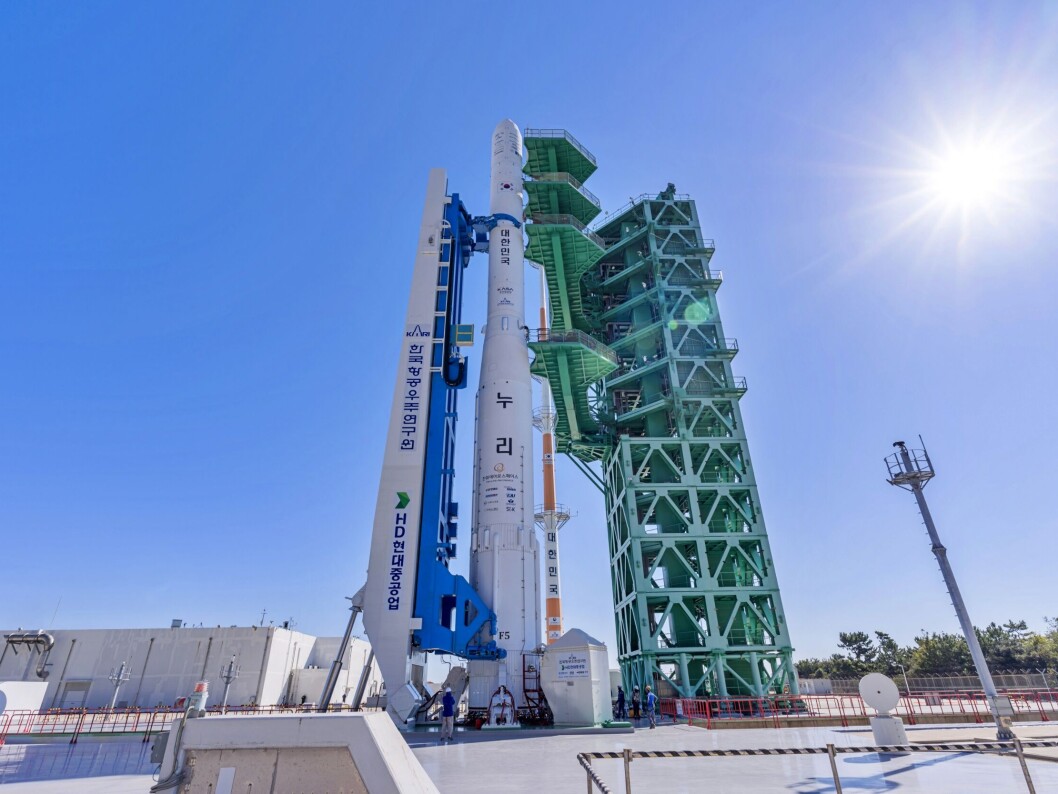
Korea's Nuri rocket is set to carry 15 satellites on its fifth flight, including half of a planned 10-satellite NEONSAT constellation. The other five need a sixth flight next year, the date that tests whether Korea can launch on a schedule.
The Investor · Invest desk
Drafted by a language model from the sources cited here and checked against its claim ledger before publication. How we use AISend a correction
What happened
- KASA administrator Oh Tae-seok set liftoff for 12:25 p.m. Wednesday from the Naro Space Center in Goheung.
- The flight is Nuri's first attempt to release, in sequence, several primary satellites designed to perform the same mission.
- Each NEONSAT weighs under 100 kilograms and carries a camera that resolves objects of 1 meter in black-and-white and 4 meters in color.
- Once all 10 are up, the constellation is meant to image the Korean Peninsula more than three times a day and revisit any spot within 24 hours.
Compiled by The InvestorSomething wrong?How this is made
Why it matters
- capability A clean release of five identical primaries would show Korea's own rocket can build a constellation in batches of five per flight.
- decision Anyone pricing Korean space suppliers on launch frequency has to wait for next year's flight, since this one supplies a method and a single date.
- exposure The peninsula coverage meant for security and disaster response depends on a second launch date that has not yet been tested.
Releasing five identical primaries one after another leaves little slack in the timing. NEONSATs 2 through 6 go out 35 to 40 seconds apart, and the upper stage turns about 45 degrees between each release to prevent collisions [2]. Four gaps of that length take 140 to 160 seconds [19]. The 10 CubeSats then leave in pairs at 10-second intervals [3]. That is four more gaps and 40 more seconds, so the separations alone run at least three minutes [19]. Deployment begins between 810 and 960 seconds after liftoff at about 575 kilometers, and the flight ends roughly 20 minutes after liftoff with a collision-avoidance maneuver and a fuel vent [4][5].
That timing tests the hardware. A launch rate needs a second date, and the only one in the reports is the sixth flight, set for next year with the other five NEONSATs [9]. The clean outcome is all five primaries in orbit this week and flight six on time, completing the set. A slip in flight six would leave half a constellation in orbit [17]. A failed sequential release would put the problem in the deployment method before the calendar matters at all.
I think the case for a regular Korean launch schedule stays open until flight six leaves the pad. The counter-case is this week's discipline. According to Sedaily, the 15-satellite manifest is a record [6]. Oh Tae-seok, the KASA administrator, said the launch management committee reviewed technical readiness, weather, the space environment and the chance of collision with space objects, and found all launch conditions met [13]. "Launch preparations are proceeding normally according to the planned schedule," Oh said [14]. "We decided to proceed with the fifth launch of the Nuri rocket as scheduled today," he said [15]. If flight six slips past next year, the routine-launch case fails, however this flight goes.
For investors in Korea's space suppliers, the evidence so far is engineering. The five primaries weigh under 500 kilograms together [18]. They are built to watch the Korean Peninsula and surrounding areas for national security and disaster response [16]. The launch coverage does not include a launch price, a contract value or the names of the companies that built the rocket and satellites. Nuri's next scheduled flight already has a booked payload, the remaining five NEONSATs [9].
What to watch
- Whether KASA confirms that all five NEONSATs reached their target orbit after the sequential separations.
- Any published cost per Nuri launch, or a contract award naming the builders of the rocket and the satellites.
- Whether any Nuri flight after the sixth is given a date.