ProductNot yet confirmed elsewhere1 publisher2 min readPublished
MSI's $1,300 gaming laptop shows where 2026 laptop budgets get cut: memory and storage
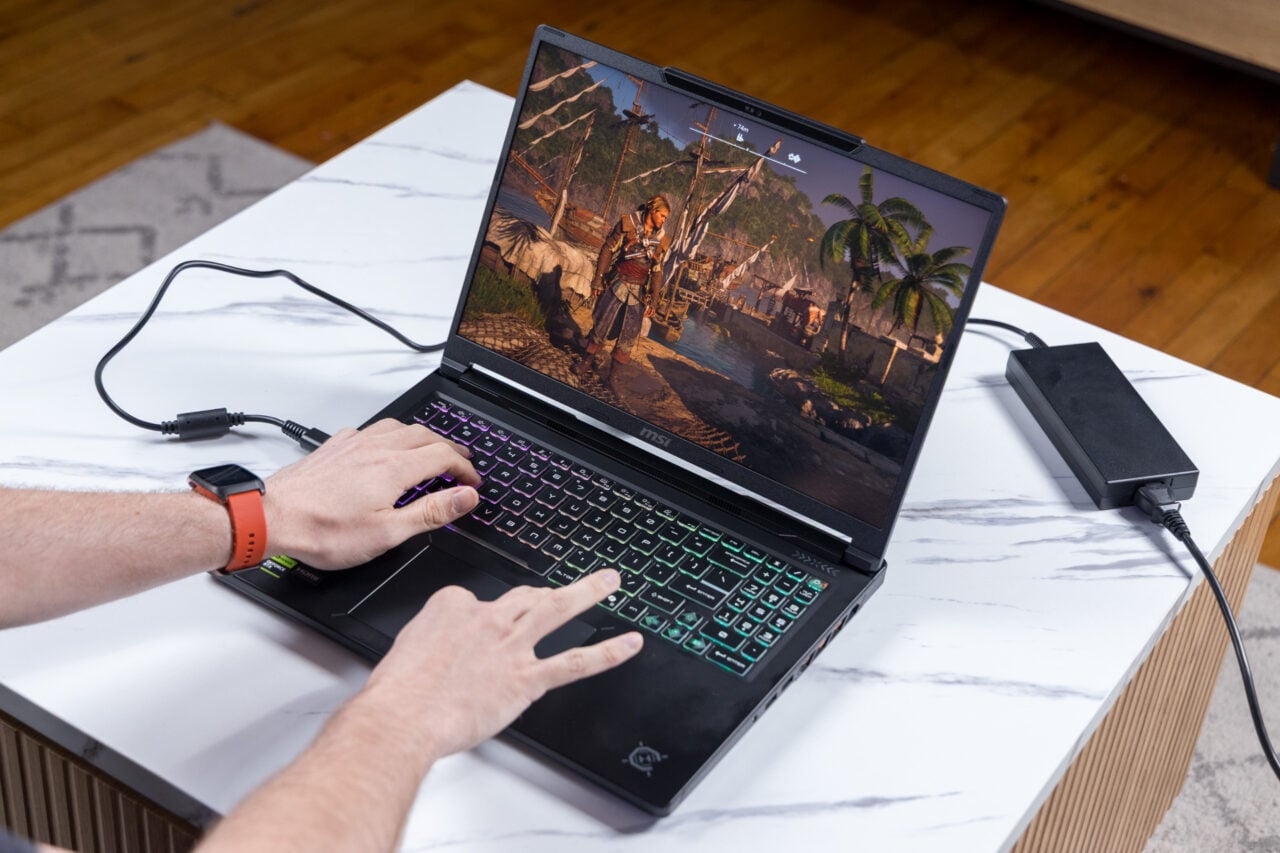
MSI pairs a current RTX 5060 with a last-generation Core i7, 16GB of RAM and a 512GB SSD at $1,300. Spec the 2026 refresh on the parts that got trimmed, not the one on the sticker.
The Product Desk
What happened
- MSI's Crosshair 16 HX model E14WFK-036US pairs a current RTX 5060 laptop GPU with a last-generation Core i7 14560HX, 16GB of RAM and 512GB of storage.
- Gizmodo puts the street price at $1,300, with this configuration sold only through Walmart.
- The reviewer says that a year ago the same money would have bought those specs comfortably, and the 512GB SSD would have looked expensive.
- Listed drawbacks include performance issues at low power, odd port placement and storage the reviewer expects to become annoying.
Why it matters
- cost The per-seat number can stay flat into 2026 while what it buys shrinks, so a refresh signed off at last year's price is quietly buying less headroom than the finance sheet suggests.
- decision Order forms written GPU-first will now approve machines whose memory and disk are the reason they get retired early, which argues for putting those two lines at the top of the spec and treating...
- constraint A 512GB disk pushes anything sizable onto external drives or the network, and the review already expects that to grate before the warranty is out.
- exposure Buyers acquiring this only for a mobile RTX 5060 take on the 16GB ceiling and the consumer chassis as part of the deal: the GPU is the reason to buy it, the memory is the reason to replace it.
Read the configuration as a budget allocation and the ranking is legible. The panel kept 240Hz at 2,560 x 1,600 but arrived with no variable refresh rate or G-Sync [2], and thermals and display brightness sit among Gizmodo's listed strengths [8]. The money went to the GPU and to the screen's headline numbers. The reductions landed on things a buyer meets in month eighteen rather than in the store: the CPU generation, the frame-pacing hardware, the memory tier and the disk [12].
The reviewer supplies the reason the processor was safe to cut. The machine "boasts a surprising amount of power despite the use of older-gen components" [9]. If a Raptor Lake part still delivers what the buyer came for, the previous generation is the cheapest line on the bill to hold, and MSI held it. Memory and storage are a different story. Gizmodo's headline frames the whole trim as the price of beating what it calls the RAMpocalypse, and it says prices keep getting worse [6]. Those two line items are not low because 16GB and 512GB are sufficient. They are low because they are the parts whose cost moved.
A purchase template reading "5060-class GPU, 16GB, 512GB" was an unremarkable ask in 2024 [1]. The same string in 2026 describes a machine the vendor arrived at by reducing the two components that decide how long it stays in service [12], and it will clear procurement untouched precisely because the string did not change.
What the review does not settle is whether the memory or the SSD can be replaced on this chassis, which is the single fact separating 16GB as a starting point from 16GB as the machine's ceiling for its whole service life. The recommendation is also aimed at students and gamers on a budget [6], not at a purchasing department, and this is one SKU through one retailer [4]. The review does name the buyer most likely to be caught: someone who wants a mobile RTX 5060 for work [10]. On the storage, Gizmodo's line is that you will not get even a sliver of a Steam library onto it [5], and a work image with toolchains and local assets is no more forgiving than a games folder.
Price is the number the vendor holds constant. What it now spends to hold that number constant is the specification itself.
What to watch
- Whether the same chassis appears at 32GB and 1TB, and what premium MSI attaches to it, which would show whether this trim was price-holding or parts supply.
- Whether the memory and SSD on this model are user-replaceable, the fact the review leaves open and the one that decides its fleet life.
- Whether the low-power performance drop reproduces in other tests, since it currently rests on a single reviewer's observation.
Clarity's read
What the record supports and how the coverage leans. The claims behind it follow.
Reality
- Evidence45
- Adoption
- Insufficient
- Hype gap+20
- Incentives50
- Confidence42
Claim ledger
Ranked by verification strength, evidence, and original report placement.
- [1]
The reviewer writes that a year ago the $1,300 price point would have seemed perfectly achievable with these specs, and would probably have been too expensive considering the 512GB SSD.
ReportedSupportedSource: Gizmodo review2 sources— create a free account to open themView cited source - [2]
The display is a QHD+ (2,560 x 1,600) IPS LCD with a 240Hz refresh rate, and it does not include variable refresh rate, Nvidia G-Sync or any equivalent anti-tearing technology.
- [3]
The MSI Crosshair 16 HX, model E14WFK-036US, ships with 16GB of RAM, an Nvidia RTX 5060 laptop GPU, an older Intel Raptor Lake chip (the Core i7 14560HX) and 512GB of storage.
- [4]
Gizmodo says the laptop can be found for $1,300, and that this specific model is only available through Walmart.
- [5]
The reviewer says you are not getting even a sliver of your Steam library onto this laptop's storage.
- [6]
Gizmodo's review headline calls the compromise the cost of beating the 'RAMpocalypse', says prices just keep getting worse, and advises students or gamers on a budget to seriously consider the machine.
- [7]
The review's listed cons include performance issues at low power, odd port placement, and minimal storage that will get annoying.
- [8]
The review's listed pros include a bright, fast display, excellent thermals, and performance for gaming and beyond.
- [9]
The reviewer writes that the laptop boasts a surprising amount of power despite the use of older-gen components.
- [10]
The reviewer notes some potential buyers are looking at the laptop for work because they just need a mobile RTX 5060, and says they will have to live with the RGB and decals.
- [11]
The chassis is plastic with stencilled gamer decals, a four-zone RGB keyboard with a scrunched numpad, and a trackpad that is not centred with the typing keys and has a dead zone about an inch from the keyboard.
- [12]
Across this model's main spec lines, only the GPU is current generation: the CPU is a previous-generation Raptor Lake part, the display omits variable refresh, and memory and storage sit at entry tier, so every reduction falls somewhere other than the GPU.
- [13]
Because the $1,300 price is unchanged while the reviewer says the same specs would have looked achievable or even overpriced a year ago, the increase shows up in the specification rather than in the price tag.
Sources
1 independent publisher whose own reporting we read for this story.
- gizmodo.comMSI Crosshair 16 HX E14W Review: Beating the RAMpocalpyse Requires Compromise
1 article · August 24, 2026
Topics and entities
Follow any of these and your For You feed starts watching them — no settings page required.
Topics
- Component Generation MismatchFollow
- Hands-On Consumer Hardware ReviewFollow
- Display TechnologyFollow
- Memory and Storage PricingFollow
- Gaming LaptopsFollow