Finland converts a nuclear prohibition into a NATO option by 64 votes
The amended Nuclear Energy Act took effect on July 1 and permits weapons handling Helsinki says it has no plans to use, and Moscow's promised effective measures remain the only unpriced part of the trade.
The Investor · Invest desk
What happened
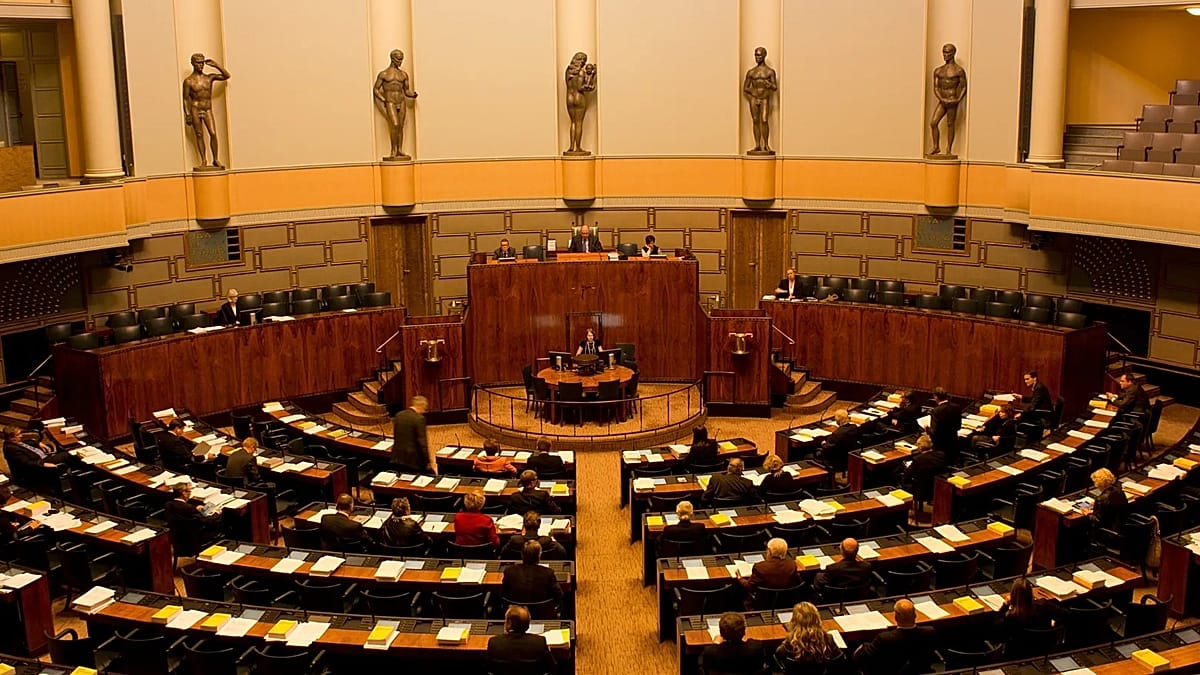
- Finland's parliament voted 125 to 61 in mid-June to amend the Nuclear Energy Act, stripping out a long-standing statutory prohibition on nuclear weapons.
- Kremlin spokesman Dmitry Peskov and former president Dmitry Medvedev called the change a direct escalation demanding a response, and Russia said it would elicit what it terms effective measures.
- Finland and Russia share a 1,340 km border, the longest boundary any NATO member has with Russia.
Why it matters
- capability Helsinki no longer needs a bill to say yes, so the next move belongs to the alliance rather than to the Finnish parliament, and the country's position can now change without another vote.
- constraint Participation in the existing model means American warheads flown by allied aircraft, so Finland cannot exercise its new option alone, and with domestic manufacture still banned it has no substitute route.
- exposure A countermeasure with no stated content and no date cannot be insured, budgeted or timed, which leaves anyone holding Finnish-side assets carrying an open-ended cost rather than a quantified one.
- contradiction Helsinki reads the statute as defensive alignment and Moscow reads it as escalation requiring an answer, and until one of those readings produces an action there is no number to work from.
Start with the arithmetic, because it says how contested this was: 125 for and 61 against is 186 ballots cast [1][10], a margin of 64 [14], and a yes share of 67.2 percent of the members who turned up [11]. Stubb signed on June 26 and the amendment was live on July 1, five days later [2][12]. Five days from signature to force is the timetable of a government moving quickly, not one hedging its position.
What Helsinki has acquired is an option, and a cheap one. The statute keeps the ban on manufacturing nuclear explosives while permitting defence-related handling, which is the legal plumbing for joining the alliance's sharing arrangements should it ever ask [4]; in that model the warheads are American, stationed on host territory and delivered by allied aircraft, as they are for Belgium, Germany, Italy, the Netherlands and Turkey [8]. Finland would be the sixth name on a list of five [13]. The vote commissioned less than it might look: Finnish leaders say no permanent stationing is planned [5], the amendment still bars a production line [4], and the reporting attaches no euro figure to any of it.
The premium sits on the other side of the trade. Peskov and Medvedev call the change a direct escalation demanding a response, and Russia's chosen formula is effective measures [7], still being repeated in late August, roughly two months after the law took force [15][16]. A treasurer cannot discount an unspecified countermeasure into a cash flow or hedge it; the only option is to carry it as an open liability. What can be located is the geography of the carry: Finland ended some 75 years of non-alignment when it joined NATO in April 2023 [3], and the statute book has now caught up with the treaty.
What happens next matters more for its sequence than for the volume of the rhetoric around it. The alliance never asks, Moscow's measures stay verbal, and the amendment turns out to be legal tidying that cost one afternoon of floor time. Or the Kremlin attaches content to the phrase, at which point there is finally something dated and specific for anyone with Finnish exposure to work with. Or NATO does ask, and a free option becomes an appropriation for handling, storage and aircraft that somebody in Helsinki has to defend line by line.
My read is the dormant branch, the version I would fund rather than the version I would argue: Finnish officials went out of their way to frame the change as alignment with collective defence without aggressive intent [6], and the retained manufacturing ban [4] means nothing physical arrives without a decision taken outside Finland. What would prove it wrong is a sharing request that names Finland. Until then the security premium is a statute, not a spend.
What to watch
- Whether Moscow ever attaches a dated, specific action to the phrase effective measures, or leaves it verbal.
- Whether Finnish appropriations start carrying lines for weapons handling, storage or dual-capable aircraft.
- Whether the alliance's list of nuclear sharing hosts moves off the five countries named.
Clarity's read
What the record supports and how the coverage leans. The claims behind it follow.
Reality
- Evidence28
- Adoption12
- Hype gap+22
- Incentives62
- Confidence40
Claim ledger
Ranked by verification strength, evidence, and original report placement.
- [1]
Finland's parliament voted 125-61 in mid-June to amend the country's Nuclear Energy Act, stripping away a long-standing prohibition on nuclear weapons.
- [2]
President Alexander Stubb signed the legislation on June 26 and it took effect on July 1.
- [3]
Finland joined NATO in April 2023, ending roughly 75 years of non-alignment.
- [4]
The amended law retains prohibitions on manufacturing nuclear explosives and allows defence-related nuclear weapon handling, giving Finland the legal framework to participate in NATO's nuclear sharing arrangements if the alliance asks.
- [5]
Finnish leaders have been explicit that there are no immediate plans for the permanent stationing of nuclear arms.
- [6]
Finnish officials framed the decision in purely defensive terms, as bringing Finland into full alignment with NATO's collective defence without representing aggressive intent.
- [7]
Senior Russian officials including spokesman Dmitry Peskov and former president Dmitry Medvedev characterised Finland's decision as a direct escalation demanding a response, and Russia warned the change would elicit what it calls effective measures.
- [8]
Several NATO members already host nuclear sharing arrangements in which US nuclear weapons can be stationed on their territory and delivered by allied aircraft: Belgium, Germany, Italy, the Netherlands and Turkey.
- [9]
Finland and Russia share a 1,340 km border, the longest boundary between any NATO member and Russia.
- [10]
The vote involved 186 ballots cast.
- [11]
The yes side took 67.2 percent of the votes cast.
- [12]
Five days elapsed between the president's signature and the law taking effect.
- [13]
Five NATO members are named as current nuclear sharing hosts, so Finland would be a sixth if it ever participated.
- [14]
The amendment passed by a margin of 64 votes.
- [15]
Russia's warnings came as recently as late August, which cryptobriefing.com reads as evidence the Kremlin treats the change as an ongoing grievance rather than a one-off diplomatic complaint.
- [16]
Russia was still issuing warnings roughly two months after the amendment entered into force.
Get this ledger inside ChatGPT. Ask about any of our stories and the answer brings its figure, each claim’s verdict and the sources. Free, no account.
Sources
1 independent publisher whose own reporting we read for this story.
- cryptobriefing.comMoscow vows effective measures in response to Finland’s nuclear weapons policy change
1 article · August 29, 2026
Topics and entities
Follow any of these and your For You feed starts watching them — no settings page required.