Science1 publisher2 min readPublished
Arginine intercalated into 1T-TaS2 holds its commensurate charge-density wave to 330 K
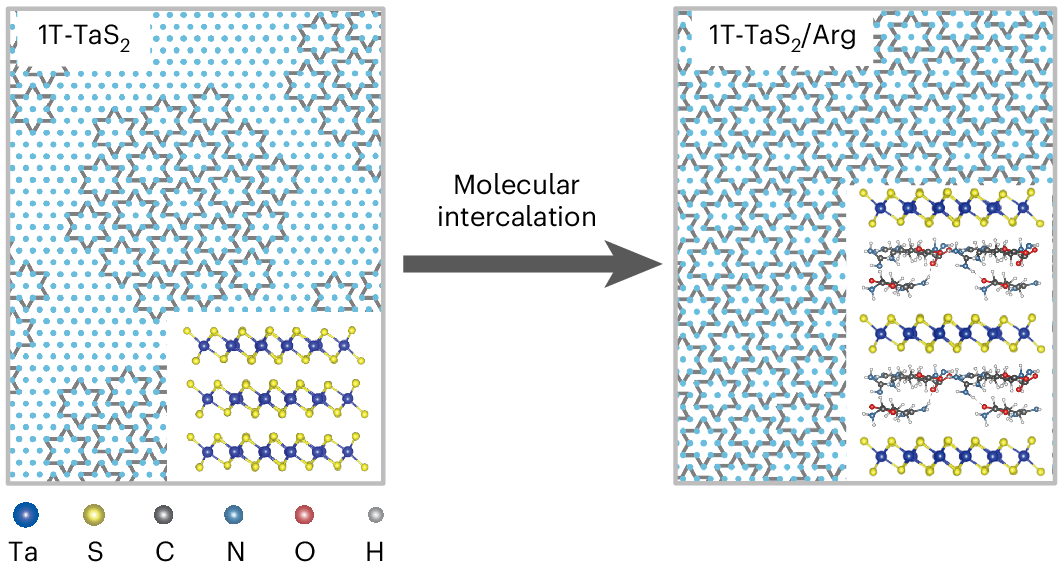
Arginine placed between the layers of 1T-TaS2 keeps the crystal's commensurate charge-density-wave phase stable up to 330 K, a paper on nature.com reports. That puts a correlated state normally confined to cryogenic temperatures within reach of uncooled experiments.
The Scientist · Science desk
What happened
- The authors attribute the higher stabilization temperature to strong non-covalent interactions between the intercalated arginine and the 1T-TaS2 atomic layers.
- Other amino acids that bind the layers more weakly shifted the charge-density-wave phase transitions less than arginine did.
- Computational modelling in the paper finds arginine reshapes the charge-density-wave energy landscape, adding both thermodynamic stability and kinetic robustness against thermal fluctuations.
- The paper cites a 2020 ACS Nano report of a room-temperature commensurate charge-density wave in epitaxial bilayer 2H-tantalum sulfide on hexagonal boron nitride.
Compiled by The ScientistSomething wrong?How this is made
Why it matters
- capability Work on the commensurate phase of 1T-TaS2 could move to uncooled sample stages, provided the phase in the hybrid behaves like the cryogenic one near room temperature.
- precedent Groups working on other layered crystals get a selection rule to test: rank candidate intercalant molecules by how strongly they bind the host layers.
- constraint Stability at 330 K settles the temperature question alone; a device built from the hybrid would also have to tolerate air and fabrication, a separate experiment.
Converted, 330 K is about 57 C [1], comfortably above an ordinary laboratory room. The starting point is described less precisely. The authors say only that the unmodified phase is intrinsically limited to cryogenic temperatures [2]. The abstract does not give the pristine transition temperature, the technique used to detect commensurate order, or whether 330 K was recorded on heating or cooling. Without the first of those, the size of the shift cannot be computed from the published summary.
The heating-or-cooling question matters because of how the modelling explains the effect. Thermodynamic stability and kinetic robustness [7] are different properties. The first means the commensurate arrangement is the lower-energy state at a given temperature. The second means it resists disruption by thermal fluctuations once it has formed. A phase with a high enough barrier can persist on warming past the temperature where it stops being favoured, so a heating curve and a cooling curve need not agree. I'd expect the full paper's data to show how much of the 330 K [4] comes from each.
The amino-acid comparison [6] is the most useful piece of the design. Any intercalant pushes the layers apart. If separation alone moved the transition, a weakly binding amino acid should have done about as well as arginine, and it did less. That points to the strength of the molecule-layer interaction [5] as the variable that matters. Across the molecules tested this is still a correlation. The causal account comes from the computational model [7].
Room-temperature commensurate order in tantalum sulfide has a precedent in the 2H polytype [9]. The reference list also includes a 2024 Nature Communications paper on endotaxial stabilization of two-dimensional charge-density waves [10]. The new contribution is a molecular route in 1T-TaS2, the polytype the authors tie to diverse emergent quantum phenomena [1]. The cited titles show what those include: a Mott state giving way to superconductivity in 1T-TaS2 [11], a high-temperature quantum spin liquid with polaron spins [12], and ultrafast switching to a stable hidden quantum state in an electronic crystal [13].
The authors wrote that stabilizing the phase at room temperature would "offer new opportunities to investigate and control emergent phenomena under ambient conditions" [3]. They go further and call the work "a versatile molecular engineering strategy for tailoring correlated states and electronic orders in van der Waals materials" [8]. I think the evidence in the abstract supports something narrower and still good: one molecule, in one crystal, holding a cryogenic phase to about 57 C [1].
What to watch
- Spectroscopy or transport data showing whether the Mott-insulating behaviour of the commensurate phase survives in the arginine hybrid near room temperature.
- Independent groups reproducing the 330 K stabilization, or applying strongly binding intercalants to other van der Waals materials.