Science1 distinct publisher3 min readPublished
A catalytically dead Csm enzyme posted 78 to 90 percent apparent knockdown by RT-qPCR. That result points at guide RNA surviving extraction rather than at any cutting. The primer design that produced it is field convention.
The Scientist · Science desk

Compiled by The ScientistSomething wrong?How this is made
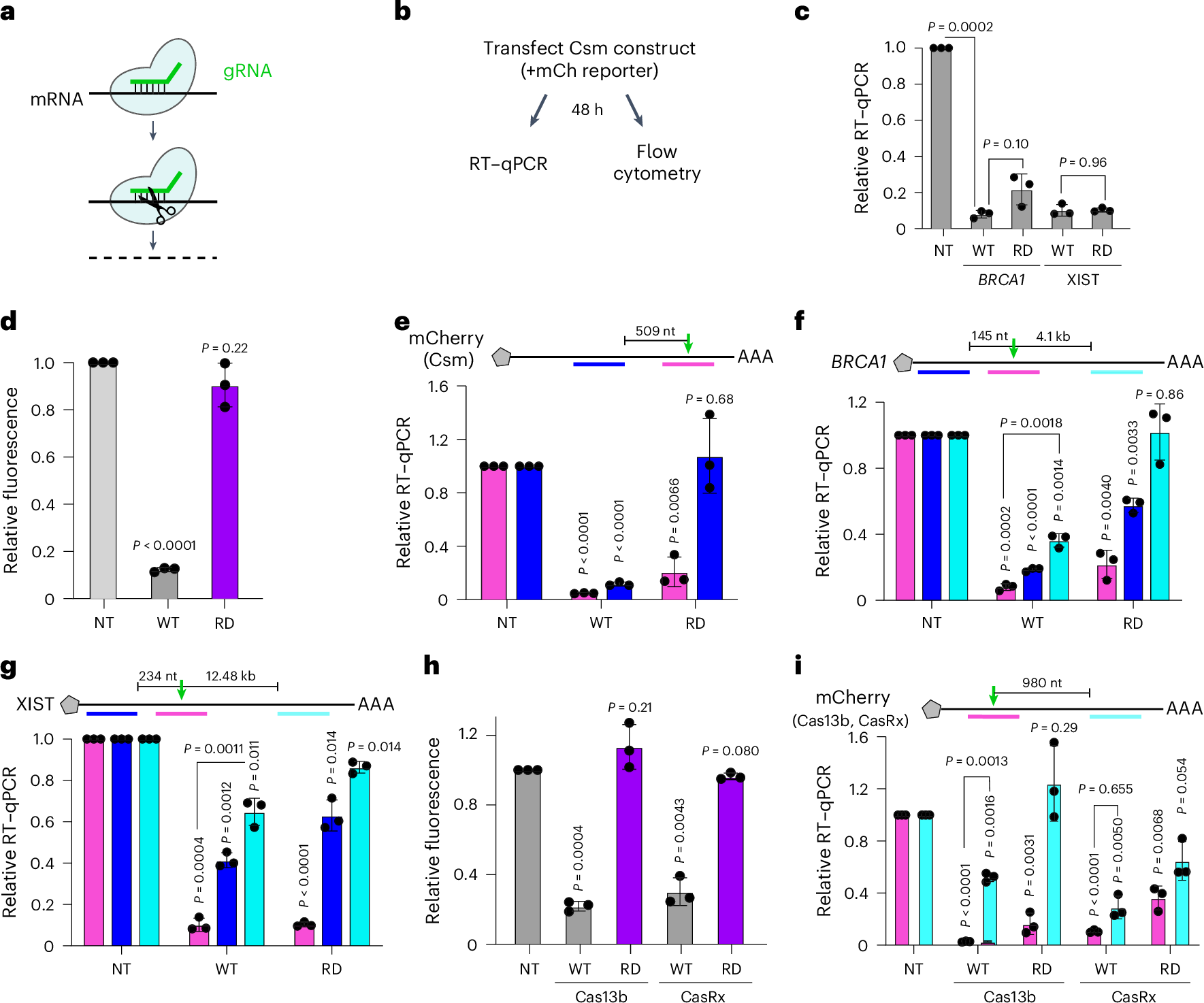
The persuasive part of this is the control, and it is a boring one. Csm3-D33A differs from the active enzyme at one residue in the nuclease site, so it should cut nothing, and it duly reduced no protein. By RT-qPCR it looked about as effective as wild type [5]. The DNase-dead and double mutants did the same, and changing the RNA extraction method did not remove the effect [6].
An explanation was already in circulation: a bound ribonucleoprotein sitting inside an open reading frame might interfere with translation or nuclear export and hasten decay [7]. XIST is the awkward case for that, since it is neither translated nor exported, and dead Csm still produced apparent knockdown of it [7]. So the authors built an mCherry reporter they could read as both RNA and protein from a single sample [8]. Active Csm cut the protein and the RNase-dead version did not. The DNase-dead version behaved like wild type, which puts the real knockdown in Csm3's RNase activity and makes Csm1's DNase activity dispensable for it [9].
The size of the gap deserves a second look, because percent knockdown is a compressed scale near the top. On XIST, the amplicon spanning the guide site reported 90 percent for active Csm while the downstream amplicon reported 35 percent [15]. Restated as transcript remaining, that is 10 percent against 65 percent, so the spanning primer implies six and a half times less surviving RNA than the downstream primer does [18]. For BRCA1 the same conversion gives 8 percent against 36 percent, a factor of 4.5 [19]. With the dead enzyme, BRCA1's spanning amplicon still read 78 percent and its upstream amplicon 42 percent, while the downstream amplicon correctly read no knockdown at all [13].
The abstract's mechanism is that guides survive RNA extraction and inhibit the reaction [2]. The recommended fix, a processive reverse transcriptase with strong strand-displacing activity [3], is the tell about what kind of inhibition this is: my reading is a physical block that has to be read through, not something you dilute away.
What remains open is how much of the RNA-targeting CRISPR literature this affects, and by how much. The authors flag their own reproduction target, since the published XIST and BRCA1 amplicons spanned the guide sites [12], and the same split appeared for PspCas13b and CasRx [16]. These systems still worked at the protein level; knockdown by the active enzymes was real throughout [8]. The paper also stops short of testing the other routes to knockdown it lists, siRNA, shRNA and antisense oligos [21], so nothing here licenses a claim about them. Conditional on primer geometry, my view: a knockdown percentage taken from an amplicon over the guide site, with no downstream amplicon, dead-enzyme arm or protein readout beside it, is an upper bound rather than a measurement [17].
Ranked by verification strength, evidence, and original report placement.
A paper titled 'A pervasive RT-qPCR artifact inflates RNA knockdown by RNA-targeting CRISPR' was published by nature.com.
The authors report that guide RNAs copurify during RNA extraction and inhibit RT-qPCR for amplicons spanning or upstream of the guide RNA binding site, resulting in overestimation of knockdown efficiency across all CRISPR systems tested.
The authors recommend using a processive reverse transcriptase with strong strand-displacing activity, together with orthogonal methods, to ensure accurate quantification when using RT-qPCR.
To reproduce published Csm-mediated knockdown, the team targeted nuclear-localized XIST and cytoplasmic BRCA1 using reported guide RNAs, primer sets and a nuclear-localized all-in-one Csm construct, and observed knockdown efficiencies similar to those reported.
The RNase-dead Csm mutant (Csm3-D33A) exhibited apparent knockdown comparable to wild-type Csm by RT-qPCR, despite showing no protein-level knockdown.
DNase-dead Csm (Csm1-D16A) and a double mutant (Csm1-D16A, Csm3-D33A) also yielded strong apparent knockdown, independent of the RNA extraction method used.
Distinct publishers with included, body-backed reporting in this cluster.
1 article · August 31, 2026
Follow any of these and your For You feed starts watching them — no settings page required.
science
The self-driving lab is out. Whether AI shows up in your filing is still open.1 distinct publisher
science
Selenium's metabolite zoo finally gets one naming system, two decades late1 distinct publisher
science
A parameter-free tree replaces UMAP, and turns up an NK cell subtype from the myeloid lineage1 distinct publisher
science
Recasting UniFrac as weighted Jaccard makes a 15,000-study metric up to a thousand times faster1 distinct publisher
Evidence-backed comparisons of source perspectives and observed adoption signals. Read the methodology
Which Builder, Operator, and Investor concerns the observed source mix emphasized—not a truth score.
Evidence, demonstrated adoption, hype gap, incentives, and confidence are assessed independently, each on its own current evidence. How these are measured.
Controls carry the argument, one lab supplies them
The negative control does the arguing here. An enzyme with its RNase site mutated out posted 78 to 90 percent knockdown on spanning amplicons while producing no protein change, DNase-dead and double mutants behaved the same, and the pattern held for PspCas13b and CasRx. Then the mechanism is nailed down rather than asserted: proteinase K did not rescue the signal, RNase treatment of cDNA did not either, spiking synthetic guide RNA into the reverse-transcription step reproduced the effect concentration-dependently, and a capped antisense oligo against the guide reversed it. The ceiling is provenance — every panel, control and percentage comes from one Nature report, 'all systems tested' means three, and the methods text available to us is truncated.
The flawed convention is adopted; the correction is not yet
Adoption here runs the wrong direction. What is in wide use is the design that fails: Nature's authors call the spanning amplicon a common strategy, cite three published studies using it, and reproduced prior Csm efficiencies with those studies' own guides and primers — so the artifact is already inside the literature. Against that, nothing in this reporting shows a single laboratory switching reverse transcriptase, moving its primers downstream or re-scoring existing data. One paper, one day old, with the field's response still unwritten.
Numbers understated if anything, scope slightly ahead of the data
The arithmetic is honest and the paper is careful with hedges — 'may have been inflated' where a louder version would have said 'were'. Where the framing gets ahead of the bench is reach: 'pervasive' rests on three CRISPR systems in one laboratory, and siRNA, shRNA and antisense oligonucleotides are named in the opening paragraph as knockdown routes but never tested for the same reverse-transcription interference. A small overshoot in a report that mostly lets a dead enzyme's 90 percent score speak for itself.
Awkward finding, thin commercial edge, no disclosures visible
The team that found the artifact is undercutting the very results it set out to reproduce, including the Csm work it was benchmarking against — a finding that costs its authors something, which is a decent sign. The one commercial contour is the prescription: switch to a processive, strand-displacing reverse transcriptase, a reagent class recommended without a named product or a side-by-side comparison in the text available here. Funding, competing interests and author affiliations do not reach us, so this reads as structure rather than disclosure.
Mechanism convincing, corroboration absent
I would bet on the mechanism: the ruled-out alternatives stack up neatly, inhibition localises to reverse transcription rather than qPCR, guide RNA alone reproduces the effect and a complementary capped oligo reverses it. What keeps this in the sixties is everything around the mechanism — a single fresh paper, no replication, no measurement of how much published knockdown data is affected, no test of whether siRNA or antisense workflows share the problem, and only part of the methods in front of us.