Science1 publisher2 min readPublished
One ligand with four unequal catechol sites yields seven conductive frameworks
Chemists made three copper frameworks and four bimetallic ones from a single ligand whose catechol groups do not react alike. Modelling and single-crystal measurements say the topology changes how charge moves.
The Scientist · Science desk
What happened
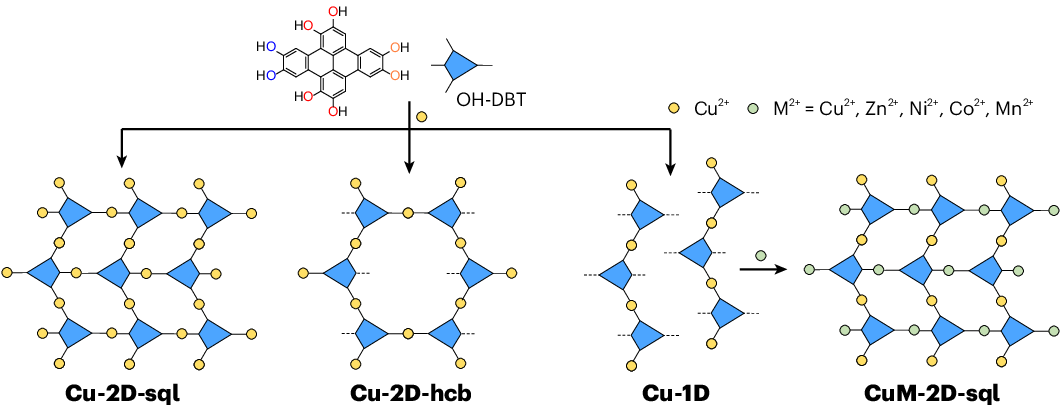
- Researchers used a single octahydroxy ligand whose catechol groups differ in reactivity to build seven distinct conductive metal-organic framework crystals, a strategy they call anisotropic reticular chemistry.
- Site-selective coordination with copper alone produced three different topologies from that one ligand: a two-dimensional square lattice, a two-dimensional honeycomb and a one-dimensional linear chain.
- Theoretical modelling together with single-crystal electrical measurements showed that changing the topology and the node composition this way modulates how charge moves through the frameworks.
Compiled by The ScientistSomething wrong?How this is made
Why it matters
- capability A chain that keeps unreacted binding sites turns the second metal into something a chemist sets, since copper's positions are already fixed before the nickel, cobalt, zinc or manganese goes in.
- constraint Anyone comparing these seven against established conductive MOFs for a device will need the transport magnitudes and sample counts in hand before they can rank them.
- decision Groups hunting new framework topologies now have a reason to spend effort on reaction control with one asymmetric ligand before commissioning a library of new ligand syntheses.
Reticular chemistry usually depends on ligands whose binding sites are interchangeable. The paper's framing of the problem is that this uniform reactivity produces homogeneous linking and limits how many topologies and node types a single ligand can give [1].
The ligand is named for its hydroxyls. Eight of them, at positions 1,2 and 5,6 and 9,10 and 12,13 of a dibenzo[fg,op]naphthacene core, which is four ortho pairs and therefore four catechol binding sites [8]. Those catechols, the authors report, differ in reactivity [2].
Getting a one-dimensional chain out of a four-site ligand leaves some of the sites uncoordinated [11]. The next step in the paper uses them: Cu-1D reacts with nickel, cobalt, zinc or manganese to give four bimetallic square lattices with defined bimetal node arrangements [4]. The sequence fixes where the copper sits before the second metal arrives. Three copper structures plus four bimetallics is where the count of seven comes from [16].
The electrical claim is that theoretical modelling and single-crystal measurements show this structural programming modulates charge transport behaviour [5]. "Modulates" leaves the direction open, and the abstract does not report conductivity or mobility figures or how many crystals were measured [12]. Single-crystal transport is also the most favourable geometry available: one selected crystal, contacted along its own axes. A device made from the same material is normally a film or a pressed pellet, and its grain boundaries add resistance.
Six structures have Cambridge Crystallographic Data Centre deposition numbers in the data-availability statement: Cu-1D, Cu-2D-sql and the four CuM-2D-sql bimetallics [6]. Cu-2D-hcb, the honeycomb, is the exception [7]. Source data are provided with the paper, and the calculations used publicly available standard packages [9].
The seven crystals support a synthesis argument, and it is a good one. If a chemist wants a square net, a honeycomb and a chain from the same starting material, unequal site reactivity is the variable to control, and the chain doubles as a reagent for the bimetallics. The authors describe the strategy as a route towards atomic-level control over the structures and electronic properties of conductive frameworks [14].
What to watch
- Whether the full paper reports conductivity and mobility per topology, and how many crystals of each structure were measured.
- Whether a structure for the honeycomb Cu-2D-hcb is deposited, or was determined by a method other than single-crystal diffraction.
- Whether the stepwise metalation route extends past nickel, cobalt, zinc and manganese, and whether a second ligand shows the same unequal site reactivity.