Science1 distinct publisher3 min readPublished
The speedup rests on a proof that turns a tree traversal into set similarity, which is the kind of result that ages well. The precision cost of the sketches is the number adopters will need next.
The Scientist · Science desk

Compiled by The ScientistSomething wrong?How this is made
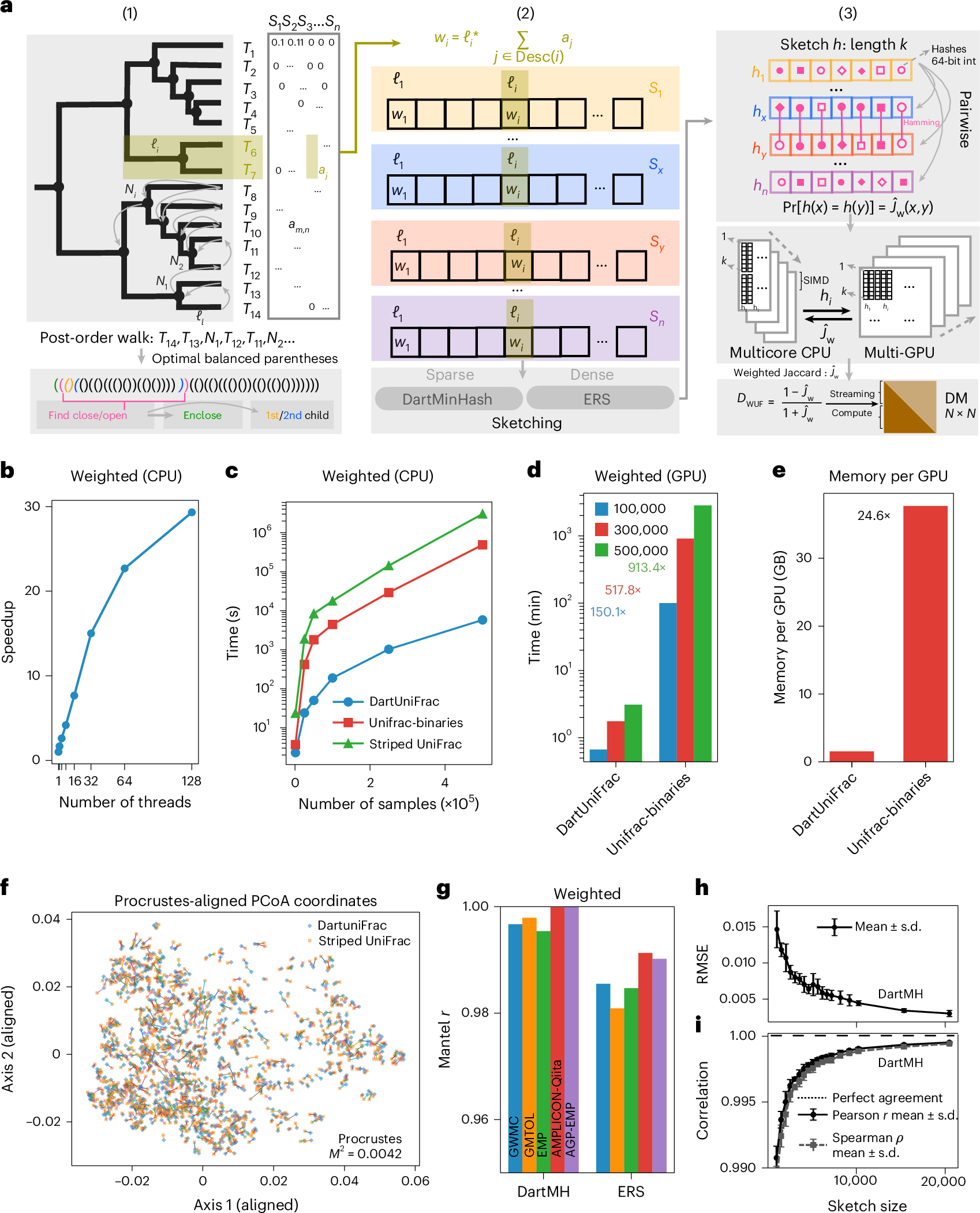
The proof is doing more work here than the graphics card. Computed the original way, UniFrac is a walk over the phylogeny: for each pair of samples you visit every branch, weight it by branch length, and accumulate a numerator of differences and a denominator of totals, which is why cost tracks the number of taxa in the tree and grows with the square of the number of samples [5]. Computed the new way, that same ratio is a weighted Jaccard similarity over branch values, the sum of elementwise minimums over the sum of elementwise maximums, with unweighted UniFrac equal to one minus it [7]. Weighted Jaccard is a quantity you can estimate from compact signatures, and the paper, published on nature.com, says DartUniFrac exploits sketching algorithms to do exactly that [2][11]. The text supplied does not name which sketch family.
The two headline numbers should not be multiplied together. "Up to three orders of magnitude" is a ceiling rather than a typical case [1], and against quadratic scaling in sample count a thousandfold speedup buys only about a 32-fold increase in cohort size at constant wall-clock time, since the square root of 1,000 is 31.6 [1]. The claimed jump is much larger. Twenty years of prior optimization, including Striped UniFrac and SIMD or GPU acceleration, worked at a few thousand samples [6], and going from three thousand samples to a million is a 300-fold increase in samples and roughly a hundred-thousand-fold increase in pairs, of which a thousandfold speedup accounts for about one per cent [2]. The remainder has to come from per-pair work falling away, which is what you would expect if the cost of a comparison is now set by sketch length instead of branch count [2]. Trees that large are not hypothetical: model-based estimates from 16S data put Earth's microbial species count above 10^12 [9].
The thing this does not tell you is what the approximation costs. The abstract and the opening of the main text report speed and scale; they do not state an error bound for sketched distances, nor compare sketched output against exact output [10]. That gap matters because the reason to prefer UniFrac over Bray-Curtis or plain Jaccard is statistical, not aesthetic: it tends to yield higher PERMANOVA R2 values and clearer ordinations when community turnover involves distantly related lineages [4]. A sketch that blurs small distances could hand back the separation you were paying for.
There is also a bottleneck the speed benchmark does not measure. All-versus-all on a million samples is about 5.0 x 10^11 unique pairs, and in single precision that matrix runs to roughly 2 terabytes before any ordination reads it [3]. Fast distances leave you holding an object most downstream tooling was not written to hold.
The reach is wider than 16S surveys, since the argument concerns branch values and applies wherever the unit of interest is defined, including metagenome-assembled genome species units delimited by average nucleotide identity [8]. My position, with its condition attached: for exploratory ordination on a cohort that is currently out of reach, I would run this today; before reporting a PERMANOVA R2 computed from sketched distances, I would want the error bound out of the supplementary methods and in front of me [4][10].
Ranked by verification strength, evidence, and original report placement.
DartUniFrac is presented as an algorithm with a near-optimal GPU-accelerated implementation that is up to three orders of magnitude faster than UniFrac and scales to millions of samples (pairwise) and billions of taxa.
DartUniFrac connects UniFrac with weighted Jaccard similarity and exploits sketching algorithms for fast computation.
The authors prove that unweighted and weighted UniFrac are essentially weighted Jaccard similarity on tree branches; for unweighted UniFrac, D_UniFrac = 1 - J_w(x,y), where J_w = sum of min(x_i,y_i) divided by sum of max(x_i,y_i).
UniFrac is a phylogenetic beta-diversity metric widely used in more than 15,000 microbiome and microbial ecology studies, including the Earth Microbiome Project and the American Gut Project.
By leveraging branch-length information, UniFrac frequently yields stronger between-group separation than nonphylogenetic distances such as Bray-Curtis and Jaccard, for example higher PERMANOVA R2 values and clearer ordinations, particularly when community turnover involves distantly related lineages, as shown in comparative evaluations across diverse datasets.
The computational complexity of weighted UniFrac is proportional to the number of taxa in the phylogenetic tree and quadratic in the number of samples in a study, because comparisons are pairwise.
Distinct publishers with included, body-backed reporting in this cluster.
1 article · August 27, 2026
Follow any of these and your For You feed starts watching them — no settings page required.
science
A parameter-free tree replaces UMAP, and turns up an NK cell subtype from the myeloid lineage1 distinct publisher
science
A compact Fanzor2 editor beats Cas12f 2.6-fold, which puts the class average near 13%1 distinct publisher
science
Nature Perspective: patching one fact into a model leaves the reasoning around it broken1 distinct publisher
science
A tryptophan trick turns bright dyes into wash-free probes, and the first screen names avasimibe1 distinct publisher
Evidence-backed comparisons of source perspectives and observed adoption signals. Read the methodology
Which Builder, Operator, and Investor concerns the observed source mix emphasized—not a truth score.
Evidence, demonstrated adoption, hype gap, incentives, and confidence are assessed independently, each on its own current evidence. How these are measured.
Checkable math, unshown benchmarks
The two halves of this paper are evidenced very differently. The equivalence result is laid out in the open — the UniFrac and weighted UniFrac equations, then their rewriting as Σmin/Σmax over branches — and it either holds mathematically or it does not, which is the strongest kind of evidence a single source can carry. The thousand-fold speedup gets no such treatment in what we have: it appears as an abstract assertion, with the timings, hardware and dataset sizes behind it left to Methods and supplements outside our reporting, and the supplied text cuts off mid-sentence as sketching is introduced. One team, one venue, no outside measurement.
Fifteen thousand studies, none of them this
The impressive usage number belongs to the incumbent. UniFrac has 15,000-odd studies behind it, plus the Earth Microbiome and American Gut projects; DartUniFrac has a publication date. There is no repository, no license, no package, no first user and no third-party run named in this reporting — the algorithm inherits its audience's attention but has not yet acquired any of its own.
Headline outruns the arithmetic
'Up to three orders of magnitude' is doing more work in the framing than in the mathematics. Because pairwise cost is quadratic, 1,000x buys about 32x more samples at fixed wall time, and the leap the paper advertises — a few thousand samples to a million — is roughly 100,000x more comparisons, so the speed multiple alone covers about one per cent of the distance; the rest has to come from the sketch, whose cost in precision is the one number never stated. Add a 2 TB output matrix at the advertised scale and the gap widens a little further. Modest overstatement, not inflation: the underlying proof is genuinely stronger than the press-ready number.
Only the builders are talking
Every figure in this story originates with the team that wrote the algorithm, in a venue where 'thousand times faster' is the sentence that gets a paper accepted and cited. That alignment shows in what is foregrounded versus what is deferred: the speedup leads the abstract, the accuracy of the approximation is nowhere in it, and the dismissal of twenty years of prior optimizations as unable to scale further is a judgement by the authors on the work they are displacing. No independent benchmark, reviewer note or competing implementation appears to check any of it.
Confident about the proof, not the speed
Split the story and confidence splits with it. That UniFrac is weighted Jaccard on branches is the kind of claim that either survives a reader with a pencil or does not, and it is stated fully enough to try; we hold it firmly. The thousand-fold speedup, the million-sample ceiling and the practical usability of the sketches rest on material we cannot see, from an interested party, with the excerpt ending before the results. Enough to say the idea is real; not enough to say what it costs in precision.