BuildNot yet confirmed elsewhere1 publisher2 min readPublished
Mistral AI joins a consortium planning 50 satellites that run AI inference in orbit
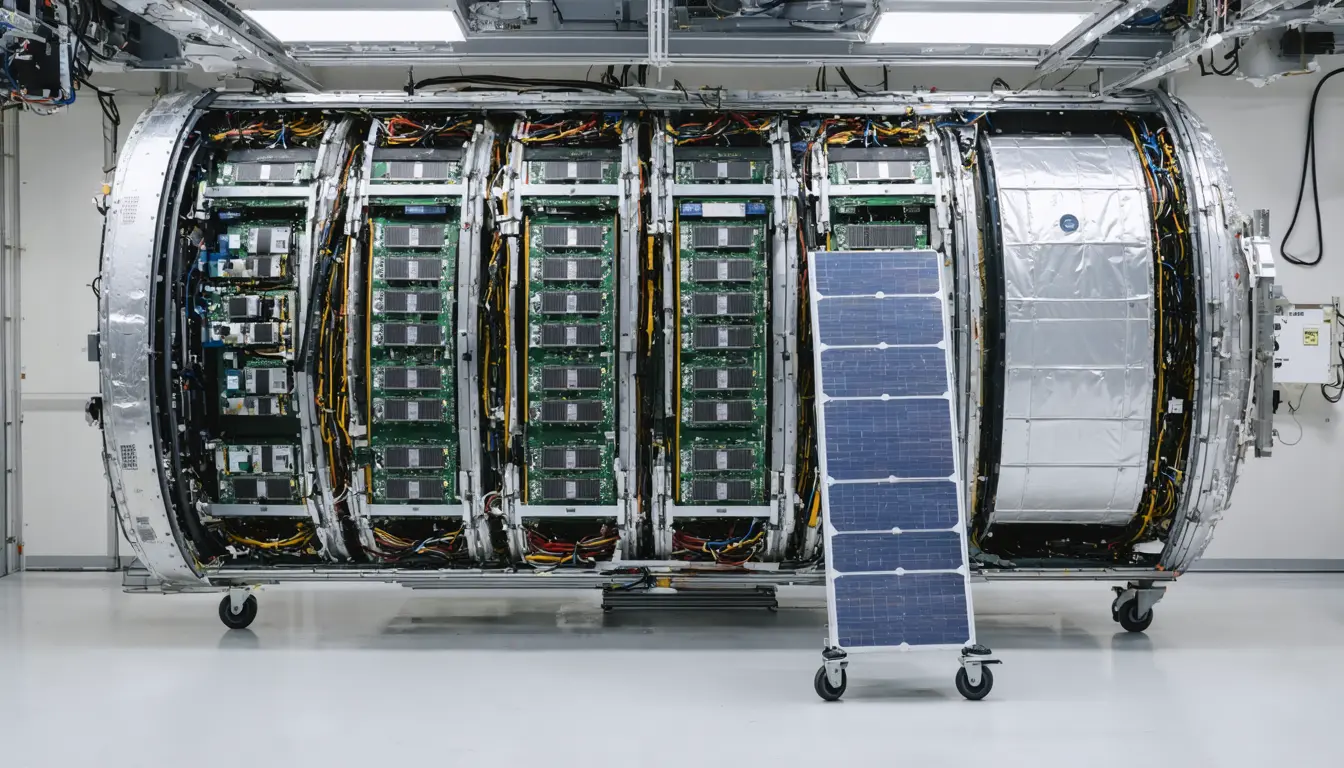
Mistral AI has joined the Altair-Next Gen consortium, whose initial phase plans 50 satellites that run AI inference in orbit. The first AI satellite is due in October 2026, but pricing, eligibility and latency figures are still unpublished.
The Engineer · Build desk
Share bar: 10 of the 50 satellites in the initial constellation, 20 percent, are reported in production.
- Satellites reported in production, claim 17 10 of 50 satellites 20%
Satellites reported in production The rest of the 50
| Share | Part | Whole | Percent | Claim |
|---|---|---|---|---|
| Satellites reported in production | 10 satellites | 50 satellites | 20% | 17 |
What happened
- The consortium is led by Marlan Space and Loft Orbital, and its stated aim is to process sensing data in orbit.
- NVIDIA, BlackSky and MaiaSpace are named as participants alongside Mistral AI, with further partners expected.
- Orbitworks says onboard NVIDIA GPUs will be the compute platform for real-time inference in space.
- Mistral's models are intended to sit alongside the sensors and support reasoning, natural-language tasking and services sold through an AI application store.
Why it matters
- constraint With no latency, coverage, accuracy or availability measurements, nobody can yet size the benefit against ground processing they already run.
- decision A team weighing this has nothing to budget against, and the first AI satellite in October 2026 is the earliest point at which anything can be tested.
- capability If the application store works as described, a customer could ask an operational question and skip writing a technical imaging request.
Onboard inference changes what has to cross the downlink. In the conventional workflow, imagery or other sensor data goes down to ground systems for processing and interpretation [13]. The plan for Altair-Next Gen is to put more of that computation on the satellite itself [14]. The saving is real only if the answer is smaller than the data it replaces and the model can run without waiting for a ground pass. The dev.to summary of the Orbitworks announcement is cautious on the first point: it says a satellite could potentially return a more targeted analytical output [15].
The speed claim is the least pinned down. Related materials describe analysis in minutes [5], and the consortium's stated direction is near-real-time AI analytics from orbit [16]. The consortium has not released standard measurements for latency, coverage, accuracy or availability [9]. A figure in minutes would have to say which legs it counts: tasking, capture, inference, downlink. Until it does, we would treat it as a direction of travel.
The program is a plan. Orbitworks says the first ten satellites are in production, which is 20 percent of the 50 planned for the initial phase [17]. The published material does not specify when the full initial constellation will be deployed [8]. The consortium still describes the program as the world's largest AI-enabled satellite infrastructure [19].
Access is where the summary says the gaps are. Natural-language tasking would let a customer express an operational question instead of building a technical imaging request [20]. Whether that reaches small teams depends on the application store. According to the summary, nothing published so far shows who can buy services, which integration options there will be, or whether it will be affordable to use [11]. The announcement does not publish pricing or a full customer product catalogue [10].
Use cases are equally open. Monitoring assets or assessing conditions at dispersed locations are possible applications of the stated architecture, not announced Altair-Next Gen products [12].
What to watch
- Whether the October 2026 launch of the first AI-enabled satellite holds, and whether latency and accuracy measurements follow it.
- Whether Orbitworks publishes pricing, eligibility rules and an application store catalogue.
- A deployment date for the full 50-satellite initial constellation, and the names of the further partners the consortium expects.
Clarity's read
What the record supports and how the coverage leans. The claims behind it follow.
Reality
- Evidence25
- Adoption
- Insufficient
- Hype gap+40
- Incentives70
- Confidence50
Claim ledger
Ranked by verification strength, evidence, and original report placement.
- [1]
Mistral AI has joined a consortium led by Marlan Space and Loft Orbital to develop Altair-Next Gen, a planned AI-enabled satellite infrastructure that would process sensing data in orbit.
- [2]
The first AI-enabled satellite is scheduled to launch in October 2026.
- [3]
Mistral AI is named as a participant alongside NVIDIA, BlackSky and MaiaSpace, with further partners expected.
- [4]
Orbitworks says onboard NVIDIA GPUs will provide the compute platform for real-time inference in space.
- [5]
Related materials describe analysis in minutes.
- [6]
The consortium plans to deploy AI models directly alongside sensors; Orbitworks says those models are intended to support reasoning and natural-language tasking, as well as services delivered through an AI application store.
- [7]
Orbitworks says the first ten satellites are already in production in Abu Dhabi.
- [8]
The published material does not specify when the complete initial constellation will be deployed.
- [9]
The consortium has not released standard measurements for latency, coverage, accuracy or availability.
- [10]
The announcement confirms the partnership and initial constellation plan but does not publish pricing or a full customer product catalogue.
- [11]
There is no published evidence yet on who will be eligible to buy services, what integration options will exist, or whether usage will be affordable for different types of customers.
- [12]
The confirmed announcement does not identify specific vertical products; examples such as monitoring assets or assessing conditions at dispersed locations are possible applications of the stated architecture, not announced Altair-Next Gen products.
- [13]
Traditional satellite workflows commonly send imagery or other sensor data to ground systems, where it can be processed and interpreted.
- [14]
Altair-Next Gen is intended to move more of the computational work to the satellite itself.
- [15]
Rather than transmitting a full dataset for analysis, a satellite could potentially return a more targeted analytical output.
- [16]
The consortium's stated direction is near-real-time AI analytics from orbit.
- [17]
The ten satellites reported in production are 20 percent of the 50-satellite initial constellation.
- [18]
Orbitworks, the Abu Dhabi-based builder behind Altair, says the initial phase will include a 50-satellite, multi-sensor constellation.
- [19]
According to Orbitworks' Altair-Next Gen announcement, the consortium describes the program as the world's largest AI-enabled satellite infrastructure.
- [20]
Natural-language tasking could make satellite capabilities easier to use for customers who need to express an operational question rather than build a highly technical imaging request.
Sources
1 independent publisher whose own reporting we read for this story.
- dev.toAltair-Next Gen Aims to Bring AI-Powered Satellite Analytics Closer to Real Time
1 article · October 13, 2026
Topics and entities
Follow any of these and your For You feed starts watching them — no settings page required.
Topics
- Earth observation and satellite monitoringFollow
- In-orbit AI inferenceFollow
- Satellite ConstellationsFollow