Science1 publisher2 min readPublished
EPFL's chip laser stays frequency-locked as its drive current nearly doubles
EPFL researchers built a chip laser that held its frequency lock from 154 to 300 milliamps of drive current with no active electronic control. It brings mass-producible semiconductor lasers closer to portable clocks and quantum sensors, though only a laboratory device has been shown so far.
The Scientist · Science desk
What happened
- At every current measured, the lock cut the laser's frequency noise more than 5,000-fold relative to the same laser running free.
- The laser's intrinsic linewidth, a measure of how stable its frequency is, stayed below 10 hertz.
- Piezoelectric actuators on the chip swept the laser's frequency by more than 1.5 gigahertz without mode hops while it stayed locked.
- The device is a laboratory demonstration, and further engineering and packaging would be needed before it could be deployed outside the lab.
Compiled by The ScientistSomething wrong?How this is made
Why it matters
- capability A semiconductor laser that holds its lock without current and phase correction could go into a portable clock, quantum sensor or fibre monitor without the servo electronics such lasers normally carry.
- decision Comparing the chip with the fiber lasers in precision systems requires the paper's absolute noise figures, since the reported suppression only says how much the lock improves this particular laser.
- constraint Manufacturing variation is one of the disturbances that normally break the lock, so the mass-production case for semiconductor lasers depends on the design holding across many chips, beyond the laboratory device reported.
Self-injection locking is expected to narrow a laser's linewidth by several orders of magnitude [4]. A factor of 5,000 in frequency noise is about 3.7 of them [2]. In this device the suppression held at every current point across a 146-milliamp sweep, close to a doubling of the drive current [c8, d1].
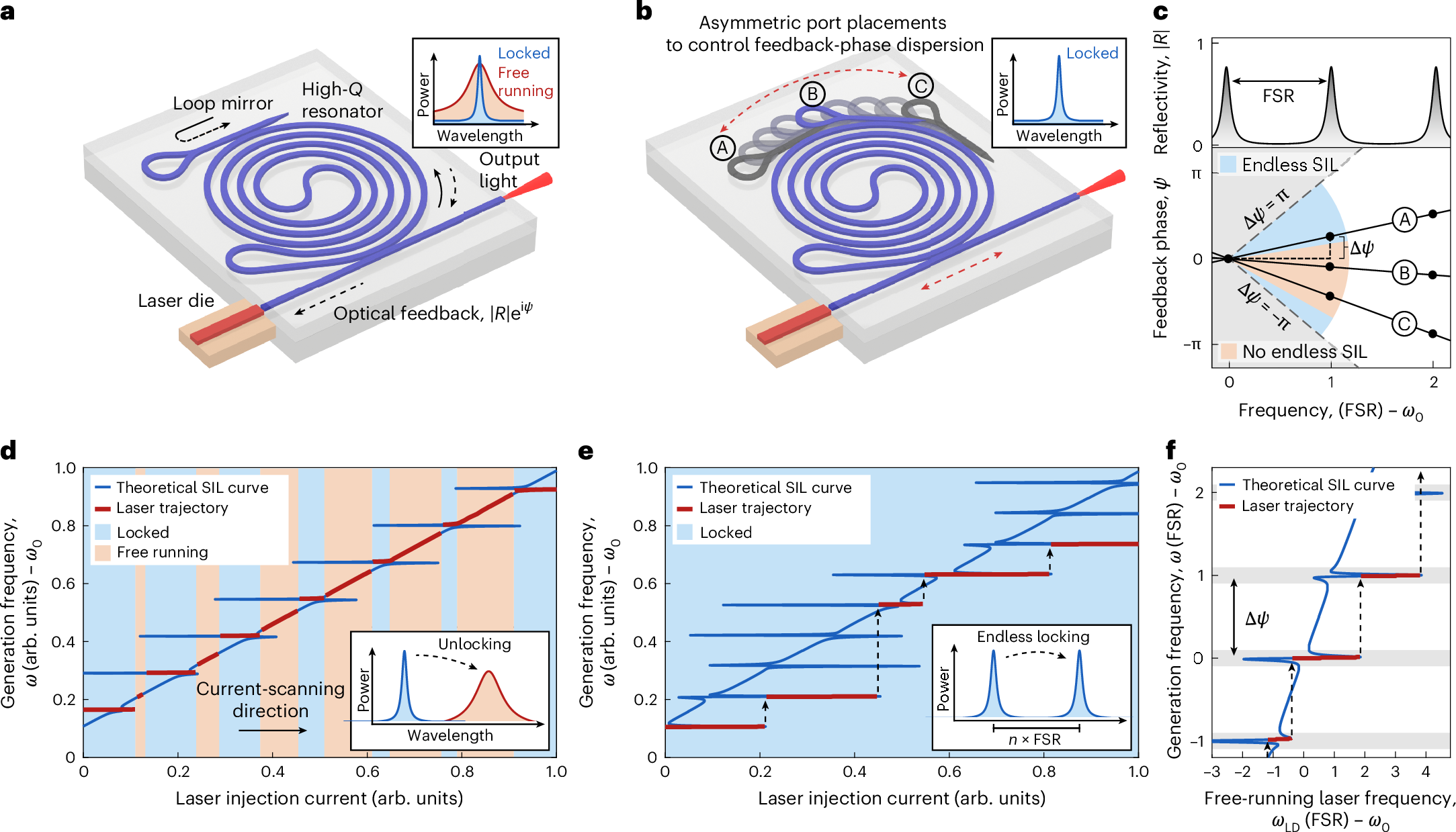
Holding a lock over that range is hard [5]. In a conventional setup, the light coming back from the resonator stabilizes the laser only at one particular drive current and one precise phase, and that phase is set by the length of the light's path [5]. Temperature shifts or tiny manufacturing variations can upset the balance. So most systems add controls and electronics that adjust the laser constantly [5]. Tobias J. Kippenberg's group at EPFL designed the chip's feedback so that the stable operating regions overlap [c6, c7]. As the current changes, the laser moves from one stable state into the next without losing its lock [7]. The researchers call the approach "endless self-injection locking" [6].
The chip is not free of electronics. Its piezoelectric actuators tune the resonator through the stress-optic effect when a voltage is applied [10]. During the frequency sweeps, though, the team did not actively control the drive current or the feedback phase [10]. Those are the two settings a conventional lock depends on [5].
The thing this doesn't tell you is how the lock behaves when the chip warms or cools. Temperature shifts are among the disturbances that break a conventional lock [5], and the test reported here varied drive current [8].
The most precise systems rely on bulky laboratory lasers, and that has kept them out of compact and portable devices [2]. Semiconductor lasers are small, electrically powered and suited to large-scale manufacturing, but their frequency fluctuates much more than that of the fiber lasers used in precision systems [3]. I think this design moves semiconductor lasers closer to portable atomic clocks, quantum sensors and fibre monitoring, provided the lock survives temperature change and the packaging still to come [11]. According to the phys.org report, the design could make compact ultralow-noise lasers easier to operate in optical sensing, lidar, coherent communications, atomic clocks and quantum sensing [13]. The paper, by Mikael Reichler and colleagues, appears in Nature Photonics [12].
What to watch
- A packaged version of the laser operated outside the laboratory, in a clock, sensor or lidar test setup.
- Other groups reproducing the overlapping-stable-region feedback design on their own resonator chips.