Science1 publisher2 min readPublished
Swiss alpine lake bacteria weakened three viruses they never encounter
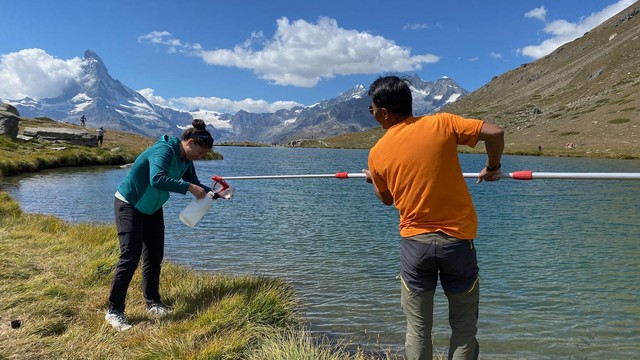
Anna Carratala's team at EPFL sampled 24 Swiss alpine lakes and found bacterial communities that weakened three viruses those lakes never harbour. Human uses are far off; the near-term promise is in protecting crops.
The Scientist · Science desk
What happened
- The communities were challenged with three named viruses: echovirus 11, the influenza A virus behind seasonal flu, and potato virus X.
- Water from the lakes yielded 200 bacterial strains, which the researchers combined into synthetic microbial communities for the tests.
- With Agroscope's Olivier Schumpp, virus-infected plants stopped being vulnerable once they were exposed to bacteria that resist bacteriophages.
Compiled by The ScientistSomething wrong?How this is made
Why it matters
- capability In soilless systems such as greenhouse tomato growing, where viruses move plant to plant through shared nutrient water, resistant bacteria offer a possible biological control.
- constraint Without the molecular mechanism, there is no way yet to match a strain to a target virus or to scale the effect on purpose; the team only suspects secreted enzymes.
- precedent The researchers call the crop result a step beyond the lab but short of real deployment, so greenhouse validation is the expected next stage, not a settled one.
Alpine lakes are hard places to live. Low nutrients, cold water, ice in winter and strong summer UV leave microbial life dominated by bacteria and viruses, which run most of the local ecology. [4] That standing pressure is what Anna Carratala's group at EPFL's Laboratory for Environmental Virology set out to use, in work published in Environmental Science & Technology. [1]
The design runs in two steps. Bacteria in these lakes already survive constant attack from bacteriophages, the viruses that infect and kill bacteria, and in the experiment the assembled communities held off a mix of local phages to varying degrees. [2][10] The question was whether that defence would carry to viruses the bacteria have never met. It did, in the dish: the communities also lowered the infectivity of three viruses that do not use bacteria as hosts at all. [3]
Why this happens is not settled. One proposed route is inherited immunity. "Earlier studies revealed that bacteria can 'remember' past viral infections through information stored in their DNA, helping them defend themselves against future attacks," Carratala said. [9] The paper does not attach a number to the reduction it reports. [3] The headline phrase, broad-spectrum antiviral activity, rests on three stand-in viruses chosen because alpine lakes never contain them, and on lab-built communities, not on a measured sweep of pathogens. [8][17]
Tamar Kohn, who leads the EPFL lab, pointed further ahead. "In the longer term, this knowledge could open new avenues for developing innovative, biologically inspired approaches to water treatment and improving water safety," Kohn said. [16]
What to watch
- Whether the team pins down the molecular mechanism it now attributes loosely to secreted enzymes or DNA-based immunity.
- Whether the crop-protection result holds in a working hydroponic greenhouse rather than lab plants.
- Whether any effect on human viruses such as echovirus 11 or influenza A gets quantified in follow-up work.