Product2 publishers2 min readPublished
Meta unveils $1,299 VR glasses with 75 Quest games retuned for hand control
Meta's new mixed reality device puts the computer in a pocket puck and the input in a pinch of thumb and forefinger. Everything in the Quest catalogue still runs, and the rest of the porting work falls to developers.
The Product Desk · Product desk
What happened
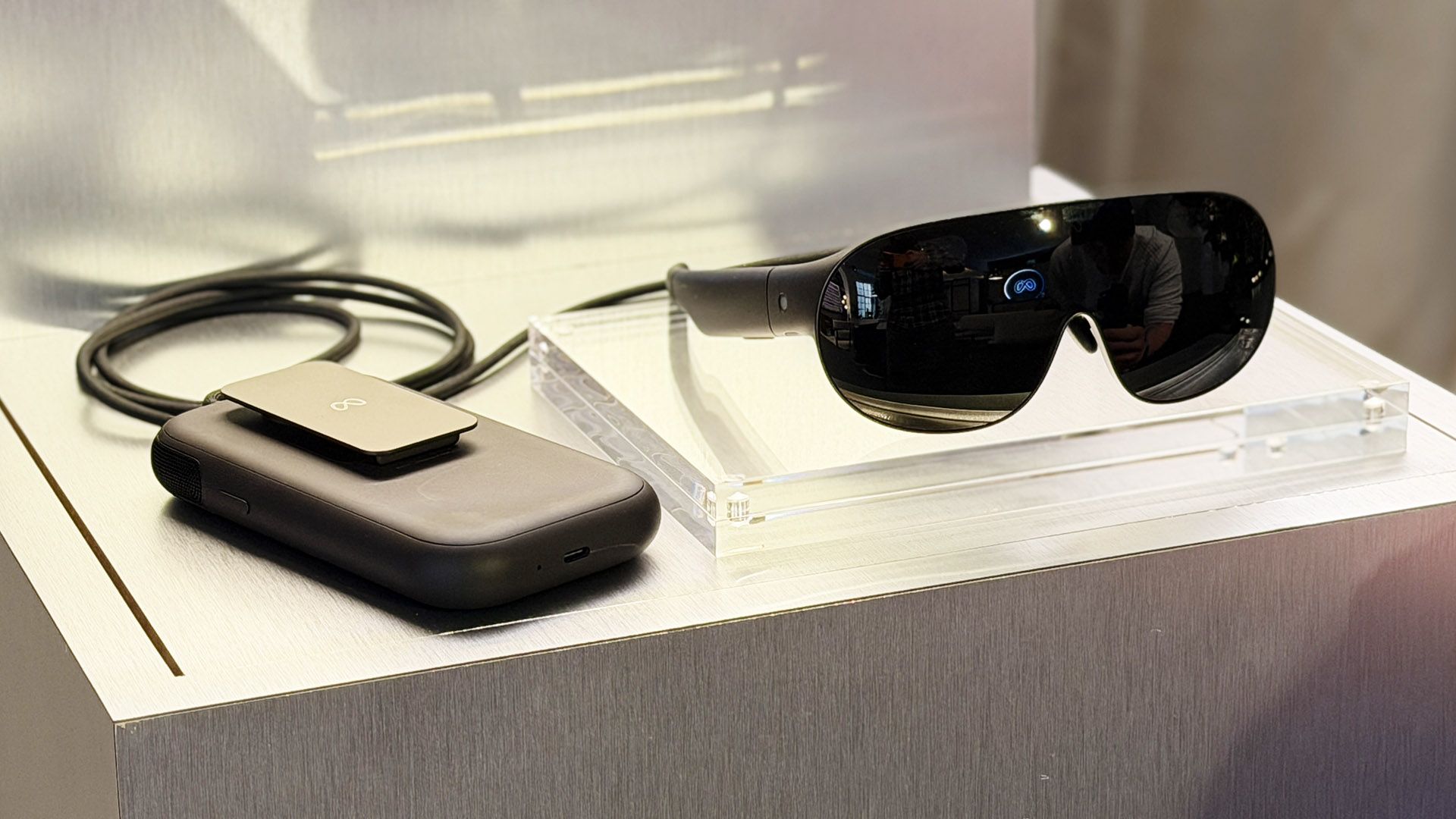
- Meta unveiled the $1,299 Meta VR Glasses, its first new VR hardware in two years, and the device is a tethered mixed reality product instead of a new Quest headset.
- The glasses weigh a little less than 100 grams, heavier than Meta's Ray-Ban Display pair and much lighter than a Quest 3S or any other headset.
- Processing, memory and storage sit in a separate puck of about 300 grams that clips to a pocket, a belt or stays in the hand.
- According to T3, control is by voice, hand or eye, no controllers come in the box, and older Meta Quest controllers still pair with the glasses.
Compiled by The Product DeskSomething wrong?How this is made
Why it matters
- decision Every team with a Quest title now picks between doing the hand-control work and shipping an app whose default buyer has nothing to hold.
- constraint Three hours of puck battery puts a ceiling on an untethered work session, so a desk rollout has to budget for a USB-C cable and a charger at each seat.
- contradiction T3 says the glasses suit long periods of wear while Engadget's account covers half an hour and flags a warm puck, so neither review tests the long-session case that work use depends on.
Both hands stayed in the lap. Engadget's reviewer tapped thumb to index finger to select and swiped the thumb along the side of the finger to scroll, and the glasses picked it up without arms raised into the camera view [9][10]. One scroll gesture would not register. The review put that down to prototype hardware [10].
T3 reports the glasses run all Quest games and apps, with 75 titles reworked for hand control [14]. Those are not the same number. T3's reviewer played Beat Saber using hands instead of controllers and wrote that it "worked extremely well", while tapping into apps and bringing up menus "takes a little more practice" [21].
The puck holds up to three hours of continuous use and supports 45W fast charging. It can also be plugged straight into USB-C for continuous use [15]. T3 wrote that the glasses can be worn comfortably for long periods, either at home or in a public setting [17]. Engadget's demo ran about 30 minutes, with the puck mostly on the table and giving off enough warmth to feel without touching it [6][5]. Neither account reports wearing them longer than 30 minutes [26].
Add the two parts together and a user is carrying about 400 grams, 300 of it clipped to a pocket, sitting on a belt or held in a hand [22][4].
Per eye, 2,412 x 2,288 pixels across a 70-degree field of view, at 37 pixels per degree, which Engadget called the sharpest mixed reality display it can remember seeing [11]. The same account reports the glasses are less immersive than a headset, because the environment does not envelop you in the way it does on one [12]. Meta said the device represents a "new era for virtual reality" [2].
A developer sorting a porting backlog has two questions to answer. First, can the primary action be a pinch with the hand at rest, with selection following the eye instead of a ray cast from a controller [9][10]. Second, does a typical session for your app end inside three hours on the puck, or does it assume a desk with a cable [15]. An app that fails the first test is asking its user to supply the controllers Meta left out of the box [13].
What to watch
- A review that wears the glasses through the full three-hour battery and reports how the puck feels clipped to a pocket rather than sitting on a table.
- Whether Meta publishes the 75 hand-optimised titles and what the optimisation required of developers.
- Whether Touch Plus controllers become a separate purchase line for buyers of the VR Glasses, and at what price.