Product3 publishers3 min readPublished
Meta debuts realistic Hologram avatars for glasses wearers on WhatsApp calls
Meta will put voice-driven scanned avatars into WhatsApp calls from its $799 Ray-Ban Display glasses this fall, ahead of its spring 2027 VR Glasses. The first people to see them will be on ordinary phones, looking at a face where a glasses call used to show the wearer's view.
The Product Desk · Product desk
What happened
- Setup is a phone scan in the Meta AI app, during which users turn their head, smile and answer open-ended questions out loud.
- On a call, a diffusion model on Meta's servers turns the caller's microphone audio into a 2D video of their face and streams it to the other person.
- Meta places a transparent watermark over avatar calls so recipients can tell the picture is not coming from a camera.
- The full-body version needs Meta's $1,299.99 VR Glasses, which also carry calls through Zoom.
Compiled by The Product DeskSomething wrong?How this is made
Why it matters
- exposure A recipient who does not know the caller wears glasses has little besides the watermark to tell them the face on screen is generated from audio.
- exposure Each Hologram call puts the caller's voice through a model on Meta's servers, so a company with rules on where call audio may go has to clear the feature before staff turn it on.
- constraint A user who scans at home in a T-shirt appears in that T-shirt and that room on every call, including a client call, until they redo the setup.
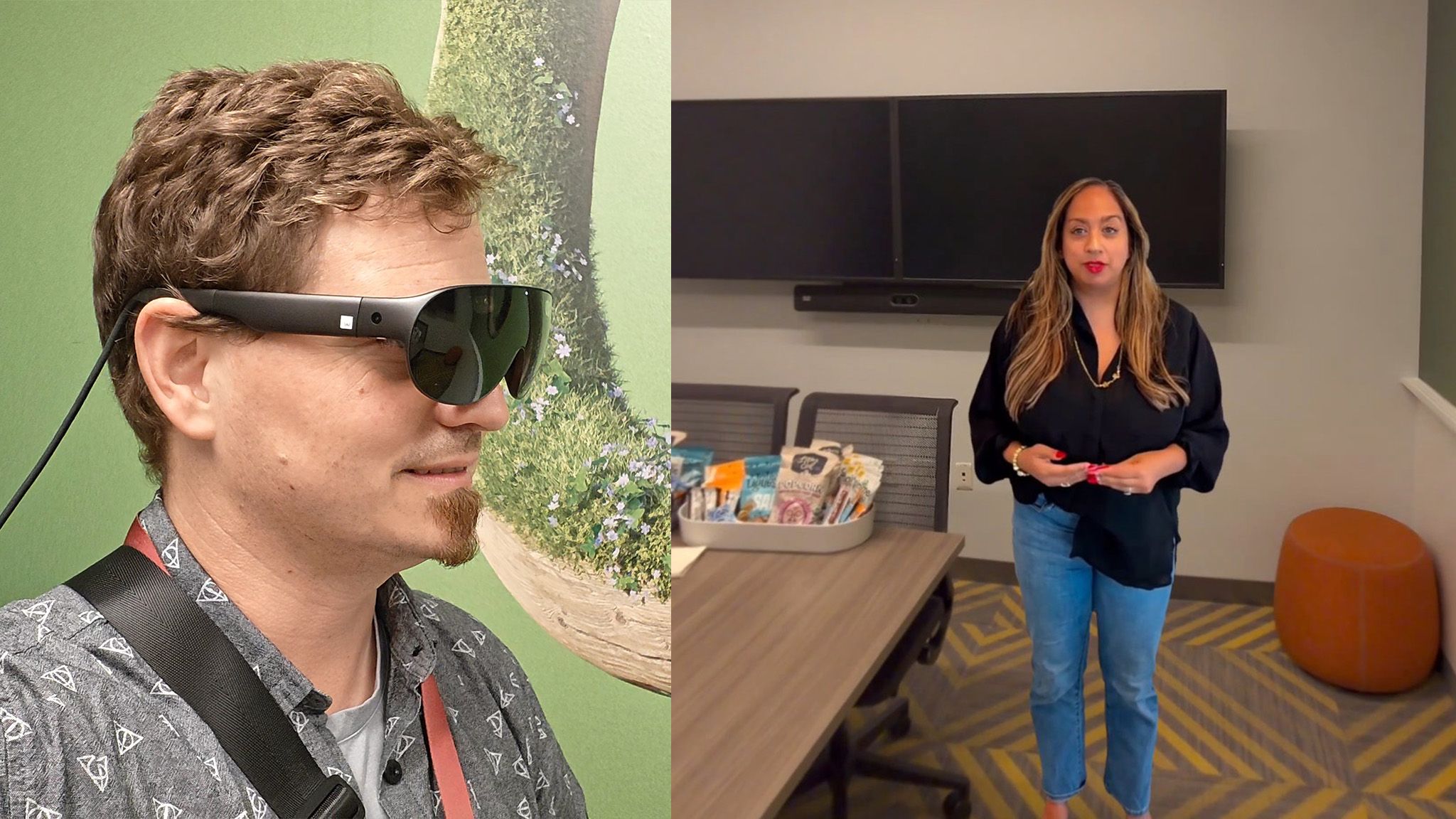
A Meta staffer put on Ray-Ban Display glasses, walked to a room out of sight and placed a WhatsApp video call to a phone [22]. UploadVR's reviewer answered. For the first few seconds he assumed the man had not put the glasses on yet and was looking into his phone's selfie camera [9]. Android Central's reviewer took a similar call and wrote that "he appeared on screen as if it were any normal day, not wearing glasses at all" [10].
At launch, Hologram fixes a glasses camera that points away from its owner. On a glasses call, the camera shows whatever the wearer is looking at, so the other person gets the view and not the face [11]. Hologram puts a face back in that frame. In both demos, the person seeing it answered on an ordinary phone [22].
Meta has shown research prototypes of realistic VR avatars, called Codec Avatars, for more than seven years, while the headsets it sold used cartoonish ones [8]. The research promised a lifelike person standing in the room, and the full-body version delivers that, but only to a viewer wearing Meta's VR Glasses [21]. The first version to ship is shoulders-up, on a phone screen [2].
Android Central timed the phone scan at about 60 seconds [12], followed by 5 to 10 minutes of processing on Meta's servers [13]. A new owner is roughly 6 to 11 minutes from a first Hologram call [14].
Meta's roadmap is looser: the company says that "at some point in the future" the model will read the glasses' IMU so the gyroscope drives the avatar's head rotation [18]. Its engineers are exploring backgrounds sampled from the glasses camera and outfit changes by text prompt [19]. Android Central reported that other apps can adopt Holograms through an API [20].
Both hands-on reports found the output convincing but split on where it belongs. Android Central's reviewer wrote, "The results are uncanny. Even, perhaps, a bit scary." [17] UploadVR's reviewer wrote that "Hologram feels shoehorned into the HUD glasses, when the mediums that realistic avatars are truly useful for are VR and AR" [16]. Meta has put WhatsApp calls first [1][2], and neither report includes the company's reason for that order.
For a team deciding where a new capability ships first, or whether to switch this one on for staff, two axes sort it. One is whether the person on the other end needs new hardware. The other is whether the feature fixes a problem users already hit. No new hardware plus an existing problem is a broad launch. New hardware plus an existing problem is a pilot with people who own the gear. No hardware plus a new problem is a novelty, judged by whether people use it again after the first try. New hardware plus a new problem is a demo. WhatsApp Hologram needs no new hardware at the receiving end, and it fixes the away-facing camera every glasses caller already has [11][22]. The full-body version needs a headset on the viewer [21] and fixes cartoonish avatars, a problem that belonged to Meta's VR products [8].
For a team piloting Ray-Ban Display, I'd switch Hologram on first for calls between colleagues who know the caller wears the glasses. The tradeoff is slower evidence on the hard case: a client who takes the call cold, with only the watermark to go on [7].
What to watch
- Whether US Early Access users keep Hologram switched on for repeat calls after the fall launch.
- Whether Meta ships IMU head tracking or text-prompt outfit changes before the VR Glasses arrive in spring 2027.
- Which outside apps adopt the Hologram API, and whether they carry the same watermark.