ProductIndependently confirmed3 publishers3 min readPublished
Meta shipped Pocket the day Gizmo died, and never had to buy anything
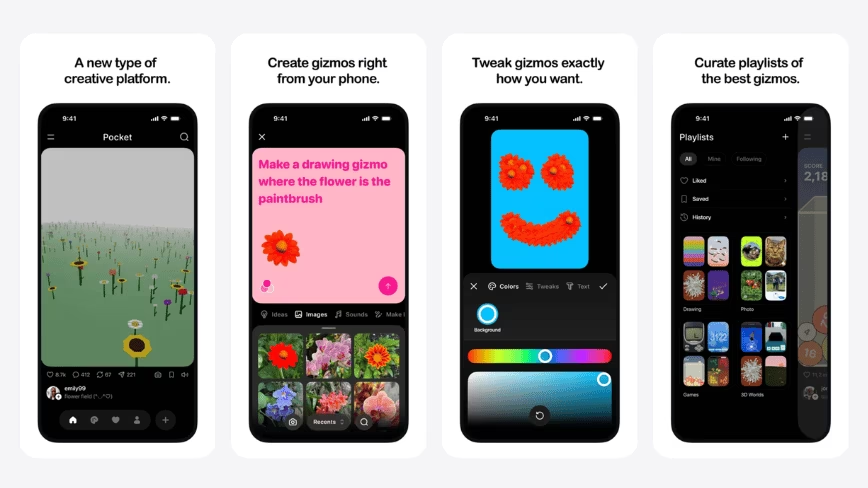
Meta hired Gizmo's team in March, licensed the technology without buying the company, and launched the result nationally the day the original went dark. Nvidia paid $6bn for the same shape of deal.
The Product Desk
What happened
- Meta opened Pocket to everyone in the US on the same day the app it was built from shut down.
- Atma said on Thursday it is winding down, and that its entire team joined Meta earlier this year.
- Pocket runs on Muse Spark, the model from Meta Superintelligence Labs.
Why it matters
- precedent A licence plus a hiring round lands where an acquisition lands with no purchase price to disclose, which makes it the offer small consumer AI teams should now expect instead of a sale.
- cost Gizmo's users absorb the structure: the app they used is switched off, while the licensed technology survives inside a company that no longer has the engineers to run it.
- capability Meta's own product team could treat Muse Spark as a shipping platform while outsiders were still waiting for an interface, an advantage that owes nothing to model quality.
- constraint Withholding Instagram's plumbing forces Pocket to earn its audience from shared links, and leaves it the cheapest app in the portfolio to switch off if it does not.
The load-bearing word in this deal is non-exclusive. Meta took a licence it did not need to hold alone [6], which only makes sense if the code was never the scarce asset. The people were, and they left in March [6]. Whatever sat at Atma Sciences afterwards was technology a third party could in principle license and nobody was left to operate, so Thursday's wind-down notice [12] reads as bookkeeping rather than an event. Josh Siegel, who ran it, called the shutdown bittersweet and said he was excited for Pocket [13]. Both of those can be true at once.
Nvidia's version of the same structure supplies a price. It agreed to pay Poolside $6bn for a licence and jobs for 109 staff, with both sides insisting this was not an acquisition [14]. That works out at roughly $55m per hired head [21]. The Next Web reckons Meta's version cost less, and it plainly ran faster: team in during March, product shipped in July, the original gone by August [8], five months from hire to shutdown and four from hire to launch [16]. TechCrunch calls it an acqui-hire [11]. Business Insider, which has used both apps, says the two experiences are pretty much identical [7]. Nobody filed to buy anything.
Then there is what Pocket runs on. Muse Spark comes out of Meta Superintelligence Labs [15], and outside developers spent months waiting on an API that Meta kept pushing back, the model having launched in April with the interface trailing it [17]. Meta has not said where that now stands [18]. What is on the record is the order of operations: the first consumer product shipped on the model is Meta's own [18].
The distribution choice is the part that does not fit the house pattern. Meta told Business Insider it has no plans for now to connect Pocket to Instagram or the rest of the family [19], which is not how this company normally launches anything. Pocket's spread instead depends on gizmo links opening for people who have not installed it [5], with comments, likes and reposts inside an app that has no direct messages [5]. Zuckerberg told analysts in July that AI-assisted development is what makes shipping new apps easier, and that Meta intends to build more ideas and scale the ones that work through its recommendation systems [9]. Pocket joins Instagram Instants, Forum, Seller, a bedtime-stories experiment, a Creator Studio app and a Mac client for Meta AI [10]. That is a portfolio built to be pruned, and an app with no connection to the family is the cheapest kind to prune.
Engadget's read was that Pocket is worth a download and a couple of minutes before boredom sets in [20]. If that is where it lands, the durable artefact is not the app. It is the deal shape: four months to ship, no purchase price, and the app it was copied from switched off on launch day [1].
What to watch
- Whether Meta now commits to a firm Muse Spark API date, having shipped its own consumer app on the model first.
- Whether Pocket gets wired into Instagram or Facebook despite Meta saying there are no plans at the moment.
- Whether the next small consumer AI team takes a licence-plus-hire deal rather than a sale, and at what price per head.
Clarity's read
What the record supports and how the coverage leans. The claims behind it follow.
Reality
- Evidence64
- Adoption28
- Hype gap+22
- Incentives66
- Confidence62
Perspective Coverage
3 publishers- Builder
- Builder 45%
- Operator
- Operator 27%
- Investor
- Investor 28%
Claim ledger
Ranked by verification strength, evidence, and original report placement.
- [1]
Meta launched Pocket across the United States, and the app it is based on shut down the same day.
- [2]
Pocket had been testing quietly in Brazil since July and is now available to everyone in the US.
- [3]
Pocket lets people type a prompt and get back a small interactive thing, which Meta calls a gizmo; gizmos publish to a scrollable feed where other people can play, save, repost or remix them.
- [4]
Gizmo was built by Atma Sciences, a company founded by former Snapchat engineers.
- [5]
Pocket has comments, likes and reposts but no direct messages, and links to individual gizmos open without the app installed, which is how Meta expects them to spread.
- [6]
Meta did not buy Atma Sciences. It hired the team and took a non-exclusive licence to the technology, Business Insider reported, having scooped the move in March.
- [7]
Business Insider, which has used both, describes Pocket and Gizmo as "pretty much identical app experiences".
- [8]
The Next Web's assessment: Meta's version cost less and moved faster, with the team joining in March, the product shipping in July and the original gone by August.
- [9]
Zuckerberg told analysts on July's earnings call, crediting AI-enabled software development: "I expect it to become a lot easier to ship new apps. So we are planning to build out more ideas and use our recommendation systems to scale them."
- [10]
Pocket joins a run of standalone Meta launches: Instagram Instants, Forum for Groups, Seller for Marketplace, an experiment in AI bedtime stories, a Creator Studio app, and a Meta AI app for Mac.
- [11]
TechCrunch describes Pocket as based on Meta's acqui-hire of the team at the vibe-coded gaming platform Gizmo earlier this year.
- [12]
Atma announced on Thursday that it is winding down, posting: "Earlier this year, our entire team joined Meta, where we have been working on a new app."
- [13]
Josh Siegel, who led Gizmo, called the shutdown bittersweet and "a labor of love by so many people for the last couple years", and said he was excited for Pocket.
- [14]
The Next Web reported this month that Nvidia agreed to pay Poolside $6bn for a licence and jobs for 109 of its staff, in a deal both sides insisted was not an acquisition.
- [15]
Pocket is built on Muse Spark, the model from Meta Superintelligence Labs.
- [16]
Meta's sequence runs five months from the team joining to the original app's shutdown, and four months from joining to shipping Pocket.
- [17]
The Next Web reported in June that Meta had repeatedly delayed the Muse Spark API promised to outside developers: the model launched in April, the interface slipped, and Meta had no scheduled date until it said it would arrive that month.
- [18]
Meta has not said what the current Muse Spark API position is; what is on the record is that Meta shipped a consumer app on the model before outside developers got a stable way in.
- [19]
Meta told Business Insider there are no plans to connect Pocket to Instagram or its other apps at the moment, which is unusual for a company that normally routes new products through the audience it already has.
- [20]
Engadget's verdict: "It could be worth a download and a couple of minutes before getting bored."
- [21]
The Nvidia-Poolside deal works out at roughly $55m per hired employee.
Sources
3 independent publishers whose own reporting we read for this story.
- engadget.comMeta's app for creating generative AI minigames is now available in the US
1 article · August 20, 2026
- techcrunch.comMeta brings Pocket, an app that lets you vibe-code and share games, to US users
1 article · August 20, 2026
- thenextweb.comMeta launched Pocket in the US, and the app it came from shut down the same day
1 article · August 21, 2026
Topics and entities
Follow any of these and your For You feed starts watching them — no settings page required.