InvestNot yet confirmed elsewhere1 publisher2 min readPublished
McKinsey: U.S. could have more jobs in 2035, though about 770,000 workers a year may need to change occupations, 3.6 times the historical rate
McKinsey Global Institute says technology could cut U.S. labor demand by the equivalent of 36 million jobs in a decade while growth adds about 41 million. On those figures jobs rise, so the open question is how fast workers can move into them.
The Investor · Invest desk
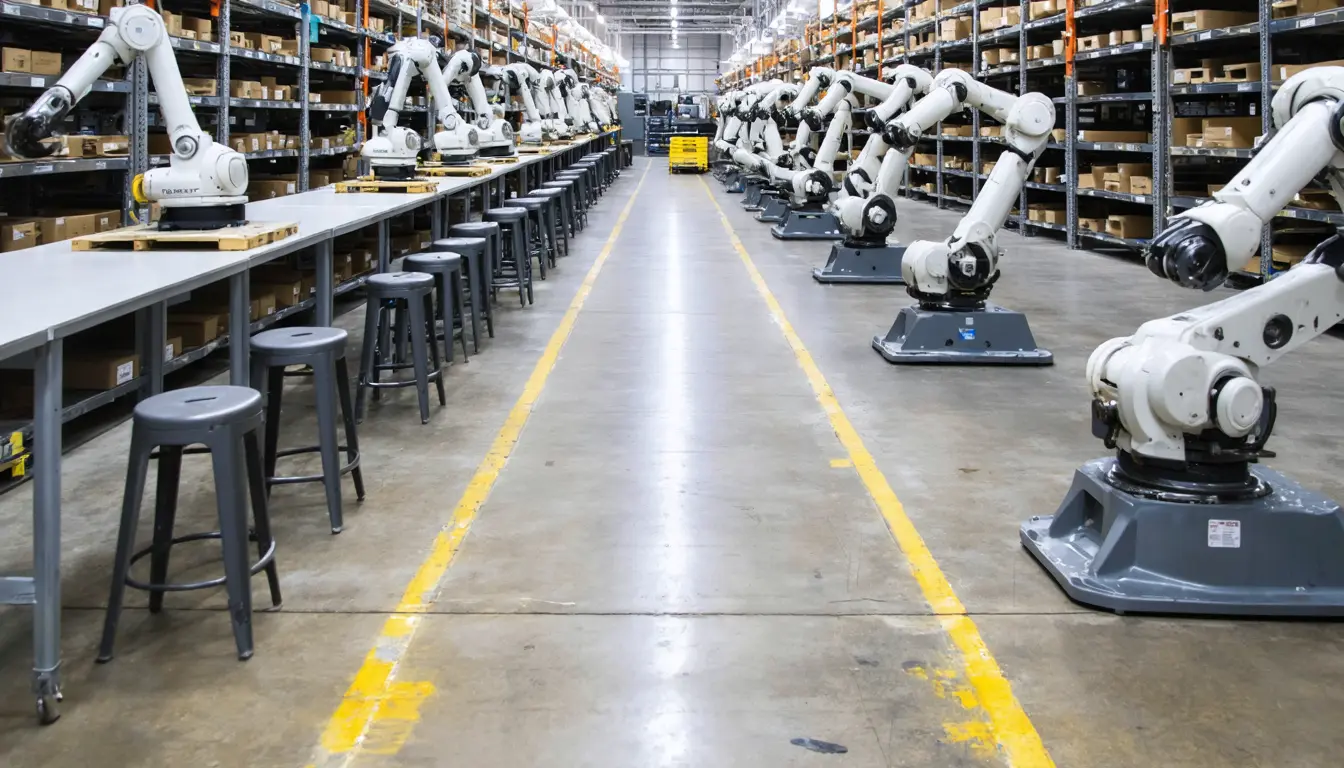
MGI: about 11 million Americans may need to leave declining occupations; technological and economic changes could cut labor demand by the equivalent of 36 million jobs; growth could create demand for about 41 million jobs; roughly 80% of office/admin work hours could be automated by 2035.
| Figure | Value | Note | Claim |
|---|---|---|---|
| Americans who may need to leave declining occupations | 11 million, about | 5 | |
| Job-equivalent demand cut | 36 million jobs | 2 | |
| New job demand, about | 41 million jobs | 3 | |
| Office/admin hours, roughly | 80% automatable | 7 |
What happened
- The same report estimates AI could automate more than half of U.S. work hours over the next decade, though Fortune's summary stresses this does not mean half the workforce disappears.
- About 11 million Americans may need to leave declining occupations for new ones, according to MGI, while others may be able to stay in their fields as the work evolves.
- Office and administrative support roles face particular exposure, with roughly 80% of current work hours potentially automated by 2035.
- About 85% of growing employment requires a credential; for 38% of those jobs it is legally required, and for another 47% employers prefer it.
Why it matters
- contradiction CEOs and their budgets disagree: 72% of the 1,200 in EY-Parthenon's survey expect skills shortages to outweigh capital access as a barrier to growth, yet only 15% are reinvesting productivity gains in workforce development.
- constraint An employer can drop a preferred credential but not a legally required one, so MGI's suggestion to weight proven skills and experience widens the talent pool only in the preferred share of jobs.
- decision Finance chiefs have to choose a scorecard: MGI recommends tracking moves into new roles, internal fills and how workers fare, not just AI-related cost savings.
Subtract the equivalent of 36 million jobs of lost demand [2] from about 41 million of new demand [3] and the U.S. ends 5 million jobs ahead [14]. As Fortune summarises the report, the U.S. could have more jobs in 2035 than today [4]. That headline can go wrong in two ways before it reaches a single worker. The 41 million depends on growth in AI-related industries and services actually arriving [3], and the 36 million is an equivalent, a measure of lost demand [2]. A third case is that both numbers hold and the people do not fit them, because new jobs may require skills workers lack today [13]. We think the third case is the live one.
The pace tells more than the total. McKinsey senior partners Eric Kutcher and Tanguy Catlin put the occupational changes at roughly 770,000 workers a year over the next decade, about 3.6 times the historical rate [6]. Divide and the past rate comes to about 214,000 a year [15]. Over ten years 770,000 a year is 7.7 million [19], which leaves the 11 million workers MGI says may need to leave declining occupations 3.3 million higher [5][20]. Fortune's summary does not say how the two figures relate. We use the lower one because it comes with a stated historical comparison.
Credentials slow the move further. The employer-preferred share is 9 percentage points larger than the legally required share [16], so more of the barrier sits with hiring habits than with statute. Fortune's wording leaves the base unclear (the 38% and 47% sum to the 85% headline figure [17]), and the comparison holds on either reading.
Company budgets do not yet look built for this. In the EY-Parthenon survey, the gap between CEOs who expect a skills barrier and CEOs reinvesting productivity gains in people is 57 points [18]. The two questions differ, so that gap compares stated worry with stated spending and is not a dollar shortfall.
In our view the binding constraint is reskilling, or more exactly the rate at which workers can be moved and credentialed, and the job count matters less at a net gain of 5 million [14]. Savings booked as margin do not fund retraining, and few CEOs in the survey report funding it [12]. We would be wrong if the 11 million move through ordinary turnover with little employer spending, or if the 41 million fails to arrive, in which case the count binds after all.
What to watch
- Whether MGI's full report reconciles the 11 million occupational leavers with the 770,000-a-year pace, which Fortune's summary does not do.
- Whether employers start dropping preferred credentials, visible in the internal-fill and role-move metrics MGI says to track.
- Whether growth in AI-related industries and services produces the roughly 41 million jobs of new demand the estimate assumes.
Clarity's read
What the record supports and how the coverage leans. The claims behind it follow.
Reality
- Evidence50
- Adoption
- Insufficient
- Hype gap−5
- Incentives
- Insufficient
- Confidence50
Claim ledger
Ranked by verification strength, evidence, and original report placement.
- [1]
McKinsey Global Institute research estimates AI could automate more than half of U.S. work hours over the next decade; Fortune's summary says that does not mean half the workforce will disappear.
- [2]
MGI estimates technological and economic changes could reduce U.S. labor demand by the equivalent of 36 million jobs over the next decade.
- [3]
Economic growth, including growth in AI-related industries and services, could create demand for about 41 million jobs.
- [4]
The U.S. could have more jobs in 2035 than today, even as technology changes how people work and the skills they need.
- [5]
MGI estimates that about 11 million Americans may need to leave declining occupations for new ones, while others may be able to stay in their fields as their work evolves.
- [6]
Roughly 770,000 workers a year may need to change occupations over the next decade, about 3.6 times the historical rate, according to McKinsey senior partners Eric Kutcher and Tanguy Catlin.
ReportedSupportedSource: Eric Kutcher and Tanguy Catlin, McKinsey, as reported by FortuneView cited source - [7]
Office and administrative support roles face particular exposure to automation, with roughly 80% of current work hours potentially automated by 2035.
- [8]
About 85% of growing employment requires a credential or certification; for 38% of those jobs the credential is legally required, and for another 47% employers prefer it.
- [9]
The research suggests companies could widen their talent pools by rethinking which qualifications are essential and giving greater weight to proven skills and experience.
- [10]
MGI recommends tracking whether employees move into new roles, whether companies fill more positions internally and how workers fare, not just AI-related cost savings.
- [11]
In the EY-Parthenon CEO Outlook Survey of 1,200 CEOs, 72% expect skills shortages to become a bigger barrier to growth than access to capital.
- [12]
In the same EY-Parthenon survey, only 15% of CEOs are reinvesting productivity gains in workforce development.
- [13]
New jobs may require different skills from those workers have today.
- [14]
Net U.S. job demand change is about +5 million jobs.
- [15]
The implied historical rate of occupational change is about 214,000 workers a year.
- [16]
The employer-preferred share (47%) is 9 percentage points larger than the legally required share (38%).
- [17]
The 38% and 47% shares sum to 85%, the same as the headline credential figure.
- [18]
The gap between the share of CEOs expecting a skills barrier (72%) and the share reinvesting productivity gains in workforce development (15%) is 57 percentage points.
- [19]
770,000 workers a year over ten years is 7.7 million occupational changes (taking 'the next decade' as ten years).
- [20]
The 11 million workers who may need to leave declining occupations is 3.3 million higher than the 7.7 million implied by 770,000 a year.
Sources
1 independent publisher whose own reporting we read for this story.
- fortune.comMcKinsey: Automation could absorb half of U.S. work hours by 2035. The bigger challenge is skills
1 article · October 12, 2026
Topics and entities
Follow any of these and your For You feed starts watching them — no settings page required.
Topics
- AI and the Labor MarketFollow
- Workforce reskilling and job disruptionFollow
- Credentials and hiring requirementsFollow
Entities
- McKinsey Global InstituteFollow
- FortuneFollow
- EY-ParthenonFollow
- Eric KutcherFollow
- Tanguy CatlinFollow